
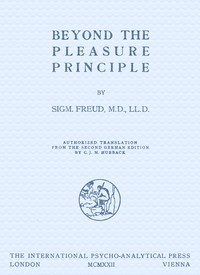
Beyond the pleasure principle by Sigmund Freud
I’ve got to be honest: when I picked up Beyond the Pleasure Principle, I expected a dusty textbook full of jargon. But it’s more like watching a really smart friend explain a wild theory while drinking coffee. Freud himself said this book is “speculative”—he’s basically thinking out loud, and you get to follow along.
The Story
Freud starts with a simple rule: all our actions are driven by pleasure—our “pleasure principle.” We want to feel good, avoid pain. Easy, right? But then he looks at patients with trauma, war veterans with nightmares, and even children playing repetitive games. None of that involves feeling good. It destroys the neat pleasure theory.
So Freud realizes alongside this pleasure-seeking force, we have a more chaotic impulse he calls the death drive. It pushes us toward a quiet end, a final release from stress. It’s not conscious—you don’t think "I want to return to inorganic matter" –but this primitive drive can show up in negativity, obsession, or thrill-seeking that risks harm. He wrestles with it step by step, arguing we’re torn between living and (sort of) unwinding. By the end, you won’t see self-destructive habits the same way.
Why You Should Read It
This book isn’t a chapter-by-chapter case study you skim. It’s a journey into Freud’s mind as he fails to explain behavior with pleasure alone. Some concepts feel wildly outdated—like when he insists all biology has a built-in drive to drop dead. But its depth hooked me. It addresses that all the why-am-I-like-this question. I’ve felt echoes of it criticizing my own repeated breakups or bad decisions. Freud makes you wonder if behind self-sabotage, there’s a biological urge to subtract tension entirely.
These are big, pretzel-twister ideas delivered in slow steps. I laughed sometimes, then felt dread. Everyday phenomena (chewing a painful memory) feel cosmic suddenly. It fits with his later pessimistic works. But reading it alone gives you a raw model of psychological pain you won’t forget.
Final Verdict
Perfect for readers who don’t run from psychological darkness. Book lovers interested in philosophy, jaded art, anxiety media, or self-reflection will devour this. Make sure you’ve read Freud’s other introductory stuff first; it assumes you’ve noticed his dream theories. Hard classic truly opens its meaning once you digest his earlier story. The prose quality: watchable (seventiness challenge some). If you find no repetition okay during vacation let one explain besides catching narrative faults.
In other important words, master tough “why” for personality cravings enough. A 80-page thunderstone. Not feel great—and get hit by it.
This work has been identified as being free of known copyright restrictions. Enjoy reading and sharing without restrictions.
Joseph Brown
10 months agoI particularly value the technical accuracy maintained throughout.
William Moore
1 year agoSolid information without the usual fluff.
William Davis
3 months agoI've been looking for a reliable source on this topic, and the chapter on advanced strategies offers insights I haven't seen elsewhere. A refreshing and intellectually stimulating read.
Robert Gonzalez
8 months agoI was skeptical about the depth of this book at first, but the visual layout and supporting data make the reading experience very smooth. A solid investment for anyone's personal development.





Linda Thompson
7 months agoThis work demonstrates a clear mastery of contemporary theories.