
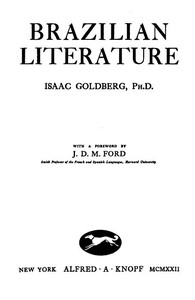
Brazilian Literature by Isaac Goldberg
Forget everything you know about dry literary surveys. Isaac Goldberg's Brazilian Literature is a guided tour through a creative revolution. Written in the 1920s, it captures the explosive first century of Brazil's national literature, from its birth pangs after independence in 1822 to its confident, modern voice in the early 1900s.
The Story
There's no main character here, unless you count Brazilian culture itself. The 'plot' is the thrilling and messy search for a national identity. Goldberg walks us through the major literary movements like a reporter on the scene. We start with the Romantic period, where writers like Gonçalves Dias looked to the nation's forests and indigenous peoples for inspiration, creating a mythic Brazilian past. Then comes the realistic push of Machado de Assis, a genius who used sharp, ironic prose to dissect Rio de Janeiro's high society. Finally, we hit the Modernist explosion of the 1920s, where artists like Mário de Andrade decided to smash tradition entirely and build something new from the rhythms of everyday Brazilian speech and life. It's a story of imitation, rebellion, and finally, self-discovery.
Why You Should Read It
What makes this book special is Goldberg's passion. He wasn't a distant academic; he was a critic writing as it was all happening. His excitement is contagious. He doesn't just list names and dates—he makes you feel why a poet's turn toward local slang was a radical act, or how a novelist's focus on a single city street changed everything. You get the sense of literature as a living, breathing, and often contentious conversation. Reading it, you understand that books and poems weren't just entertainment; they were the tools Brazil used to define itself.
Final Verdict
This is the perfect book for curious readers who love history, culture, and a good origin story. It's for anyone who has enjoyed a novel by Jorge Amado or Clarice Lispector and wanted to know how they got there. It's also a great pick for travelers to Brazil who want to look beyond the beaches and see the country's intellectual heart. While it's about literature, it's really about the birth of a modern nation's soul. Keep in mind it was written in 1922, so it ends just as the Modernist wave is breaking—consider it Part One of an incredible story.
This work has been identified as being free of known copyright restrictions. Preserving history for future generations.
Nancy Martin
8 months agoClear and concise.