1

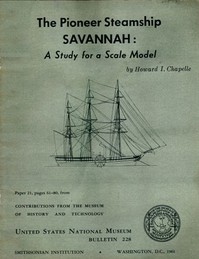
The Pioneer Steamship Savannah: A Study for a Scale Model United States National Museum Bulletin 228, 1961, pages 61-80 — A Closer Reading
(0 User reviews)
974
Project Gutenberg
2008
Not confirmed
Savannah (Steamship); Ship models
Readers of public-domain and historical texts
Project Gutenberg digital edition
en
Edition facts
Words
12,656
Reading time
56 min
Text sections
2
The Pioneer Steamship Savannah: A Study for a Scale Model United States National Museum Bulletin 228, 1961, pages 61-80 — A Closer Reading can be approached with a clearer sense of reading commitment from its source measurements: 12,656 words, 56 min estimated reading time, and 2 detected text sections.
The text analysis averages about 21.5 words per sentence, while the detected sections provide another way to judge how the source is divided.
Project Gutenberg metadata also associates the work with “Savannah (Steamship),” connecting these edition facts with the source record’s subject description.
Source:
Project Gutenberg record #25544
This editorial note examines Howard I. Chapelle's reconstruction of the Savannah's plans, focusing on how the text uses logbook entries, customhouse records, and contemporary reports to resolve discrepancies in an existing museum model. The analysis highlights the interplay between documentary evidence and physical reconstruction, particularly in the treatment of paddle wheels, bunker stowage, and deckhouse dimensions.
Editorial Edition Score
4.5/5
★★★★★
★★★★★
Calculated from edition completeness, EPUB availability, text structure and catalogue metadata. Not a user rating.
How this score is calculated
- Description quality20 pts
- Title & short description10 pts
- Source metadata20 pts
- Text length15 pts
- Chapters / structure15 pts
- EPUB file integrity20 pts
Total of 100 points, scaled to a 2.5-5.0 range. Editions with an empty description or a missing EPUB file are not scored.
Edition quality
Read the Text
E-text prepared by Colin Bell, Joseph Cooper, Chris Logan, and the Project Gutenberg Online Distributed Proofreading Team (https://www.pgdp.net)
Note: Project Gutenberg also has an HTML version of this file which includes the original illustrations. See 25544-h.htm or 25544-h.zip: (https://www.gutenberg.org/dirs/2/5/5/4/25544/25544-h/25544-h.htm) or (https://www.gutenberg.org/dirs/2/5/5/4/25544/25544-h.zip)
Contributions from the Museum of History and Technology: Paper 21
THE PIONEER STEAMSHIP SAVANNAH:
A Study for a Scale Model
The Pioneer Steamship
_A Study for a Scale Model_
_The original plans of the pioneer transatlantic steamer_ Savannah _no longer exist, and many popular representations of the famous vessel have been based on a 70-year-old model in the United States National Museum. This model, however, differs in several important respects from contemporary illustrations._
_To correct these apparent inaccuracies in a new, authentic model, a reconstruction of the original plans was undertaken, using as sources the ship's logbook and customhouse description, a French report on American steam vessels published in 1823, and Russian newspaper accounts contemporary with the_ Savannah's _visit to St. Petersburg on her historic voyage of 1819. The development of this research and the resulting information in terms of her measurements and general description are related here._
THE AUTHOR: _Howard I. Chapelle is curator of transportation in the United States National Museum, Smithsonian Institution._
The United States National Museum has in its watercraft collection a rigged scale model purported to be of the pioneer transatlantic steamer _Savannah_. For many years this model was generally accepted as being a reasonably accurate representation and was the basis for countless illustrations. Curiously enough, the model (USNM 160364) does not agree with the published catalog description[1] as to the side paddle wheels. Neither does it agree with the material in the Marestier report,[2] which is accepted as the only source for a contemporary picture of the _Savannah_.
The recent naming of an atomic-powered ship in honor of the famous steamer greatly increased popular interest in the pioneer ship and its supposed model. Consequently, the National Museum undertook the research necessary to correct or replace the existing model. This research has been carried out by the staff of the Museum's transportation division with the aid of Frank O. Braynard of the American Merchant Marine Institute, Eugene S. Ferguson, curator of mechanical and civil engineering at the Museum, and others.
The _Savannah_ crossed from Savannah, Georgia, to Liverpool, England, in the period May 22 to June 20, 1819; and proceeded to the Baltic, where she entered at St. Petersburg (now Leningrad), Stockholm, and a few other ports. On her return she reached Savannah on November 30, and on December 3 she sailed for Washington, D.C., arriving on December 16. Her original logbook now on exhibition in the Museum,[3] covers the period between March 28, 1819, when she first left New York for Savannah, to December 1819 when she was at Washington.
The old model (fig. 1) was built about 1890-1892 by Lawrence Jenson, a master shipwright and model builder of Gloucester and Rockport, Massachusetts, under the supervision of Capt. Joseph Collins of the U.S. Fish Commission. Notes in the records of the Museum's transportation division show that the research for this model was done by Captain Collins through use of an unidentified lithograph, printed after the transatlantic voyage, and what then could be learned about American sailing ships contemporary with the _Savannah_. In these notes the complaint is made that no contemporary representation of the steamship had then been found.
The old, inaccurate model, built to the scale of one-half inch to the foot, represents an auxiliary, side-wheel, ship-rigged steamer. The model scale measurements are about 120 feet in over-all length, 29 feet in beam, and 13 feet 6 inches depth in hold. The tonnage is stated on the exhibit card to have been about 350 tons, old measurement. The model has crude wooden side paddles of the radial type, a tall straight smokestack between fore and main masts, a small deckhouse forward of the stack, a raised quarter-deck, and a round stern.
The first step in the research for creating a more faithful representation of the _Savannah_ was to obtain the customhouse description of the ship. It was readily established that she was built as a sailing packet ship by the Fickett and Crockett shipyard[4] at Corlaer's Hook, East River, New York, and that she was launched August 22, 1818. Her register shows that she was 98 feet 6 inches in length between perpendiculars, 25 feet 10 inches in beam, 14 feet 2 inches depth in hold, of 319-70/94 tons burthen, and with square stern, round tuck, no quarter galleries, and a man's bust figurehead.
Howard I. Chapelle's study of the Savannah is built around a single, precise problem: the existing museum model (USNM 160364) does not match contemporary descriptions. The author, curator of transportation at the United States National Museum, sets out to reconstruct the original plans using the ship's logbook, customhouse description, a French report by Marestier, and Russian newspaper accounts. The text moves methodically from identifying discrepancies—such as the side paddle wheels—to proposing specific dimensions for the deckhouse, bunkers, and stack. This is not a narrative history but a technical argument, where each measurement is weighed against available evidence.
Reconstructing from Fragments
The opening pages establish the documentary foundation. Chapelle lists his sources with care: the logbook, customhouse description, Marestier's 1823 report, and Russian newspaper accounts from the Savannah's 1819 visit to St. Petersburg. He does not claim completeness—the original plans no longer exist—but treats each document as a partial witness. The logbook provides the voyage timeline (May 22 to June 20, 1819, from Savannah to Liverpool), while Marestier's sketches offer the only contemporary picture of the vessel. The author's method is to cross-check these sources against the museum model, noting where the model departs from the written and visual record. This approach gives the text a forensic quality: every assertion is tied to a specific document or measurement.
The Paddle Wheel Problem
A central puzzle is the side paddle wheels. The existing model shows them in a way that contradicts both the published catalog description and Marestier's report. Chapelle devotes careful attention to the wheel's folding mechanism, describing how the fixed and pivoted arms were arranged. He notes that some writers refer to a "jointed" or "hinged" axle, but Marestier's sketch makes no mention of such an arrangement. The author reconstructs the folding process step by step: the fixed arms are brought parallel to the rail, the chain span is disconnected, and the pivoted blades are dropped onto the fixed arms and lashed. This level of mechanical detail is typical of the study, which treats the ship as a machine to be reverse-engineered from fragmentary evidence.
Bunkers and Stowage
Fuel stowage presents another reconstruction challenge. Chapelle calculates the space needed for coal versus cord wood, noting that coal would require bunkers alongside the boilers in the lower hold, while the lighter cord wood could be stowed in the wings on the lower deck. He proposes specific dimensions: for coal, two bunkers each in excess of 30 square feet in cross section and about 28 feet in length; for cord wood, two bunkers of about 60 square feet in cross section and 20 to 24 feet in length. The text emphasizes that these are estimates based on the required tonnage and cubic footage, not on surviving plans. The author also speculates on the location of bunker hatches, placing them forward of the deckhouse and outboard, sized to allow coal baskets or cord wood to be passed below.
The Deckhouse and Stack
Chapelle's reconstruction of the deckhouse and stack shows how he balances Marestier's sketch against functional requirements. Marestier shows the deckhouse extending from a little forward of the mainmast to a little forward of the paddle wheel axle. The author argues that this house probably covered the main hatch and the crank-connecting-rod hatchway, making it longer than Marestier indicates—between 17 and 18 feet. Its width is guessed at 11 feet, based on the opening cut in the upper deck for machinery. The stack location is taken directly from Marestier: abreast the buckets on the forward side of the paddle wheels. Chapelle adds a detail about the stack being swivelled to turn the elbow to leeward, with straps bolted to the upper stack for rotating it with heaving bars. These small mechanical inferences give the reconstruction its texture.
Chapelle's study is best read as a working document, not a finished history. The text is dense with conditional language—"probably," "perhaps," "it may have been"—that signals the limits of the evidence. Readers interested in the Savannah as a historical artifact will find a detailed argument for how a ship can be rebuilt from paper traces. The value lies not in a definitive answer but in the transparency of the method: each assumption is labeled, each dimension justified. This is a curator's report, and it rewards attention to the process of reconstruction itself.
Reading Mr. Chapelle’s careful untangling of the Savannah’s logbook, I felt the same quiet pleasure as when tracing an old letter’s faded postmarks. Those tiny, stubborn details—coal bunkers, paddle-wheel measurements—suddenly become a living thread to the past. It reminded me of an accompanying volume, Ocean Steam Navigation and the Ocean Post — Story, Setting & Ideas, which treats the sea’s early mail routes with equal, tender patience.
There are no reviews for this eBook.
There are no comments for this eBook.
Reader reflection
Record your reading impressions
A brief reflection can help important ideas stay with you longer.
Your progress
0
/
10
2
How much did you enjoy the reading experience?
3
How likely are you to recommend this book?
4
How demanding did the text feel?
5
Do you expect to return to this book?
6
How much did the book move you?
7
How would you describe its reading pace?
8
Did any part of the book feel personally relevant?
9
In one sentence, what did you learn?
10