
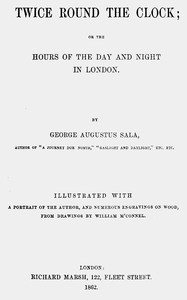
Twice round the clock; or, The hours of the day and night in London by Sala
Forget a traditional novel with a hero and a villain. 'Twice Round the Clock' is a different kind of adventure. George Augustus Sala, a famous journalist of his day, structures the entire book as a single day in London. He starts in the eerie quiet of the very early morning, with bakers firing up their ovens and market porters trudging to work. From there, he's our relentless guide. We follow the city waking up: the rush of clerks, the opening of shops, the fashionable promenades in the parks.
The Story
The 'plot' is simply the clock ticking forward. Sala takes us into places most people never saw. We visit the frantic newspaper offices as they race to print the evening edition. We sneak into a grand opera house to see the stagehands at work, and then we might plunge into a rowdy pub or a grimy lodging house for the poor. He describes the dazzling gaslight of the theatres and the dangerous, pitch-black alleys just a few streets away. There's no single character to follow, but instead a swirling crowd of thousands—hackney cab drivers, street urchins, society ladies, policemen, and thieves—all going about their business as the hours pass. The book ends as it began, in the relative stillness of late night, with a different set of nocturnal characters taking over the streets.
Why You Should Read It
This book is pure atmosphere. Reading it feels less like studying history and more like having a superpower: the ability to be a ghost in 1859 London. Sala has a sharp eye and an even sharper pen. He's funny, sarcastic, compassionate, and horrified by turns. You get the sense he loved this messy, overwhelming city, flaws and all. What I love most is the incredible detail. He tells you what people are wearing, what they're eating (oysters were a cheap street food!), what they're shouting, and how much things cost. It makes the past feel startlingly real and immediate. It’s not a polished, romantic view; it's loud, smelly, vibrant, and often unfair.
Final Verdict
This book is perfect for anyone with a curiosity about real life in the past. If you're a fan of Charles Dickens, you'll see the real-world inspiration for his novels. If you love history, but find textbooks dull, this is your antidote. It's also great for writers looking for authentic historical texture. A word of warning: Sala's views are very much of his time, so some passages require a modern reader's understanding. But if you want to time-travel without a machine, just open this book. It’s a noisy, brilliant, and unforgettable tour.
You are viewing a work that belongs to the global public domain. Share knowledge freely with the world.
Aiden Rodriguez
1 year agoAmazing book.
William Anderson
3 months agoI stumbled upon this title and the author's voice is distinct and makes complex topics easy to digest. Absolutely essential reading.
Elizabeth Jackson
1 year agoAs someone who reads a lot, it creates a vivid world that you simply do not want to leave. Truly inspiring.
Lisa Wilson
1 year agoBeautifully written.



Ethan Martin
1 year agoHonestly, the arguments are well-supported by credible references. One of the best books I've read this year.