1

Aircraft — Story, Setting & Ideas
(0 User reviews)
2202
Project Gutenberg
2024
Not confirmed
Airplanes; Aeronautics
Readers of public-domain and historical texts
Project Gutenberg digital edition
en
Edition facts
Words
100,546
Reading time
438 min
Text sections
40
Before opening Aircraft — Story, Setting & Ideas, the edition data offers a quick orientation: 100,546 words, 7 hr 18 min estimated reading time, and 40 detected text sections.
The text analysis averages about 20.9 words per sentence, while the detected sections provide another way to judge how the source is divided.
Project Gutenberg metadata also associates the work with “Airplanes,” connecting these edition facts with the source record’s subject description.
Source:
Project Gutenberg record #74358
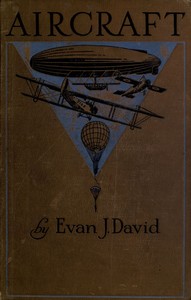
Evan J. David's 1919 survey traces aeronautics from balloons to transatlantic flights, emphasizing design evolution and commercial potential through precise technical description and historical milestones.
Editorial Edition Score
4.9/5
★★★★★
★★★★★
Calculated from edition completeness, EPUB availability, text structure and catalogue metadata. Not a user rating.
How this score is calculated
- Description quality20 pts
- Title & short description10 pts
- Source metadata20 pts
- Text length15 pts
- Chapters / structure15 pts
- EPUB file integrity20 pts
Total of 100 points, scaled to a 2.5-5.0 range. Editions with an empty description or a missing EPUB file are not scored.
Edition quality
Read the Text
off the ground. By observation of birds he saw that their wings were arched, which suggested reason for failures of previous experiments in this line; so afterward his planes were arched also. He was the first man to be lifted off the ground by plane surfaces, and to demonstrate that arched surfaces were necessary to sustained flight of heavier-than-air craft.
To the rigid wings Lillienthal fastened a rigid tail and this constituted his glider. There were no control levers and the only way he could steer was by shifting the balance, by use of his legs, in one direction or another. By means of an artificial hill he had constructed he could coast downward for some distance without striking the ground. He was unfortunately killed in one of these experiments in 1896.
Chanute’s experiments in gliding were similar to Lillienthal’s, but they were conducted on the sand-dunes along Lake Michigan, near Chicago. His apparatus was more strongly constructed, of trussed biplane type—a construction suggested to him by his experience in bridge building, and one which persists to-day as the basis of strength in our present military biplanes. In design it was similar to a box kite, and it was the kind which the Wrights adopted for their experiments.
The leaders of the second school were: Clement Ader (1890-97), Sir Hiram Stevens Maxim (1890-94), and Samuel Pierpont Langley (1895-1903).
Clement Ader, the famous French scientist, under the auspices of the French Government, conducted experiments from 1890 to 1897. In 1890 he filled his Arion, a boat-shaped machine with two propellers, with a steam-engine, but the apparatus never flew. He finished his next machine in 1897 after six years of hard work. It was large enough to carry a man, but, like its predecessor, it never left the ground, and the French Government refused to support his experiments further.
While Ader was making his experiments in France, Sir Hiram S. Maxim was at work constructing a large multiplane for the English Government, which he fitted with two steam-engines of 175 horse-power. But like Ader’s experiments it toppled over at the first trial and was badly damaged, and the British Government refused further backing.
The experience of Samuel Pierpont Langley in America is not unlike the experience of Ader in France and Maxim in England. He was employed by the Board of Ordnance and Fortification of the United States army to construct the “Aerodrome” of his own invention. Congress appropriated $50,000 for the purpose. Langley’s machine was a tandem monoplane, 48 feet from tip to tip, and 52 feet from bowsprit to the end of its tail. It was fitted with a 50 horse-power engine and weighed 830 pounds. The trials of this aerodrome, two attempts to launch it, were made on October 7 and December 8, 1903. On both occasions the aerodrome became entangled in the defective launching apparatus, and was thrown headlong into the Potomac River—on which the launching trials were made. Following the last failure, when the aerodrome was wrecked, the press ridiculed the whole enterprise, and Congress refused to appropriate money for further experiments. The Langley aerodrome, fitted with a Curtiss motor and Curtiss controls, flew in 1913-14.
As with experiments of the first school they did not attain practical results. The machines were usually wrecked at the first trial without giving any clew to the nature or whereabouts of the trouble. Although Langley’s machines were reconstructed and flown later this should not detract in any way from the fame of the Wright brothers, Orville and Wilbur, who really were the first to construct an aeroplane which was driven by a gasoline motor, lifting a man off the ground, and pursuing a steered and sustained flight through the air.
Evan J. David opens Aircraft with a sweeping historical arc: man's longing to fly, the Montgolfier brothers' 1783 paper bag, and the first free-balloon flight by d'Arlandes and de Roziers. The prose moves briskly through early failures—steam engines too heavy, electric motors too weak—until the gasoline engine finally made dirigibles steerable. David's diction is direct and factual, favoring concrete numbers (horsepower, speeds, distances) over rhetorical flourish. He singles out specific inventors—Henri Gifford, Captain Renard, Santos-Dumont—and marks each as a step forward. The preface promises a simple treatment, but the excerpts show a writer who trusts technical detail to carry the narrative.
Numbers as Narrative
David repeatedly anchors his history in precise figures. The 1852 Gifford dirigible was 143 feet long, 39 feet in diameter, driven by a three-horsepower steam engine at six miles per hour. Renard's 1884 electric motor delivered one shaft horsepower per eighty-eight pounds of battery weight. The Wright brothers' 1903 flight is noted without embellishment, but later statistics accumulate: 30,500 feet altitude, 920 miles nonstop, a free balloon drifting 1,503 miles from Paris to Kharkoff. These numbers do more than inform; they create a ladder of incremental achievement. David rarely pauses to praise—he lets the figures imply progress. The effect is a history told through engineering benchmarks rather than heroic anecdotes.
The Gasoline Engine as Turning Point
David frames the internal combustion engine as the decisive enabler of practical flight. Before it, every gas-bag was “at the mercy of the winds.” He traces a clear line: steam engines posed fire and weight problems; electric motors, despite Renard's clever chlorochromic battery, remained impractical. Only when the gasoline motor could generate “more than a dozen horse-power” did dirigibles become steerable. Santos-Dumont's 1898 flight from the Paris Zoological Gardens—steering “in nearly every point of the compass”—is presented as the proof of concept. David's language is matter-of-fact, but the structural emphasis on power-to-weight ratio reveals his analytical bent. He treats the engine not as a romantic breakthrough but as a solution to a specific mechanical constraint.
War and the Acceleration of Innovation
The excerpts show David using wartime examples to illustrate rapid technical advance. He describes a super-Zeppelin flying from Jamboli to Khartum and back—6,000 miles each way—carrying twenty-two crew and twenty-five tons of supplies, turned back by wireless when its destination fell. The detail is clinical: the mission's failure is recorded without drama. Elsewhere, he notes German Zeppelins bombing London, Paris, and Bucharest, and transporting machinery from Austria-Hungary to Constantinople. David does not moralize; he treats these as data points in the evolution of range and payload. The war, in his telling, compressed decades of development into four years, forcing solutions to problems of endurance, navigation, and heavy lift that peacetime might have left unexplored.
A Commercial Future in the Making
David's subtitle promises attention to “commercial future,” and the excerpts bear this out. He lists present uses—mail, reconnaissance, transport—and hints at possibilities: passenger lines, freight routes, global connectivity. The tone is cautiously optimistic, grounded in the same factual style he applies to history. When he describes the NC-4 flying-boat's transatlantic crossing (Rockaway to Plymouth, commanded by Lieutenant-Commander Read), he emphasizes its four Liberty 450-horsepower engines and the arrangement of motors. The commercial potential is implied by the feat itself. David avoids grandiose predictions; instead, he lets the trajectory of increasing range and reliability suggest that aircraft will soon carry goods and people as routinely as ships carry cargo.
David's Aircraft rewards readers who appreciate technical specificity and a clear-eyed view of technological progress. The book's strength lies in its accumulation of verifiable detail—dimensions, speeds, payloads—rather than in narrative flair. Readers should expect a survey organized around milestones, not personalities, and a tone that remains steady whether describing a 1783 paper balloon or a 1919 transatlantic flight. The work is best approached as a contemporary document of how aviation looked to an informed observer at the close of World War I, before the industry's explosive growth in the 1920s.
Reading Evan J. David’s account of early flight, I kept thinking about how much trust those first designs demanded. It reminded me, strangely, of The story of rope — Background and Themes—both are quiet histories of things we now take for granted. Sometimes the most ordinary knots and cables held futures aloft, long before anyone called them aviation.
There are no reviews for this eBook.
There are no comments for this eBook.
Reader reflection
Take a moment to reflect on this book
Create a short personal record of your experience with this book.
Your progress
0
/
10
2
What was your overall reaction to the book?
3
How likely are you to recommend this book?
4
How demanding did the text feel?
5
Did any part of the book stay with you emotionally?
6
Did anything about the book feel genuinely new?
7
Would you start a conversation about this book?
8
How did the reading compare with what you expected?
9
In one sentence, what did you learn?
10