1

Artificial fire-works — Reading Companion
(0 User reviews)
1021
Project Gutenberg
2021
Not confirmed
Fireworks -- Early works to 1800
Readers of public-domain and historical texts
Project Gutenberg digital edition
en
Edition facts
Words
53,900
Reading time
235 min
Text sections
16
The source record for Artificial fire-works — Reading Companion measures this digital text at 53,900 words, 3 hr 55 min estimated reading time, and 16 detected text sections.
The text analysis averages about 34.3 words per sentence, while the detected sections provide another way to judge how the source is divided.
Project Gutenberg metadata also associates the work with “Fireworks -- Early works to 1800,” connecting these edition facts with the source record’s subject description.
Source:
Project Gutenberg record #64306
An 18th-century artillery officer's practical manual on fireworks construction, detailing compositions, moulds, and techniques for rockets, stars, and complex displays, with precise measurements and step-by-step instructions.
Editorial Edition Score
4.8/5
★★★★★
★★★★★
Calculated from edition completeness, EPUB availability, text structure and catalogue metadata. Not a user rating.
How this score is calculated
- Description quality20 pts
- Title & short description10 pts
- Source metadata20 pts
- Text length15 pts
- Chapters / structure15 pts
- EPUB file integrity20 pts
Total of 100 points, scaled to a 2.5-5.0 range. Editions with an empty description or a missing EPUB file are not scored.
Edition quality
Read the Text
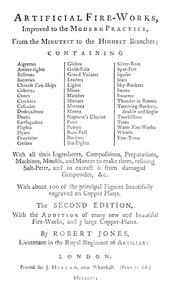
ARTIFICIAL FIRE-WORKS,
Improved to the MODERN PRACTICE,
From the MINUTEST to the HIGHEST Branches;
Aigrettes Amber-lights Balloons Batteries Chinese Fire-Ships Cohorns Cones Crackers Cascades Dodecadrons Ducks Earthquakes Flights Flyers Fountains Gerbes Globes Gold-Rain Grand Volutes Leaders Lights Mines Matches Mortars Marrons Moons Neptune’s Chariot Potts Pumps Rain-Fall Rockets Sea-Fights Silver-Rain Spur-Fire Squibs Stars Sky-Rockets Swans Swarms Thunder in Rooms Towering-Rockets, double and single Tourbillons Trees Water Fire-Works Wheels Yew-Trees
With all their Ingredients, Compositions, Preparations, Machines, Moulds, and Manner to make them, refining Salt-Petre, and to extract it from damaged Gunpowder, &c.
With about 100 of the principal Figures beautifully engraved on Copper Plates.
With the ADDITION of many new and beautiful Fire-Works, and 3 large Copper-Plates.
Lieutenant in the Royal Regiment of ARTILLERY.
Printed for J. MILLAN, near Whitehall. (Price 7s, 6d.)
TO SIR CHARLES FREDERICK, KNIGHT OF THE MOST NOBLE ORDER OF THE BATH, SURVEYOR GENERAL OF HIS MAJESTY’S ORDNANCE, AND FELLOW OF THE ROYAL SOCIETY, AT LONDON. THIS TREATISE ON ARTIFICIAL FIREWORKS IS HUMBLY INSCRIBED BY HIS MOST OBEDIENT AND MUCH OBLIGED HUMBLE SERVANT,
I shall not pretend to say any thing here concerning the origin of Fireworks; those who are willing to be better informed of that point, may have recourse to the treatise of M. F***, on that subject, who has handled this point in a most elaborate manner; and perhaps it may be no displeasing surprize to the reader, to find that, while he imagines himself only concerned about an invention which, he could not have thought to have subsisted above 422 years, he is carried gradually back to the age of Augustus, and from thence to the time of the Trojan war.
It is sufficient for me that Fireworks have subsisted a long time, and still continue to do so among the politest nations of both Europe and Asia. I am very well aware that it may here be objected, there are already treatises published on this subject, and some of those voluminous ones; but then those are either translations from the French and Italian authors, &c. which in themselves are both imperfect and erroneous; or else they are very small abridgments, and those little, not of the art itself, only on some particular branches of it.
I have endeavoured, in the following treatise, to avoid prolixity as much as possible without being obscure; the rules I have laid down, are as plain as was in my power to make them, and I have endeavoured to carry the reader in by the most gradual manner, from the minutest circumstances to the highest, and have been careful to keep to the subject I first proposed, only as an Essay on Artificial Fire-works. I own I cannot help reflecting with some kind of chagrin, that, whenever we have had occasion for any of these sort of diversions to be exhibited in England, we have almost always had recourse to foreigners to execute them; if this has been owing to the ignorance of our own people on this subject, I shall be very happy if it is in my power to correct it; if it is only owing to that prevailing fondness we entertain for every thing that is foreign, I know no remedy for that evil but time and experience.
Colonel Amherst Lumney Arnold, Esq; Captain Anderson Mr. Thomas Ardesoif Thomas Appreece, Esq; Lieutenant Abbot Mr. Nenon Armstrong John Archbold, Esq;
Sir Richard Betenson, Baronet Lieutenant-General Belford Lieutenant-Colonel Brome Captain Buchannan Captain Richard Bowles Charles Booth, Esq; Captain Burt Captain Bothwick Captain Basset Captain Henry Balfour Captain Henry Brasier Christopher Bath, Esq; Captain Bettesworth Lieutenant Blomfield Lieutenant Bellew Lieutenant Barbutt Lieutenant Bruere Lieutenant Burton Lieutenant Brady Lieutenant Burgh Lieutenant Burrows Lieutenant Brietzcke Lieutenant Barber Lieutenant Browne Ensign Bertie Mr. Bertie ―――― Burk, Esq; Mr. Burford.
Lieutenant-Colonel Chenevix Lieutenant-Colonel Cleaveland Lieutenant-Colonel Carlton Major A. Campbell The Honourable Lucius Ferdinand Cary Captain Campbell Captain Clark Captain Charlton Thomas Cunningham, Esq; John Cockburn, Esq; Cecil Calvert, Esq; John Cathcart, Esq; Partrick George Craufurd, Esq; Lieutenant Chapman Lieutenant Richard Chapman Thomas Chowne, Esq; ―――― Cooke, Esq;
Lieutenant-General Durand Sir Charles Davers Colonel Desaguliers Lieutenant-Colonel Dalling Major Dade Captain Debbeig Captain Dixon Captain Desbrisay Captain Davis George Durant, Esq; Henry Pelham Davis, Esq; Lieutenant Durnford Lieutenant Dixon Lieutenant Douglass Lieutenant Downing Mr. Decosta
Lieutenant-General Elliot Sir John Eyles Styles, Baronet ―――― Edmonds, Esq.
Sir Charles Frederick, Knight of the Bath William Farrell, Esq; William Charles Farrell, Esq; Captain Christopher French Captain Fuller Captain French
The Right Honourable the Marquiss of Granby Lieutenant-Colonel Godwin Captain Gordon Captain Garth Captain Gray Captain George Lieutenant Garstin Lieutenant Grose Lieutenant Gossip John Henry Grose, Esq; Jacob Grose, Esq; Mr. Gresse
Robert Jones, a lieutenant in the Royal Regiment of Artillery, opens his 1766 treatise with a deliberate dismissal of historical inquiry: he will not discuss the origin of fireworks, referring curious readers to a French author who traces the art back to the Trojan war. Instead, Jones stakes his claim on practical improvement, asserting that existing English treatises are either imperfect translations or mere abridgments of particular branches. His preface sets a tone of methodical clarity—promising to avoid prolixity without obscurity—and the body of the work delivers on that promise through exhaustive technical detail.
Precision in Measurement and Moulds
Jones’s instructions are anchored in exact ratios and dimensions. For single rain falls, he specifies the former diameter in sixteenths of an inch for each rocket weight: two sixteenths for four-ounce rockets, four for eight-ounce, five for one-pound, and so on up to seven sixteenths for six-pounders. The length of the case is also given in inches or diameters, leaving no ambiguity. Moulds are described as flat-bottomed, without nipples, and cases must be driven tight—the better the case sits the mould, the more driving it will bear. A funnel of thin tin is recommended for filling small cases quickly, a practical concession to the tedium of hand-ladling.
Layered Effects and Temporal Sequence
Jones explains how to create double rain falls that change appearance mid-burn: some appear first as a star then as rain, others the reverse. The method is straightforward—fill the case with rain composition to within half an inch of the top, then top with star composition, or vice versa. He extends this to multi-stage rockets: they may burn as stars, then rain, then stars again, or finish with a report. To achieve this, the first rammed end is cut open after filling and bouncing, then primed. The star composition for such purposes must be stronger than for rolled stars, a subtle adjustment that reveals Jones’s attention to performance under different conditions.
Construction of Stars: Rolling, Driving, and Stringing
Three distinct methods for making stars are detailed. For strung stars, dry composition is wrapped in paper squares, twisted tight, then rolled with paste on the hands. After drying, flax or tow is wound around each star, and a second paste rolling follows. Once dry, a hole is pierced through each star, and cotton quick-match is run through, holding ten or twelve stars at intervals. Tailed stars, which emit a comet-like tail of sparks, can be rolled with a liquor of spirit of wine and thin size, or driven with composition moistened only with spirit of wine. Drove stars require cases rolled thin with paste; the composition is damped with spirit of wine in which camphor has been dissolved, and rammed hard enough not to break the case. Each method yields a different visual effect, and Jones provides the precise steps to achieve them.
Jones’s manual is best read as a working document, not a history. The reader will find no narrative arc, only a sequence of recipes and procedures that assume hands-on familiarity with tools and materials. The value lies in the specificity: the exact sixteenths of an inch, the order of filling, the choice of spirit of wine over water. For anyone attempting to reconstruct eighteenth-century fireworks, these details are the difference between a sputtering spark and a controlled cascade.
There’s something comforting in how carefully the old artillery officer measures his stars and fuses, as if patience itself were a kind of fuel. I thought of that quiet diligence when I later found the Workshop on Electronic Texts: Proceedings, 9-10 June 1992 — Story, Setting & Ideas, another place where slow, precise hands try to shape something that will bloom only later, in someone else’s sky.
There are no reviews for this eBook.
There are no comments for this eBook.
Reader reflection
What was your reading experience?
Capture what you thought, learned, and would like to remember.
Your progress
0
/
10
2
How did the book work for you overall?
3
Would you recommend this book to another reader?
4
What was the reading difficulty like?
5
Did it raise ideas you would like to talk about?
6
Did the book offer a fresh perspective?
7
Was the book easy to understand?
8
Did the book deliver what you hoped for?
9
Which lesson or insight stayed with you?
10