1

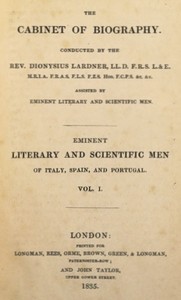
Eminent literary and scientific men of Italy, Spain, and Portugal. Vol. 1 (of 3) — Text and Context
(0 User reviews)
289
Project Gutenberg
2021
Not confirmed
Authors -- Biography; Scientists -- Biography
Readers of public-domain and historical texts
Project Gutenberg digital edition
en
Edition facts
Words
112,814
Reading time
491 min
Text sections
13
This digital edition of Eminent literary and scientific men of Italy, Spain, and Portugal. Vol. 1 (of 3) — Text and Context is described by source-level measurements including 112,814 words, 8 hr 11 min estimated reading time, and 13 detected text sections.
The text analysis averages about 30.1 words per sentence, while the detected sections provide another way to judge how the source is divided.
Project Gutenberg metadata also associates the work with “Authors -- Biography,” connecting these edition facts with the source record’s subject description.
Source:
Project Gutenberg record #65030
This volume of the Cabinet Cyclopaedia presents biographical sketches of Dante, Petrarch, Boccaccio, Lorenzo de' Medici, Bojardo, Berni, Ariosto, and Machiavelli, written by James Montgomery and Mary Shelley. The excerpts reveal a focus on lineage, intellectual formation, and the interplay between literary ambition and political patronage.
Editorial Edition Score
4.8/5
★★★★★
★★★★★
Calculated from edition completeness, EPUB availability, text structure and catalogue metadata. Not a user rating.
How this score is calculated
- Description quality20 pts
- Title & short description10 pts
- Source metadata20 pts
- Text length15 pts
- Chapters / structure15 pts
- EPUB file integrity20 pts
Total of 100 points, scaled to a 2.5-5.0 range. Editions with an empty description or a missing EPUB file are not scored.
Edition quality
Read the Text
Alighieri was the grandfather of Dante; and concerning him, Cacciaguida, in the last-mentioned canto, informs the poet, that, for some unnamed offence, his spirit has been more than a hundred years pacing round the first circle of the mountain of purgatory; adding,--
"Ben si convien, che la lunga fatica Tu gli raccorci con l' opere tue."
"And well it would be, were his long fatigue Shorten'd by thy good deeds."
Dante was born in the spring of the year 1265. Benvenuta da Immola calls his father a lawyer; but little more is recorded of him except that he was twice married, and left two sons and a daughter, at an early age, to the guardianship of relatives. Dante (abridged from Durante) was born of Bella, his father's second wife, of whom, during her pregnancy, Boccaccio relates a very significant dream,--on what authority he does not say, and with what truth the reader may judge for himself. She imagined herself sitting under the shade of a lofty laurel, in the midst of a green meadow, by the side of a brilliant fountain. Here she was delivered of a boy, who, in as little time as might easily happen in a dream, grew up into a man before her eyes, by feeding upon the berries that fell from the tree, and drinking of the pure stream which watered its roots. Presently he had become a shepherd; but, climbing too eagerly up the stem to gather some leaves from the laurel, with the fruit of which he had been hitherto nourished, he fell headlong to the ground, and on rising appeared no longer a man, but a magnificent peacock. It would be aggravating the offence of wasting time by quoting such a fable, were we to give the obvious interpretation. This, however, the great Boccaccio has done with most magniloquent gravity,--a task for which, of all men, he was no doubt the most competent, as it is probable that no soul living (the lady herself not excepted) besides himself was in the secret either of the vision or the moral. One point of the latter, which could not easily be guessed, may be mentioned; namely, that the spots on the peacock's tail (the hundred eyes of Argus) foreshowed the hundred cantos of the "Divina Commedia." The ingenious author of the Decameron may have borrowed the idea of this dream from Dante's own allusion to the laurel and its leaves,--the meed of poets and of princes,--in his preposterous invocation of Apollo at the commencement of the "Paradiso."
Dante himself never alludes to this notable omen, though often referring, with conscious pride, to his genius, and the circumstances by which it had been awakened and exercised. This he attributed to the benign influence of the constellation Gemini, which ruled at his nativity. In the "Paradiso," Canto XXII., mentioning his flight from the planetary system to the eighth sphere, where the fixed stars have their dwelling, he exclaims,--
"O Reader! as I hope once more to reach That realm of holy triumph[1], for whose sake I oft lament my sins and smite my breast, Thou could'st not, in so brief a space, through fire Have pass'd and pluck'd thy finger, as I saw And was within the sign that follows Taurus. O glorious stars! light full of highest virtue! From whence, whate'er it be, my genius sprang, With you arose, and set the Sire of life[2], When first I breathed the Tuscan air. With you My lot was cast, when grace was given to mount The lofty wheel which guides your revolutions. To you, devoutly, my whole soul aspires To gather courage for the bold adventure That draws me onward tow'rds itself."[3]
Brunetto Latini (his tutor afterwards) is reported to have foretold the boy's illustrious destiny, on due consultation with the heavenly bodies that presided at his birth. Yet, superstitious as Dante appears to have been in this respect, in the twentieth canto of the "Inferno" he punishes astrologers, and those who presume to predict events, by twisting their heads over their shoulders, and making those for ever look backward who, too daringly, had looked forward into inscrutable futurity.
The opening biography of Dante plunges into questions of ancestry and civic origin, tracing the poet's lineage to a Roman house and citing his own ambiguous references in the Paradiso. This concern with pedigree recurs throughout the volume: Petrarch's father is exiled, Boccaccio's father is a merchant, and Lorenzo de' Medici is born into a ruling dynasty. The authors consistently anchor each subject's intellectual development in family circumstances and early education, often noting the specific teachers, texts, or travels that shaped their minds.
Ancestry as a Biographical Frame
The volume repeatedly opens lives with genealogical detail. Dante's descent from the Frangipani and the ambiguous words of Cacciaguida are given careful attention. For Petrarch, the exile of his father from Florence is presented as a formative event. Boccaccio's father, a merchant, is mentioned as determining his early career. Lorenzo de' Medici's grandfather Cosimo and father Piero are introduced before his own accomplishments. This pattern suggests that the editors considered family origin essential to understanding a figure's later achievements, and they often rely on the subject's own writings—like Dante's Commedia—for evidence.
Intellectual Formation and Patronage
The excerpts show a strong interest in how each figure acquired knowledge. Marsiglio Ficino's biography details his study of Greek, his translation of Plato, and the patronage of Cosimo de' Medici, who rewarded him with a farm and manuscripts. Pico della Mirandola's education is described as a tour of the schools of France and Italy, and his acquisition of Hebrew, Chaldaic, and Arabic is noted. The authors frequently mention the teachers, books, and patrons who enabled these pursuits, and they do not shy away from noting the costs—such as Pico's purchase of dubious Cabalistic manuscripts.
The Tension Between Solitude and Public Life
A recurring contrast in these lives is between the scholar's desire for quiet study and the demands of courtly or civic engagement. Ficino is described as loving solitude and delighting in country life with philosophic friends, yet he was courted by popes and kings. Dante, as the opening lines from Byron suggest, is portrayed as a figure racked by strife and dying alone, only to be celebrated by posterity. The biographies do not resolve this tension; instead, they present it as a defining condition for men of letters and science in this period.
Readers should note that this volume is part of a larger series, the Cabinet Cyclopaedia, and that the biographies were written by two authors with different styles—Montgomery and Shelley. The excerpts suggest that Shelley's contributions may be more concerned with intellectual history and patronage, while Montgomery's may lean toward literary analysis. The book assumes familiarity with the major works of its subjects and does not provide plot summaries.
I keep thinking about how those old writers shaped their lives around patrons, and it feels strangely close to how we shape our days around quiet rituals. There’s a tenderness in that—the slow, private work of preparation. It reminded me of a peculiar little book, The Puering, Bating & Drenching of Skins — Reading Notes, which lingers the same way, like a soft footnote to a forgotten craft.
There are no reviews for this eBook.
There are no comments for this eBook.
Reader reflection
What was your reading experience?
Capture what you thought, learned, and would like to remember.
Your progress
0
/
10
2
What was your overall reaction to the book?
3
Would you encourage someone else to read it?
4
How demanding did the text feel?
5
Was the book easy to understand?
6
What did you appreciate most?
7
Did any part of the book stay with you emotionally?
8
Would you like to discuss this book with someone?
9
What changed or sharpened your thinking?
10