1

Glass and Glass Manufacture — Themes and Context
(0 User reviews)
3178
Project Gutenberg
2020
Not confirmed
Glass manufacture
Readers of public-domain and historical texts
Project Gutenberg digital edition
en
Edition facts
Words
36,228
Reading time
158 min
Text sections
23
For Glass and Glass Manufacture — Themes and Context, the stored edition analysis reports 36,228 words, 2 hr 38 min estimated reading time, and 23 detected text sections.
The text analysis averages about 24.6 words per sentence, while the detected sections provide another way to judge how the source is divided.
Project Gutenberg metadata also associates the work with “Glass manufacture,” connecting these edition facts with the source record’s subject description.
Source:
Project Gutenberg record #63421
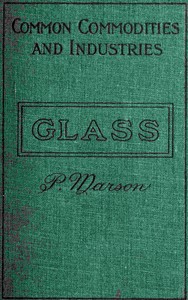
Percival Marson's 1918 industrial manual details glassmaking from raw materials to finished products, with a focus on wartime production challenges and the practical realities of furnace work.
Editorial Edition Score
4.8/5
★★★★★
★★★★★
Calculated from edition completeness, EPUB availability, text structure and catalogue metadata. Not a user rating.
How this score is calculated
- Description quality20 pts
- Title & short description10 pts
- Source metadata20 pts
- Text length15 pts
- Chapters / structure15 pts
- EPUB file integrity20 pts
Total of 100 points, scaled to a 2.5-5.0 range. Editions with an empty description or a missing EPUB file are not scored.
Edition quality
Read the Text
n for a long time before this as a centre for the mines producing , and eventually this clay was adopted for making glass-house pots; now many other sources are available for these fire-clays. Much of the antiquity of the glassmaking of England is hidden in the neighbourhood of Stourbridge, and the writer has himself found a few antique specimens of old green devitrified window glass embedded in the subsoil of some fields near Oldswinford, probably relics of the Huguenots, who practised and extended the art of glassmaking in that district. Other important centres for glassmaking now are York, London, Manchester, Edinburgh, Newcastle, and Birmingham; but, although glassmaking has reached a high degree of excellence in this country, there is nothing yet comparable with the extensive factories which exist abroad. The conservatism of many English manufacturers, and the adverse influence of the Glass Makers’ Society, considerably restrict the progress of this trade compared with the broad and progressive manner in which it is carried on abroad.[1]
_See_ article “Trade Unionism,” in last chapter.
------------------------------------------------------------------------
THE CHEMISTRY OF GLASS-MAKING AND THE MATERIALS USED
The term “glass,” in a general sense, is applied to the hard, brittle, non-crystalline, transparent, opaque or translucent vitreous substance which results from fusing silica with active mineral solvents or fluxes, such as the alkalies, earthy bases, or metallic oxides. Silica exists in great abundance, in a free natural state, in the form of flints, quartz, and sand; and in the latter form it is now most generally used for glassmaking. When sand alkali and lead oxide are heated together to a high temperature, the sand is dissolved by the solvent action of the fused alkali and lead oxide until the whole becomes a molten mass of glass. The solvent action of the alkalies, soda potash or lead oxide, is very energetic whilst being heated, and the mass boils with evolution of gases until, at last, the solution, becoming complete, settles down to a clear quiescent molten liquid metal, which is quite soft and malleable, after the nature of treacle. In this condition it is ready for working. The time and temperature necessary for melting such mixtures vary according to the proportions and composition of the ingredients.
=Silica=, combined with alumina and other oxides, is freely distributed in nature in the form of clays, granites, and feldspars, which are also available for use in glassmaking. Originally glass was made by using crushed and ground flint stones as the source for the silica: hence is derived the old name of “flint” glass; but now the large extensive deposits of white sand present a much more convenient and less expensive source, and sand has become universally used. Fine white sand is obtained from Fontainebleau, near Paris; other sources are Lippe, Lynn, Aylesbury, Isle of Wight, Holland, and Belgium.[2] These are the sources preferred by crystal glass manufacturers and makers of fine quality glass, such as chemical ware pressed glass, tube, cane, and medical bottles, on account of their greater purity. The commoner varieties of sand from Reigate and Bagshot and even red sand are being used in the manufacture of the lower grades of glass such as beer bottles and jam jars, where a greater latitude in the chemical impurities present is permissible. Only the best and purest silica sands are used for making cut crystal and optical glasses. In these trades the sand is always cleaned by washing it in water to clear it from any salt, chalk, or other impurities which may possibly be present. The sand, after washing, is heated to redness, or “burnt,” in order to burn off any organic or vegetable matter, and when cold it is sifted through a fine screen to take out any coarse grains or lumps. In this prepared state, the sand is ready for weighing out into the proportions desired for mixing with the other materials, and is stored for use in covered wooden compartments situated in or near the mixing rooms, along with the other materials which may be used in the glass mixtures.
_See_ “British Glass Sands” (Boswell), “British Glassmaking Sands” (Peddle); papers read at the third meeting, Society of Glass Technology, Sheffield, for further information.
The alkalies, potash or soda, or a mixture of both, are commonly used in making glass in the form either of carbonates, sulphates, or nitrates. The soda and potash silicates form very fusible glasses, but they are not permanent, being soluble in water; therefore they cannot be used alone. In making glassware for domestic use, other bases, such as lead oxide, barium, or lime, have to be added to form more insoluble combinations with the silica or sand.
Percival Marson opens his 1918 manual with a striking claim: before August 1914, few people realized how essential glass was to war munitions. This blunt assertion sets the tone for a book that is less a leisurely survey and more a urgent technical briefing. Marson writes as a consultant and medallist in glass manufacture, and his prose reflects a practical, no-nonsense approach. He is quick to point out inefficiencies—such as manufacturers who stubbornly refuse to use better clays—and equally quick to praise innovations like the Scottish manufacturer who averted a wartime crisis. The preface establishes that this is not a neutral textbook but a document shaped by national industrial needs.
A Practical Eye on Raw Materials
Marson devotes considerable attention to the clays used for glasshouse pots, the containers in which glass is melted. He notes that Stourbridge pot-clays are the traditional choice, but he does not hesitate to call many manufacturers “conservative” for refusing to try superior British clays. This is a recurring pattern: Marson respects established practice but is not afraid to criticize it. He describes the making of pot rings and stoppers in precise, step-by-step detail, from rolling a clay ring around a frame to pressing stoppers in plaster molds. The language is direct and instructional: “An indentation is made in the middle, forming a small hole.” There is no romanticism here—only the clear, patient voice of someone who has handled the materials himself.
The Physical Drama of the Furnace
When Marson turns to annealing and setting pots in the furnace, his writing shifts from methodical explanation to something almost cinematic. He describes how all other work in the glass house must cease, as “all hands are required to help in the strenuous and arduous work.” Gangs of men pull down brick walls; others advance with long iron crowbars, “sharpened at the points,” to lever the old pot from the siege. The rhythm of the sentences accelerates, mirroring the urgency of the task. Marson does not merely list steps; he conveys the physical effort and risk involved. The pot, once heated to white heat over a week, must be moved on a three-pronged iron trolley, and any mishap in loading or unloading can cause latent strains that only appear later in the furnace. This section reveals Marson’s respect for the skill and danger of the work.
War, Efficiency, and National Dependence
Throughout the preface and early chapters, Marson ties glassmaking directly to national security. He lists the uses of glass in telescopes, gun sights, microscopes, and laboratory ware for testing high explosives and special steels. He warns that “if defective glasses were supplied there would be a great loss in our industrial efficiency.” The war context is not an afterthought; it is the lens through which Marson evaluates the industry. He credits Professor Herbert Jackson and the Institute of Chemistry for providing formulas for special glasses, and notes that government recognition followed. Yet Marson’s tone remains pragmatic rather than patriotic. He is more interested in the technical problem—how to make the right glass—than in rhetoric. This focus on practical outcomes gives the book a distinctive, no-frills voice that sets it apart from more general industrial histories.
Marson’s manual rewards readers who attend to its shifts in pace: from the measured, almost bureaucratic catalog of raw materials to the vivid, almost breathless account of furnace work. The book is best approached as a technical document with a strong authorial presence—one that is willing to name inefficiencies and to celebrate ingenuity, all while keeping the war effort firmly in view. Readers interested in the intersection of craft, industry, and national crisis will find much to study in Marson’s direct, unadorned prose.
Reading about the slow breathing of a glass furnace reminded me of my grandfather’s workshop, where sand and heat became something fragile and whole. That patient craft felt familiar when I later turned pages ofOcean Steam Navigation and the Ocean Post — Story, Setting & Ideas, tracing how saltwater and coal carried letters across distance. Both books hum with the same quiet dignity of making things move, endure, arrive.
There are no reviews for this eBook.
There are no comments for this eBook.
Reader reflection
Take a moment to reflect on this book
Create a short personal record of your experience with this book.
Your progress
0
/
10
2
How did the book work for you overall?
3
Is this a title you would suggest to others?
4
How much effort did this book require?
5
What was its emotional impact?
6
How distinctive were its ideas or approach?
7
How well did it match your expectations?
8
Which part made the strongest impression?
9
What is the main idea you are taking away?
10