1

LRL Accelerators, The 184-Inch Synchrocyclotron — Text and Context
(0 User reviews)
1628
Project Gutenberg
2010
Not confirmed
Cyclotrons; Particle Accelerators
Readers of public-domain and historical texts
Project Gutenberg digital edition
en
Edition facts
Words
7,344
Reading time
32 min
Text sections
2
The source record for LRL Accelerators, The 184-Inch Synchrocyclotron — Text and Context measures this digital text at 7,344 words, 32 min estimated reading time, and 2 detected text sections.
The text analysis averages about 18.0 words per sentence, while the detected sections provide another way to judge how the source is divided.
Project Gutenberg metadata also associates the work with “Cyclotrons,” connecting these edition facts with the source record’s subject description.
Source:
Project Gutenberg record #33397
This editorial note examines the Lawrence Radiation Laboratory's 1960 pamphlet on the 184-inch synchrocyclotron, focusing on its precise technical diction, explanatory structure, and the interplay between historical narrative and pedagogical clarity in describing a major scientific instrument.
Editorial Edition Score
4.5/5
★★★★★
★★★★★
Calculated from edition completeness, EPUB availability, text structure and catalogue metadata. Not a user rating.
How this score is calculated
- Description quality20 pts
- Title & short description10 pts
- Source metadata20 pts
- Text length15 pts
- Chapters / structure15 pts
- EPUB file integrity20 pts
Total of 100 points, scaled to a 2.5-5.0 range. Editions with an empty description or a missing EPUB file are not scored.
Edition quality
Read the Text
Produced by Erica Pfister-Altschul, Mark C. Orton, and the Online Distributed Proofreading Team at http://www.pgdp.net
THE 184-INCH SYNCHROCYCLOTRON
LAWRENCE RADIATION LABORATORY
UNIVERSITY OF CALIFORNIA, BERKELEY, CALIFORNIA
THE 184-INCH SYNCHROCYCLOTRON 2
PRINCIPLE OF OPERATION OF A CONVENTIONAL CYCLOTRON 3
THE PRINCIPLE OF PHASE STABILITY 6
DESIGN AND CONSTRUCTION OF THE 184-INCH SYNCHROCYCLOTRON 8
Radiofrequency System 10
Internal Targets and Beam Extractor 12
CYCLOTRON EXPERIMENTS 15
THE 184-INCH SYNCHROCYCLOTRON
His success with the 60-inch cyclotron in 1939 led Dr. E. O. Lawrence to propose a much more powerful accelerator, one which could produce new types of nuclear rearrangements and even create particles. Grants totaling $1,225,000 permitted work to start on the 184-inch cyclotron in August 1940.[1] It was designed to accelerate atomic particles to an energy of 100 million electron volts (Mev), five times that possible with the 60-inch machine.
Before the new cyclotron could be finished World War II began. Construction on the cyclotron was therefore halted. However, because of interest in separating the isotopes of uranium by the electromagnetic method, work on the giant magnet continued at an even faster pace. This magnet would contain 3700 tons of steel in its yoke and pole pieces, and 300 tons of copper in its exciting coils (Fig. 1). By May 1942 the magnet was completed. During that summer it was used in a pilot plant to separate the first significant amounts of U^{235} ever obtained. The 184-inch magnet remained in use in a research and development program at Berkeley until the end of the war, supplying information to Oak Ridge, Tennessee, where a large separation plant had been erected.
Construction on the rest of the cyclotron was resumed in 1945. By that time a new principle had been discovered which made it possible to obtain ion beams of much higher energy than originally hoped for. Yet a considerably lower accelerating voltage could be used. This important discovery was made independently by Dr. V. Veksler in Russia and by Dr. Edwin M. McMillan, present Director of the Lawrence Radiation Laboratory. Before attempting to discuss this principle, we should first review the operation of a conventional cyclotron.
PRINCIPLE OF OPERATION OF A CONVENTIONAL CYCLOTRON
The main parts of a cyclotron are represented in Fig. 2. Charged particles (ions) are accelerated inside an evacuated tank. This is to prevent the beam from colliding with air molecules and being scattered. The vacuum tank is placed between the poles of an electromagnet, whose field bends the ion beam into a circular orbit.
The operation begins when the ions are introduced into the region between two accelerating electrodes, or "dees."[2] Because the ions carry a positive electric charge, they are attracted toward that dee which is electrically negative at the moment. Were it not for the magnetic field, the ions would be accelerated in a straight line; instead they are deflected into a circular path back toward the dee gap. By the time the ions again reach the dee gap, the sign of the electric potential on the dees is reversed, so that now the ions are attracted toward the opposite dee.
As this process of alternating the electric potential is repeated, the ions gain speed and energy with each revolution. This causes them to spiral outward. Finally they strike a target inserted into their path or are extracted from the cyclotron for use as an external beam.
The time required for an ion to complete one loop remains constant as it spirals outward. This is because its velocity increases sufficiently to make up for the increased distance it travels during each turn. This means that the electric potential applied to the dees must alternate at a constant frequency, called the "resonant frequency."
The resonant frequency f is given by the relationship
He f = --------- , (1) 2[pi]mc
where H, e, [pi], c, and m are constants. H is the strength of the magnetic field of the cyclotron, e is the electric charge carried by the ion, [pi] equals 3.14, c is a conversion factor, and m is the mass of the ion. For example, the resonant frequency for protons accelerated in a 15,000-gauss magnetic field is 23.7 megacycles (Mc).[3] We call such a rapidly alternating potential a "radiofrequency voltage" and the electronic circuit for producing it a "radiofrequency oscillator."
The energy E of an ion emerging from the cyclotron is given by
H^2 R^2 e^2 E = ------- ---- , (2) 2 mc^2
where H, e, and m are as defined above, and R is the radius at which the beam is extracted. From this equation we see that for a given type of ion (where e and m are constant), the energy depends on the diameter and strength of the magnet, but not directly upon the voltage applied to the dees.
The 184-inch synchrocyclotron pamphlet opens with a terse historical note: a $1,225,000 grant from the Rockefeller Foundation, the John and Mary Markle Foundation, and the Research Corporation, plus a University of California guarantee, funded construction starting in August 1940. The prose is economical, stating that the machine was “designed to accelerate atomic particles to an energy of 100 million electron volts (Mev), five times that possible with the 60-inch machine.” This direct comparison establishes scale without hyperbole. The text then pivots to wartime interruption, noting that the magnet—3700 tons of steel and 300 tons of copper—was repurposed for uranium isotope separation. The authorial voice remains factual, letting the numbers convey the engineering ambition.
Diction of Precision and Scale
The pamphlet consistently uses exact figures and technical terms to build credibility. For instance, the magnet’s composition is given as “3700 tons of steel in its yoke and pole pieces, and 300 tons of copper in its exciting coils.” The phrase “exciting coils” is a precise electrical engineering term, not a colloquialism. Similarly, the text specifies that the cyclotron’s frequency is calculated as “f = 23.7 Mc” using given values of magnetic field, charge, and mass. This inclusion of a worked formula—complete with units in gauss, electrostatic units, and grams—demonstrates a pedagogical intent: the reader is shown how the numbers arise, not just told the result. The authors avoid vague descriptors like “very large” or “extremely powerful,” instead anchoring every claim in measurable quantities.
Explanatory Structure and Reader Guidance
The pamphlet is organized as a guided tour from principle to practice. It begins with the historical impetus, then reviews “the operation of a conventional cyclotron” before introducing the “principle of phase stability” discovered by Veksler and McMillan. This sequence assumes the reader needs foundational knowledge first. Diagrams are referenced (e.g., “Fig. 2. Basic parts of a cyclotron”) and described in the text: “Charged particles (ions) are accelerated inside an evacuated tank. This is to prevent the beam from colliding with air molecules and being scattered.” The cause-effect logic is explicit. Later, when discussing nuclear chemistry, the text explains that “chemistry targets are usually inserted right into the cyclotron so that they can be bombarded directly by the circulating beam.” Each step is justified, making the technical process accessible without oversimplification.
Voice of Institutional Authority
The pamphlet’s authorial voice is that of the Lawrence Radiation Laboratory itself—impersonal, authoritative, and collective. Sentences often begin with “The operation begins when” or “One of the important investigational programs is concerned with,” avoiding first-person pronouns. This creates a tone of institutional consensus. When describing discoveries, the text credits individuals but frames them as part of a larger endeavor: “This important discovery was made independently by Dr. V. Veksler in Russia and by Dr. Edwin M. McMillan, present Director of the Lawrence Radiation Laboratory.” The mention of McMillan’s current title reinforces the laboratory’s ongoing prestige. The bibliography lists internal reports (e.g., “UCRL-8050”) and staff-authored articles, further cementing the sense of a self-contained research community speaking to an interested public.
Recurring Details of Engineering and Application
Throughout the pamphlet, specific engineering details recur, linking design choices to experimental outcomes. For example, the vacuum system is described as essential because “the beam from colliding with air molecules and being scattered.” Later, the beam extraction system is mentioned but not detailed, hinting at the complexity behind simple statements. The appendix provides a “Summary of Specifications” with percentages of research time (86% nuclear physics, 12% biophysics, 2% nuclear chemistry) and performance metrics like “Maximum energy (Mev) 730” for protons. These numbers are not just data; they reflect the machine’s actual use. The text also notes that “the π0 meson was discovered with this cyclotron in 1950,” a concrete achievement that grounds the technical description in real scientific payoff.
Readers approaching this pamphlet should attend to how its authors balance historical narrative with technical exposition. The text is not merely a description of a machine but a document of a particular moment in mid-century physics, where large-scale instrumentation required clear communication to justify funding and guide future users. The precise diction, structured pedagogy, and institutional voice all serve to make the 184-inch synchrocyclotron comprehensible without diminishing its complexity. This editorial note has highlighted those authorial choices; the pamphlet itself rewards careful reading of its numbers, diagrams, and footnotes.
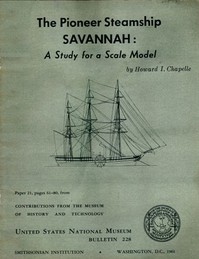
Flipping through this synchrocyclotron pamphlet, I remembered my father’s old engineering manuals—precise, unadorned, quietly proud of their machinery. The same feeling returned with The Pioneer Steamship Savannah: A Study for a Scale Model United States National Museum Bulletin 228, 1961, pages 61-80 — A Closer Reading; both documents treat a complex artifact with such gentle, methodical reverence. That patience feels like a lost language now, one I’m glad to overhear again.
There are no reviews for this eBook.
There are no comments for this eBook.
Reader reflection
Before you leave, reflect on the book
Use these questions to collect your thoughts before moving on.
Your progress
0
/
10
2
Was reading this book enjoyable?
3
Is this a title you would suggest to others?
4
How easy was the book to follow?
5
Did anything about the book feel genuinely new?
6
How closely did the book connect with your experience?
7
How valuable was this book for your own interests?
8
Is this a title worth rereading?
9
What changed or sharpened your thinking?
10