1

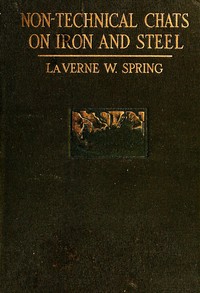
Non-technical chats on iron and steel, and their application to modern industry — Context and Discussion
(0 User reviews)
259
Project Gutenberg
2024
Not confirmed
Steel; Iron
Readers of public-domain and historical texts
Project Gutenberg digital edition
en
Edition facts
Words
78,211
Reading time
341 min
Text sections
29
The catalog record for Non-technical chats on iron and steel, and their application to modern industry — Context and Discussion provides practical reading context through 78,211 words, 5 hr 41 min estimated reading time, and 29 detected text sections.
The text analysis averages about 22.7 words per sentence, while the detected sections provide another way to judge how the source is divided.
Project Gutenberg metadata also associates the work with “Steel,” connecting these edition facts with the source record’s subject description.
Source:
Project Gutenberg record #73090
A 1917 industrial primer that uses conversational chapters, recurring metaphors of growth and family, and a movement from raw ore to finished products to explain iron and steel manufacture without technical jargon.
Editorial Edition Score
4.9/5
★★★★★
★★★★★
Calculated from edition completeness, EPUB availability, text structure and catalogue metadata. Not a user rating.
How this score is calculated
- Description quality20 pts
- Title & short description10 pts
- Source metadata20 pts
- Text length15 pts
- Chapters / structure15 pts
- EPUB file integrity20 pts
Total of 100 points, scaled to a 2.5-5.0 range. Editions with an empty description or a missing EPUB file are not scored.
Edition quality
Read the Text
the metallic form and not in combination with other elements as an earth or ore. As the centuries rolled on, man eventually learned that this soft red metal could be pounded into thin-edged implements and that it made more useful tools than those of stone, which his ancestors had taught him to form. Some of these metal implements were hard and had fairly good cutting edges, made so by accidental or intentional presence of tin, and little did he dream that the twentieth century upon finding his buried bronze implements would think his crude alloy so wonderful and talk reverently of a “lost art of tempering copper.”
Gold, too, became known to him because it also occurs “native.” Its melting point was low enough that he could fashion it into ornaments, idols, and other articles for religious purposes. But during the hundreds of centuries of the “Stone Age” and during much of this—the “Bronze Age”—copper, bronze, and gold were the only metals used. Though the smiths became very dextrous in casting and modeling these metals, they yet knew not iron or steel.
Round about them during these many centuries, as multi-colored earths or rocks, were the ores of various metals. They little dreamed that when rightly treated certain of the heavy red, yellow, or black earths which lay right at their doors could give up that most useful metal, iron. No one even had knowledge of such a substance, for, unlike copper and gold, iron never occurs “free,” having too great a tendency to chemically combine with other elements, for example, oxygen of the air, with which, in moist climates, it so readily forms “iron rust.” Besides, its melting point is high and so much heat and carbon are needed for its “reduction” from the ore that, during the thousands of years that had gone before, it had never been produced.
But one day by accident and under fortunate coincidence of rich ore, high heat, and plenty of carbon in the form of charcoal from the wood, a lump of metallic iron was formed underneath a pile of logs which had got afire and burned fiercely because of a high wind. When pounded between two stones this new heavy metal, too, was malleable and could be formed into a spearhead superior to anything yet known. Every one was interested and an observant one soon “doped out” that certain earths could be made to yield this new metal, iron.
The art of extracting it spread slowly, each artisan learning from his neighbor, and, as rich ores were plentiful in many districts, iron became more and more generally produced. Not only in one country was this so but evidence shows that in many others—in Egypt, Chaldea, Borneo, India, China, etc.,—roughly similar processes and crude furnaces came to be used.
Tubal-Cain, supposedly about 4000 years B.C., is mentioned in the Bible as an “artificer in iron and brass,” and a wedge of wrought iron was buried in the great pyramid of Cheops probably as early as 3500 B.C. This wedge was recently found and is now the property of the British Museum. The Chinese made use of iron many centuries before the Christian era, but the Assyrians are supposed to have been the first to use the metal on a really extensive scale.
The much discussed pillar at Delhi, India, which is still standing in a remarkable state of preservation, is twenty-two feet high. It is made up of several wrought iron sections cleverly welded together. As the natives regard it with religious awe, metallurgists have been unable to make thorough investigation and chemical analysis. While the date of its erection is somewhat in doubt, it is supposed to have been about the 4th or 5th century A.D.
But from our modern viewpoint those early iron furnaces were queer things. The first were little more than piles of ore and wood or charcoal on the tops of hills where a brisk wind would make a hot fire. Later, with the invention of the crudest of bellows, the smelting was done in small holes in the side of banks of clay, charcoal made from the forest trees being used as fuel. Indeed, some of these types of furnaces still exist and are so operated to-day in neglected districts in Western India and elsewhere, producing their little five to 100 pound balls of iron after several hours of tedious work.
Spring opens not with a furnace roar but with a confession: he wrote these chapters during his spare time, first for a company magazine, because he believed the story of iron could fascinate anyone. The book’s structure mirrors a factory tour—starting with ore and fuel, moving through blast furnaces and converters, then into foundries and rolling mills. Each chapter is a self-contained “chat,” yet together they trace a deliberate arc from raw material to finished product. Spring repeatedly warns that he is simplifying, leaving out exceptions, and that the book is “only a sort of outline.” This candor shapes the reader’s experience: we are invited to see the big picture, not to master every detail.
A Family Tree of Iron
Spring organizes his subject by drawing a family metaphor. Pig iron, wrought iron, cast iron, and steel are not separate substances but relatives, each with a distinct personality. He notes that the terminology itself grew haphazardly: “Like ‘Topsy’ of ‘Uncle Tom’s Cabin’ fame, the various members of the iron family ‘just growed.’” This image recurs—the iron family “just growed”—to explain why classification is messy. For instance, “malleable iron” once meant wrought iron in Europe, while in America it came to mean a heat-treated cast iron. Spring uses these historical tangles to show that the names we use are products of accident and custom, not logic. He traces the lineage: pig iron is the crude parent; wrought iron is the tough, fibrous ancestor; steel is the versatile modern descendant. Each chapter adds a branch to the tree, and the reader begins to see how one material transforms into another through heat, carbon, and mechanical work.
The Journey from Ore to Ingot
The book’s movement is geographical as well as conceptual. Spring takes the reader from the mine to the blast furnace, then to the Bessemer converter or open-hearth furnace, and finally to the rolling mill. He describes the physical layout of a typical plant: the stock house, the casting pit, the soaking pits. The reader is led past each station in sequence. In the chapter on molding, Spring explains how patterns are pressed into sand, how flasks are closed, and how molten iron is poured—and then he notes that for small castings, a single mold may contain “ten or twenty, and, occasionally, as many as two hundred pieces.” This attention to scale and repetition gives the reader a sense of the industry’s rhythm. The journey is not just a list of steps; it is a guided walk through a working landscape, where each stage has its own sounds, temperatures, and skilled workers.
Recurring Images: Heat, Chill, and Fracture
Spring returns again and again to three sensory details: the color of a fracture, the depth of a chill, and the appearance of a test sprue. These are not abstract concepts; they are visible, tangible signs that a foundryman reads like a doctor reads a pulse. In the chapter on malleable cast iron, Spring describes “test sprues, showing white, slightly mottled, medium mottled, and gray fractures.” He explains that the composition of the melt is “regulated according to the depth of the chill as well as by appearance of test sprues.” The reader learns to see iron through a metallurgist’s eyes: white iron is brittle, gray iron is soft, mottled iron is in between. These recurring images of fractured surfaces and chilled edges become a visual shorthand. Spring uses them to connect the abstract chemistry of carbon content to the concrete practice of the foundry floor. The book’s many diagrams and photographs reinforce this habit of looking closely at broken metal.
The Chatty Voice and Its Limits
Spring’s tone is deliberately informal. He addresses the reader directly, uses contractions, and occasionally jokes. He calls the Bessemer process “immense” and Reaumur’s decision to publish his research “a notable exception to the customs of those days.” But this friendliness has a purpose: it lowers the barrier for readers who might be intimidated by technical subjects. At the same time, Spring is careful to mark the boundaries of his knowledge. He admits that some statements are “not strictly accurate” because he has omitted details and exceptions. He warns that the book is “in no way intended to be an encyclopedia.” This honesty is part of the chatty contract: the author is a guide, not an oracle. The reader is trusted to understand that simplification is a teaching tool, not a deception. The result is a book that feels like a conversation with an experienced engineer who is eager to share what he loves, but who also knows when to stop.
Spring’s chats work best when read as a sequence, not as a reference. The recurring images—fractures, chills, molds, and furnaces—build a mental picture of an industry that is both ancient and modern. Readers who want to understand the logic behind the processes should follow the order of chapters, from raw materials to finished products. Those who prefer to dip into a single topic will find each chat self-contained, but they will miss the cumulative effect of seeing how iron and steel are made from the ground up.
That rainy afternoon, I kept returning to how the book described ore as something quiet, waiting for the fire to wake its true nature. It felt like patience, not transformation. Later, the same mood drifted me toward a different kind of metal story—Motorcycle, Solo (Harley-Davidson Model WLA) — Story, Setting & Ideas—a machine built for roads alone, carrying the same patient weight.
There are no reviews for this eBook.
There are no comments for this eBook.
Reader reflection
Take a moment to reflect on this book
Create a short personal record of your experience with this book.
Your progress
0
/
10
2
What was your overall reaction to the book?
3
Would you encourage someone else to read it?
4
How much effort did this book require?
5
What did you appreciate most?
6
Could you see yourself revisiting this book?
7
How clear did the writing feel?
8
What did you think about the pace?
9
What changed or sharpened your thinking?
10