1

Oxy-acetylene welding manual — A Closer Reading
(0 User reviews)
1521
Project Gutenberg
2024
Not confirmed
Welding
Readers of public-domain and historical texts
Project Gutenberg digital edition
en
Edition facts
Words
45,846
Reading time
200 min
Text sections
21
For Oxy-acetylene welding manual — A Closer Reading, the stored edition analysis reports 45,846 words, 3 hr 20 min estimated reading time, and 21 detected text sections.
The text analysis averages about 21.8 words per sentence, while the detected sections provide another way to judge how the source is divided.
Project Gutenberg metadata also associates the work with “Welding,” connecting these edition facts with the source record’s subject description.
Source:
Project Gutenberg record #74867
A 1919 school manual for oxy-acetylene welding, written by an Army officer to standardize instruction. The text shifts from a preface arguing for systematic teaching to precise shop procedures, with attention to filler-rod handling, flue repair, and the behavior of molten steel.
Editorial Edition Score
4.9/5
★★★★★
★★★★★
Calculated from edition completeness, EPUB availability, text structure and catalogue metadata. Not a user rating.
How this score is calculated
- Description quality20 pts
- Title & short description10 pts
- Source metadata20 pts
- Text length15 pts
- Chapters / structure15 pts
- EPUB file integrity20 pts
Total of 100 points, scaled to a 2.5-5.0 range. Editions with an empty description or a missing EPUB file are not scored.
Edition quality
Read the Text
Italics, bold face and small capitals in the source document have been transcribed _between underscores_, =between equal signs= and as ALL CAPITALS, respectively.
More Transcriber’s Notes and an overview of changes made may be found at the end of this text.
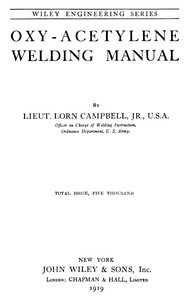
WILEY ENGINEERING SERIES
OXY-ACETYLENE WELDING MANUAL
LIEUT. LORN CAMPBELL, JR., U.S.A. _Officer in Charge of Welding Instruction, Ordnance Department, U. S. Army._
TOTAL ISSUE, FIVE THOUSAND
NEW YORK JOHN WILEY & SONS, Inc. LONDON: CHAPMAN & HALL, LIMITED 1919
Copyright, 1919 BY LORN CAMPBELL
_Copyrighted in Great Britain_
PRESS OF BRAUNWORTH & CO. BOOK MANUFACTURERS BROOKLYN, N. Y.
(=1=) The oxy-acetylene method of welding and cutting metals has of late been receiving considerable attention. Its tremendous power of creating, repairing and destroying the work of man has been but recently recognized in its broadest sense, and the demand for operators, skilled in the manipulation of this apparatus, which always has been far in excess of the supply, now knows no limit. Many authorities have set forth their views and theories upon this subject, in America and also in foreign countries. These have been published from time to time in many of the leading periodicals and magazines, as well as in book form. It seems the purpose of most of these works has been to advance the operators who already have a smattering knowledge of this art, or to present to the purchaser of apparatus a set of operating instructions.
(=2=) It is singular indeed that a school manual, devoted exclusively to the instruction of the beginner, which will serve as an aid to the instructor as well as to the student, has not yet been put forth. It cannot be said that there is not a demand for such. Recently there seems to have been a mushroom growth of welding classes. The majority of the vocational schools, colleges, night schools, and automobile schools have all entered the instruction in oxy-acetylene welding on their rolls and each is attempting to instruct in an entirely different manner from the other. There can be no question as to the expediency of affording the educational institutions a systematic as well as a standardized method of instructing. But the books and articles of the nature mentioned are not suited to this purpose, and were not designed for it. A school-book is wanted; something to be used in the classroom, to be employed as a reference in the shop practice, to be studied for what it contains, and to indicate further lines of research, where such are required.
(=3=) To meet this demand, the present “Manual” has been written to serve the instructor as well as the student. In its preparation many books, both well-known and obscure, have been examined and the methods of shop instruction have been carefully studied by the author.
(=4=) It has been found that regardless of how fast the ground may be covered in the lecture room, the average student’s power of assimilation is limited and considerable time has been spent in determining this ratio and applying it between the lecture subjects and shop work.
(=5=) It must be remembered that while the chapters comprising the theoretical part of this welding manual follow in the order given, the actual shop practice, as previously mentioned, is the most important.
(=6=) Kindly aid has been received from many sources. Granjon & Rosemberg, Kautney, M. Keith Dunham, S. W. Miller, Henry Cave, C. J. Nyquist, P. F. Willis, Ben K. Smith, and others have embodied in their writings many excellent ideas, which have assisted the author in bringing out certain points advantageously. The following manufacturers are to be given credit for many of the illustrations:
The Oxweld Acetylene Co., Newark, N. J. The United States Welding Co., Minneapolis, Minn. The Bastian Blessing Co., Chicago, Ill. The Linde Air Products Co., New York City. The General Welding & Equipment Co., Boston, Mass. The Messer Manufacturing Co., Philadelphia, Pa. The Alexander Milburn Co., Baltimore, Maryland. The Torchweld Equipment Co., Chicago, Ill. The Davis-Bournonville Co., Jersey City, N. J. The K. G. Welding Co., New York City. The Chicago Eye Shield Co., Chicago, Ill. The Commercial Acetylene Supply Co., New York City. The Welding Engineer, Chicago, Ill. The Journal of Acetylene Welding, Chicago, Ill.
NOTE.--Lieut. Campbell offers his services without charge to anyone interested in this method of welding and may be addressed care of JOHN WILEY & SONS, INC., Publishers, 432 Fourth Avenue, New York City.
WILEY ENGINEERING SERIES
The Wiley Engineering Series will embrace books devoted to single subjects. The object of the Series is to place in the hands of the reader all the essential information regarding the particular subject in which he may be interested. Extraneous topics are excluded, and the contents of each book are confined to the field indicated by its title.
The preface of this 1919 manual immediately establishes a pedagogical mission: the author, an Army officer in charge of welding instruction, argues that existing books either advance semi-skilled operators or serve as apparatus instructions, leaving a gap for a true school manual. He notes a “mushroom growth of welding classes” and calls for a “systematic as well as a standardized method of instructing.” This framing shapes the entire work, which moves from general principles to detailed shop procedures.
The voice is direct and practical, often addressing the welder as “you” in later sections. The manual’s structure reflects its classroom intent: it progresses from equipment setup through techniques for cast iron, steel, and pipe, with frequent references to jigs, preheating, and filler-rod angles.
A School Manual’s Rationale
The opening pages reveal a deliberate rhetorical strategy. Campbell positions his manual as a response to a perceived lack: “It is singular indeed that a school manual, devoted exclusively to the instruction of the beginner, has not yet been put forth.” He criticizes the diversity of teaching methods across vocational schools, colleges, and night schools, asserting that existing books “were not designed for” classroom use. The preface thus serves as both justification and advertisement, emphasizing that the manual is “to be used in the classroom, to be employed as a reference in the shop practice.” This argumentative tone is unusual for a technical manual and suggests the author was advocating for standardization within a rapidly expanding field.
Voice and Instructional Detail
Once past the preface, the prose becomes terse and procedural. In the steel-welding section, Campbell writes: “When steel is in a melted condition, it seems to be in a very susceptible state. It appears to absorb gases.” The hedging (“seems,” “appears”) is rare; most instructions are blunt: “it is advisable to execute steel welds just as rapidly as possible.” The manual includes specific shop techniques, such as heating a filler-rod six or eight inches from the end and bending it to 90 degrees, or welding cast-iron rods into a T shape because “cast iron will not bend.” These details reflect a writer who has observed welders at work and codified their methods.
Pacing and Practical Sequences
The manual’s pacing shifts from broad principles to step-by-step operations. A notable example is the boiler flue retipping procedure: “Cut off the poor end until solid metal is reached, with a pipe cutter, which will tend to ‘V’ the work as it cuts and at the same time will squeeze the edge of the pipe in.” The description then follows the flue through flattening, placement in V-blocks, tacking, and continuous welding with a helper turning the piece. This granularity—including warnings about metal running inside the pipe and the option to grind down excess metal—demonstrates the manual’s commitment to replicable shop practice. The author assumes the reader has access to anvils, grinders, and angle-iron troughs, grounding the text in a real workshop environment.
Readers should approach this manual as a period artifact of industrial education. Its value lies not only in the welding techniques—some obsolete, others still current—but in its attempt to impose order on a craft in flux. The author’s voice, at once authoritative and pedagogical, reveals the assumptions of early 20th-century technical training: that skill can be systematized, that the beginner needs a single reliable text, and that the instructor’s role is to mediate between the book and the bench.
The rain kept me indoors, and that Army officer’s manual on oxy-acetylene welding held me longer than expected—not for the flames, but for his quiet insistence on precision. Filler rods and molten pools felt almost meditative. Afterwards, my hand drifted to a slimmer volume, Measuring Tools — Key Ideas to Explore, and I understood: measuring is just another way of paying close attention.
There are no reviews for this eBook.
There are no comments for this eBook.
Reader reflection
Take a moment to reflect on this book
Create a short personal record of your experience with this book.
Your progress
0
/
10
2
Was reading this book enjoyable?
3
Would you recommend this book to another reader?
4
How much effort did this book require?
5
Did the book deliver what you hoped for?
6
Would you like to discuss this book with someone?
7
How distinctive were its ideas or approach?
8
Which aspect of the book did you value most?
9
What did this book teach you most?
10