1

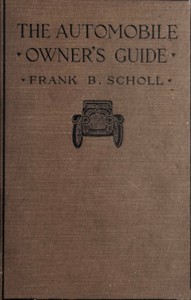
The automobile owner's guide — Inside the Classic
(0 User reviews)
223
Project Gutenberg
2022
Not confirmed
Automobiles; Automobiles -- Handbooks, manuals, etc.
Readers of public-domain and historical texts
Project Gutenberg digital edition
en
Edition facts
Words
89,015
Reading time
388 min
Text sections
66
The catalog record for The automobile owner's guide — Inside the Classic provides practical reading context through 89,015 words, 6 hr 28 min estimated reading time, and 66 detected text sections.
The text analysis averages about 20.6 words per sentence, while the detected sections provide another way to judge how the source is divided.
Project Gutenberg metadata also associates the work with “Automobiles,” connecting these edition facts with the source record’s subject description.
Source:
Project Gutenberg record #69375
Frank B. Scholl's 1920 guide for automobile owners avoids technical jargon, using simple language and diagrams to explain care, repair, and troubleshooting. The book's structure moves from general operation to specific systems, with a notable three-column trouble chart and recurring emphasis on practical, owner-level maintenance.
Editorial Edition Score
4.9/5
★★★★★
★★★★★
Calculated from edition completeness, EPUB availability, text structure and catalogue metadata. Not a user rating.
How this score is calculated
- Description quality20 pts
- Title & short description10 pts
- Source metadata20 pts
- Text length15 pts
- Chapters / structure15 pts
- EPUB file integrity20 pts
Total of 100 points, scaled to a 2.5-5.0 range. Editions with an empty description or a missing EPUB file are not scored.
Edition quality
Read the Text
GASOLINE ENGINE CONSTRUCTION, AND PARTS 12
The engine block castings, cylinders, pistons, connecting rods, bearings, crank shaft, cam shaft and fly-wheel.
VALVE CONSTRUCTION AND OPERATION 21
Valve construction. Types and operation of the valves in an 8-cylinder V-type engine. Valve locations and valve grinding. Valve care.
THE OPERATION OF A 4-CYCLE 4-CYLINDERED GASOLINE ENGINE 29
Explaining the cycle. The 4-, 6-, 8-, 12-cylindered engine -- The Knight sleeve valve engine -- S. A. E. Horse Power Scale -- Displacement-Engine charts -- Lubrication oils and greases -- Lubrication systems -- Care -- Cleaning -- and adjusting of lubrication systems.
BRIEF TREATISE ON CARBURETION 45
The Stromberg plain tube Model M carburetor. Principle of action -- Installation -- Adjustment and maintenance -- Stromberg Model L adjustment.
NITRO SUNDERMAN CARBURETOR 60
Principle of action, action of venturi, adjustment and general care.
The Schebler Model R carburetor, action and adjustment points.
STEWART CARBURETOR 65
Principle of operation -- Adjustment and maintenance.
Operating principle -- Adjustment and care.
SCHEBLER PLAIN TUBE CARBURETOR 72
Operation -- Instructions for installing, adjustment and maintenance.
KEROSENE CARBURETORS 76
Operating principle -- Installation and adjustment.
HEATED MANIFOLDS AND HOT SPOTS 79
Action -- Advantage and design.
Purpose of cooling system -- Circulating systems -- The force pump circulating system -- Overheating -- Radiator cleaning -- Freezing -- Freezing solutions -- Radiator repairing -- The air cooling system.
MUFFLER CONSTRUCTION 86
Purpose -- Advantage -- Type -- Assembly and Maintenance.
Operating principle -- Purpose of the air vent -- Failure to feed gasoline to carburetor -- Removing top -- Cleaning gasoline strainer screen -- Operating principle and general maintenance.
ELECTRICAL DICTIONARY OF PARTS, UNITS AND TERMS 95
Voltage -- Amperage -- Ohms -- Current -- Circuit -- Low Tension Current -- High Tension Current -- Induction Coil -- Commutator -- Insulation -- Shunt or choking coil -- Fuse -- Condenser -- Dynamo -- Voltaic cell -- Accumulator -- Storage battery -- Electrolyte -- Hydrometer -- Ammeter -- Circuit breaker -- Switch -- Generator -- Regulator -- Contact-breaker -- Non-vibrating coil -- Distributors.
Parts -- Assemblage -- Operating principle.
BOSCH HIGH TENSION MAGNETO, TYPE ZR 105
Operating principle -- Primary or low tension circuit -- Secondary or high tension circuit -- Timing magneto gears -- Timing magneto with engine -- The condenser -- Safety spark gap -- Interrupter timing range -- Cutting out ignition -- Caution -- Care -- Maintenance.
MAGNETO WASHING, REPAIRING AND TIMING 111
Magneto cleaning -- Magneto repairing -- Magneto assembling -- Magneto timing to engine.
NORTH EAST IGNITION SYSTEM 114
Wiring ignition distributor -- Ignition coil -- Breaker box and distributor head assembly -- Condenser -- Breaker contacts -- Breaker cam -- Distributor head -- Automatic spark advance mechanism -- Manual spark control -- Timing the distributor -- General care.
ATWATER KENT IGNITION SYSTEMS 126
Type CC system -- Operating principle -- Setting or timing -- Adjustment -- Oiling -- General care.
ATWATER KENT BATTERY IGNITION SYSTEM 132
Type K-2-Operating principle -- Operation of contact maker -- Contactless distributor -- Wiring diagram of current flowage -- Setting and timing the unisparker -- Timing with engine -- Automatic spark advance -- Contact point adjustment -- Oiling diagram -- Condenser -- Testing for ignition trouble.
PHILBRIN SINGLE SPARK, AND HIGH FREQUENCY DUPLEX IGNITION SYSTEMS 141
Operation of contact maker -- Current induction -- Duplex system -- Duplex switch -- Duplex switch action -- Wiring diagram -- Adjustment of contact points -- General care.
ELECTRICAL STARTING AND LIGHTING SYSTEMS 147
The generator -- The regulator -- The automatic cut-out -- One unit system -- Two unit system -- Three unit system -- The starting motor -- Lubrication -- Maintenance.
ELECTRIC LIGHTING AND STARTING SYSTEMS 154
Wiring diagram Bijur system -- Operation of Bijur system -- Starting motor -- Operation of starting motor -- Wiring circuits -- Fuse -- Ground fuse -- Lamp controller -- Oiling -- Battery testing -- General care.
NORTH EAST STARTER USED ON DODGE BROTHERS’ CARS 161
Model G starter-generator operation -- Wiring diagram -- Starter-generator action -- Mounting -- Drive -- Charging rate adjustment -- Fuse -- Locating trouble -- Starting switch and reverse current cut-out -- Running with battery disconnected.
THE DELCO ELECTRICAL SYSTEM 167
Motoring the generator -- Cranking the engine -- Generating electrical energy -- Diagram of motor generator operation -- Lubrication -- Ignition switch -- Circuit breaker -- Ignition coil -- Distributor -- Contact breaker and timer -- Care.
Construction -- Chemical action -- Cells -- Electrolyte solution -- Battery charging -- Care and maintenance -- Hydrometer testing -- Battery idle -- Battery freezing -- General care.
SPARK PLUGS AND CARE 186
Type -- Construction -- Connections -- Assembling -- Repairing -- Cleaning -- General care.
CLUTCH CONSTRUCTION, TYPE AND CARE 189
Frank B. Scholl's The Automobile Owner's Guide (1920) opens with a direct claim: only one-third of owners understand their cars. The book is built around that gap. Scholl deliberately strips out technical terms, tables, and scales, aiming the text at “a man or a boy with a common school education.” The result is a manual that moves from general operation to specific systems—engine, ignition, battery—each chapter building on the last. Diagrams are used not for exactness but to clarify points “more readily understood and explained in this manner.” The structure itself is a teaching tool.
A Guide Built for the Non-Mechanic
Scholl states in the preface that his book covers “the entire field that would be of value to the owner or chauffeur in making his own repairs.” The language stays concrete: parts are described by function, not by engineering specifications. For example, the storage battery chapter explains that a battery “does not produce or generate electrical force” but stores current for starting, lighting, and ignition. The text repeatedly anchors new concepts to familiar actions—checking a resistance unit by feeling its heat, adjusting contacts with a gauge on the distributor wrench. This pedagogical structure, moving from what a part does to how to maintain it, reflects Scholl's stated goal of making an efficient mechanic out of a reader with common schooling.
Recurring Images: The Diagram as Explanation
Throughout the excerpts, Scholl refers to figures—Fig. 100 (Delco ignition contact breaker), Fig. 101 (storage battery sectional view)—but he insists these are not to scale. “No attempt has been made to conform to proportionate exactness,” he writes. The illustrations serve as schematic aids, not blueprints. This recurring approach treats the visual as a bridge between text and real engine bay. The reader is expected to look at the diagram, read the description, then apply both to the actual car. The same pattern appears in the ignition chapter: a detailed explanation of timer contacts is followed by a figure reference, then adjustment instructions. The image is never left to stand alone.
Movement Between Systems: From Ignition to Battery
The book's progression is logical but not rigid. Chapter XXVI on the storage battery follows chapters on ignition and generator. Scholl ties them together: the battery supplies current for ignition, and he cross-references topics like “Motoring the Generator” for ignition current requirements. The movement between systems is signaled by repeated phrases like “described under the heading.” This creates a web of references that encourages the reader to flip between sections. The trouble hints chapter, arranged in three columns (troubles, cause, remedy), is the culmination of this cross-referencing—a quick-lookup tool that assumes the reader has absorbed the earlier system-by-system explanations.
Practical Troubleshooting as a Structural Principle
Scholl devotes a chapter to trouble hints, but the troubleshooting mindset appears throughout. In the ignition section, he lists symptoms (missing at low speeds, heating of the resistance unit) and their likely causes (shorted unit, defective condenser). Each diagnosis is followed by a remedy: “should be immediately remedied.” The storage battery chapter similarly warns against operating with the battery removed, linking that condition to rapid contact burning. This pattern—symptom, cause, fix—mirrors the three-column chart. It turns every chapter into a potential diagnostic tool. The book's structure thus mirrors its purpose: not just to explain, but to equip the owner to act when something goes wrong.
Scholl's guide is best read not cover-to-cover but as a reference you return to as specific problems arise. The cross-references between chapters reward a reader who already knows the basics of their car's layout. Keep a notebook handy for your own car's quirks; the book's generalized advice becomes most useful when you map it onto your particular make and model. The three-column trouble chart at the end is a good place to start when something breaks—but only if you've already skimmed the earlier chapters on each system.
There are evenings when I flip through Scholl’s old guide and feel the patient patience of someone who simply wanted things to work—no fuss, just care. That same quiet respect for craft lingers in A Pioneer Railway of the West — A Reader’s Guide, as if both writers believed machines and tracks were only ever poems about steadiness. I found myself smiling at that shared faith.
There are no reviews for this eBook.
There are no comments for this eBook.
Reader reflection
Take a moment to reflect on this book
Create a short personal record of your experience with this book.
Your progress
0
/
10
2
Was reading this book enjoyable?
3
Would you encourage someone else to read it?
4
How demanding did the text feel?
5
Would a second reading be valuable?
6
Did any part of the book stay with you emotionally?
7
Would this book work well in a reading group?
8
Could you follow the author’s main argument?
9
Which lesson or insight stayed with you?
10