
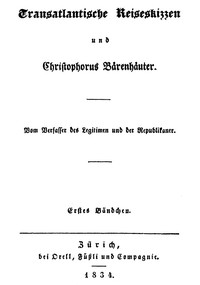
Transatlantische Reiseskizzen und Christopherus Bärenhäuter. Erstes Bändchen.
So, what's this old book actually about? Transatlantische Reiseskizzen (that's 'Transatlantic Travel Sketches') is exactly what it sounds like. It follows the author, writing under the pen name Charles Sealsfield, as he leaves Europe and lands in America. The journey starts with the Atlantic crossing itself—never a pleasant trip in the age of sail—and then dumps him straight into the bustling, multicultural port of New Orleans. From there, he heads north, traveling up the Mississippi and into the frontier heartland, observing everything from bustling cities to isolated homesteads.
The Story
The book isn't a novel with a single plot. It's a series of vivid snapshots. One minute he's describing the chaotic energy of a New Orleans street, the next he's sharing a campfire with a rugged frontiersman, and then he's analyzing American politics with a local intellectual. The 'Christopherus Bärenhäuter' part (which roughly means 'Christopher the Lazybones' or 'Idler') seems to be a character or a persona he uses—maybe a stand-in for himself—as he observes this new world with a mix of awe, criticism, and dry humor. The 'story' is the journey of discovery, both of a new land and of his own changing perspectives.
Why You Should Read It
Here’s the cool part: this isn't a dry history book. Sealsfield has opinions, and he's not afraid to share them. He points out the contradictions he sees—the grand ideals of liberty right next to the harsh reality of slavery, the incredible opportunity alongside brutal hardship. His writing makes you feel the mud, smell the river, and hear the strange mix of languages. You get the sense of America as a work-in-progress, a loud, messy experiment. Reading it now is a fascinating reality check. It reminds us that the things we argue about today—identity, immigration, what it means to be 'American'—have been central to the national conversation since day one. It’s history without the polish.
Final Verdict
This one is perfect for history buffs who are tired of stuffy academic texts, or for anyone who loves great travel writing with a sharp edge. If you enjoyed Mark Twain's keen observations or Bill Bryson's witty social commentary, you'll find a kindred spirit in Sealsfield. It does require a little patience—the language is from another time, and it’s more a collection of scenes than a driving narrative—but the insights you get are worth the effort. Think of it as a long, fascinating conversation with a very well-traveled, slightly cynical, but deeply curious friend from the past.
The copyright for this book has expired, making it public property. Use this text in your own projects freely.
Steven Torres
1 year agoWithout a doubt, the character development leaves a lasting impact. One of the best books I've read this year.
Dorothy Flores
4 months agoI started reading out of curiosity and the pacing is just right, keeping you engaged. I will read more from this author.







Brian Harris
9 months agoHonestly, the storytelling feels authentic and emotionally grounded. Absolutely essential reading.