1

Comparison of Woods for Butter Boxes — Key Ideas to Explore
(0 User reviews)
463
Project Gutenberg
2022
Not confirmed
Butter -- Preservation; Wooden boxes; Butter -- Packaging
Readers of public-domain and historical texts
Project Gutenberg digital edition
en
Edition facts
Words
5,847
Reading time
26 min
Text sections
2
The catalog record for Comparison of Woods for Butter Boxes — Key Ideas to Explore provides practical reading context through 5,847 words, 26 min estimated reading time, and 2 detected text sections.
The text analysis averages about 15.9 words per sentence, while the detected sections provide another way to judge how the source is divided.
Project Gutenberg metadata also associates the work with “Butter -- Preservation,” connecting these edition facts with the source record’s subject description.
Source:
Project Gutenberg record #67359
A 1923 agricultural bulletin comparing white fir, cottonwood, and spruce for butter boxes, detailing experiments on flavor absorption, structural performance, and economic viability for California's dairy and lumber industries.
Editorial Edition Score
4.4/5
★★★★★
★★★★★
Calculated from edition completeness, EPUB availability, text structure and catalogue metadata. Not a user rating.
How this score is calculated
- Description quality20 pts
- Title & short description10 pts
- Source metadata20 pts
- Text length15 pts
- Chapters / structure15 pts
- EPUB file integrity20 pts
Total of 100 points, scaled to a 2.5-5.0 range. Editions with an empty description or a missing EPUB file are not scored.
Edition quality
Read the Text
There was a demand from both the lumber and the butter interests for investigation to find a suitable substitute for spruce.
The production of spruce is somewhat limited in California, but there is an abundance of white fir and a limited amount of cottonwood available. However, the creamerymen have not used white fir and cottonwood to any extent for butter containers, on account of the belief that these materials would impart a wood flavor to the butter.
Inasmuch as nearly all of the butter made in this State is shipped or stored in wooden containers, the use of white fir or cottonwood, would mean first, a material saving to the butter manufacturers in marketing expense, and second, an opportunity for the lumber interests to use a large amount of raw material already available in California, which heretofore had been of little commercial value or use.
The volatile fats in butter have the property of absorbing odors, which often results in an undesirable flavor. Great care then must be exercised in keeping butter from coming in contact with materials that will impart a foreign flavor. Butter need be exposed to foreign odors only a short length of time before the flavor is permanently affected.
Experiments[A] were conducted, therefore, to determine whether white fir or cottonwood would impart a flavor to the butter and also to determine the possibility of storing butter in cubes and marketing it in 60-pound cases when these woods were used.
[A] This experiment was suggested by Mr. M. B. Pratt, Deputy State Forester. Through his coöperation, all box material was furnished by the Swayne Lumber Company of Oroville and the Capitol Box Factory of Sacramento.
CUBE BUTTER IN COLD STORAGE
The butter for cold storage was packed in white fir, cottonwood, and spruce containers holding ten pounds each. Both seasoned and unseasoned woods were used in each of the three methods of packing.
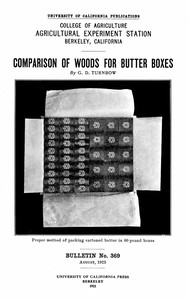
The first set packed with butter were plain unseasoned boxes of each of the woods. The second set had the inner surface paraffined before packing. The method of paraffining was to invert the box over a steam jet and steam thoroughly. This served a double purpose in that it opened the pores of the wood and allowed the paraffin to penetrate, and the heated surface of the wood kept the paraffin in a liquid condition so that it could be put on in a thinner coat than if the paraffin had been applied to a cold surface. After the boxes had been allowed to drain, the inside was then painted with paraffin at 240° F. This method gave a complete covering to the wood, a result which is not always obtained by some of the commercial paraffin atomizers. The third set was paraffined as above and, in addition, lined with good parchment paper so that no butter could come in contact with either wood or paraffin (fig. 1). Twenty-three 10-pound boxes were packed in the three ways.
They were filled with the butter from one churning which scored 92½ after being chilled for 24 hours at 50° F. and were shipped immediately after the first scoring to a cold storage plant in San Francisco and stored at a temperature of 12° F. The butter was scored monthly for six months. The summary of the scoring is given in table 1.
Influence of Various Woods on Cube Butter in Storage[B]
[B] This scoring was done by T. J. Harris, San Francisco Dairy Produce Exchange, S. L. Denning, Oakland, and G. D. Turnbow, College of Agriculture, University of California.
========================================================================= Average score No. Kind of butter in of of How First Lowest Average of same kind sample wood treated score score all scores of box ------------------------------------------------------------------------- 1 White Fir Unseasoned 92.5 89 90.857 No Paraffin No Parchment 2 Cottonwood Unseasoned 92.5 86 89.214 No Paraffin No Parchment 3 Spruce Unseasoned 92.5 88 90.785 No Paraffin No Parchment 4 Spruce Seasoned 92.5 89 90.642 Paraffin No Parchment 6 White Fir Seasoned 92.5 90 90.857 Paraffin No Parchment 7 Cottonwood Seasoned 92.5 87 89.571 Paraffin No Parchment ------------------------------------------------------------------------- 5 Cottonwood Unseasoned 92.5 88 89.857 Paraffin No Parchment 8 Spruce Unseasoned 92.5 90 90.928 Paraffin No Parchment 9 White Fir Unseasoned 92.5 89 90.571 Paraffin No Parchment ------------------------------------------------------------------------- 10 Cottonwood Unseasoned 92.5 91.0 91.714 Paraffin Parchment 11 Cottonwood Unseasoned 92.5 89.0 90.571 91.142 Paraffin Parchment 18 Cottonwood Unseasoned 92.5 89.0 91.142 Paraffin Parchment ------------------------------------------------------------------------- 12 Spruce Unseasoned 92.5 90.5 91.5 Paraffin Parchment 13 Spruce Unseasoned 92.5 91.0 91.571 91.333 Paraffin Parchment 14 Spruce Unseasoned 92.5 90.0 90.928 Paraffin Parchment ------------------------------------------------------------------------- 15 White Fir Unseasoned 92.5 89.0 90.928 Paraffin Parchment 16 White Fir Unseasoned 92.5 90.0 91.285 91.107 ------------------------------------------------------------------------- 17 White Fir Seasoned 92.5 89.0 90.857 91.142 Paraffin Parchment 20 White Fir Seasoned 92.5 90.5 91.428 Paraffin Parchment ------------------------------------------------------------------------- 19 Cottonwood Seasoned 92.5 90.5 91.571 Paraffin Parchment ------------------------------------------------------------------------- 21 Spruce Seasoned 92.5 90.0 91.214 Paraffin Parchment 22 Spruce Seasoned 92.5 90.0 91.571 91.523 Paraffin Parchment 23 Spruce Seasoned 92.5 91.0 91.785 Paraffin Parchment -------------------------------------------------------------------------
The bulletin opens with a practical problem: during World War I, spruce—the standard wood for butter boxes on the Pacific Coast—became scarce and expensive. Turnbow immediately frames the investigation as a response to dual pressures: lumber interests seeking a market for abundant white fir and cottonwood, and creamerymen wary of wood flavor tainting their butter. The text moves briskly from economic context to experimental design, establishing a pattern of alternating between industrial need and sensory testing.
What follows is a tightly structured report: three woods (spruce as control, white fir, cottonwood), three packing methods (plain, paraffined, parchment-lined), and two seasoning conditions (seasoned and unseasoned). The excerpts show a methodical approach, with butter scored by named experts from the San Francisco Dairy Produce Exchange and the College of Agriculture. The recurring image is the wooden box itself—a container that must be both structurally sound and chemically inert.
The Problem of Wood Flavor
The bulletin also reveals a secondary concern: the wood’s physical properties. The boxes must hold ten pounds of butter each, be stackable in 60-pound cases, and survive cold storage. The structure of the report moves between these two poles—sensory and structural—without ever losing sight of the economic stakes. The reader is reminded that California had an abundance of white fir and a limited amount of cottonwood, but these woods had “little commercial value” until this experiment. The problem of wood flavor is thus not merely a technical issue but a bottleneck for regional resource use.
Experimental Design and the Role of Paraffin
The scoring was done by T. J. Harris, S. L. Denning, and Turnbow himself—three individuals whose names are given, lending the report a collaborative, institutional credibility. The bulletin does not describe the scoring criteria in the excerpts, but the presence of named judges suggests a formal sensory panel. The structure of the experiment—three woods × three packing methods × two seasoning conditions—creates a matrix of 18 test conditions, though the excerpts only hint at the full matrix. The reader is left to infer that the results were tabulated, but the bulletin’s movement from problem to method to results is clear.
Movement Between Scenes: From Forest to Cold Storage
This movement is not merely descriptive; it mirrors the bulletin’s argument. The economic problem (shortage of spruce) leads to a material solution (testing local woods), which is then validated through a controlled experiment. The cold storage scene is where the sensory test occurs—where the invisible transfer of flavor is either confirmed or refuted. The bulletin’s structure thus enacts a journey from resource scarcity to scientific assurance, with the wooden box as the constant object. The recurring image of the box—plain, paraffined, lined—anchors each scene, reminding the reader that the container is both the problem and the potential solution.
The Role of the Appendix: A Catalog of Bulletins
The appendix also reveals the bulletin’s intended audience: not just creamerymen, but also lumbermen, farm advisors, and county agents. The list includes “The Function of the Farm Bureau” and “Suggestions to the Settler in California,” indicating a readership concerned with both production and rural development. The bulletin’s structure—problem, experiment, results, and then a catalog of related works—mirrors the extension service’s mission to disseminate practical knowledge. The reader is left with the sense that this single experiment is one node in a network of investigations, each aimed at making California agriculture more self-sufficient.
The bulletin is best read as a document of its time: a response to wartime scarcity, a collaboration between state agencies and private industry, and a careful exercise in sensory science. Turnbow’s method—comparing three woods under controlled conditions—remains a model for evaluating packaging materials. The reader should pay attention to the footnotes, which name the collaborators and the scoring judges, and to the appendix, which places this study in a broader institutional context. The bulletin does not reveal its final verdict in the excerpts, but the structure itself argues for the possibility of substitution, provided the right precautions are taken.
That odd little bulletin about butter boxes stayed with me—how something so plain could quietly measure what wood absorbs and resists. I found myself thinking of The Art of Bookbinding: A practical treatise, with plates and diagrams — Edition Insights afterward, another humble craft where materials whisper their own subtle truths. Sometimes the smallest details hold the most patient feeling.
There are no reviews for this eBook.
There are no comments for this eBook.
Reader reflection
Record your reading impressions
A brief reflection can help important ideas stay with you longer.
Your progress
0
/
10
2
How much did you enjoy the reading experience?
3
How likely are you to recommend this book?
4
How much effort did this book require?
5
How personally connected did you feel to the book?
6
How useful were the ideas in this book?
7
Did the book meet your expectations?
8
How strongly did the book affect you emotionally?
9
In one sentence, what did you learn?
10