1

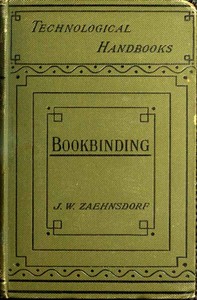
The Art of Bookbinding: A practical treatise, with plates and diagrams — Edition Insights
(0 User reviews)
264
Project Gutenberg
2016
Not confirmed
Bookbinding -- Handbooks, manuals, etc.; Bookbinding
Readers of public-domain and historical texts
Project Gutenberg digital edition
en
Edition facts
Words
60,234
Reading time
262 min
Text sections
21
This digital edition of The Art of Bookbinding: A practical treatise, with plates and diagrams — Edition Insights is described by source-level measurements including 60,234 words, 4 hr 22 min estimated reading time, and 21 detected text sections.
The text analysis averages about 18.0 words per sentence, while the detected sections provide another way to judge how the source is divided.
Project Gutenberg metadata also associates the work with “Bookbinding -- Handbooks, manuals, etc.,” connecting these edition facts with the source record’s subject description.
Source:
Project Gutenberg record #51213
Zaehnsdorf's 1890 manual blends precise workshop instructions with a craftsman's warnings about chemical misuse, revealing the practical reasoning behind hand-colouring, marbling, and finishing techniques.
Editorial Edition Score
4.9/5
★★★★★
★★★★★
Calculated from edition completeness, EPUB availability, text structure and catalogue metadata. Not a user rating.
How this score is calculated
- Description quality20 pts
- Title & short description10 pts
- Source metadata20 pts
- Text length15 pts
- Chapters / structure15 pts
- EPUB file integrity20 pts
Total of 100 points, scaled to a 2.5-5.0 range. Editions with an empty description or a missing EPUB file are not scored.
Edition quality
Read the Text
Refolding — Machines — Gathering … 3–8
CHAPTER II. Beating and Rolling: Machines … 9–12
CHAPTER III. Collating: Interleaving … 13–19
CHAPTER IV. Marking up and Sawing in … 20–23
CHAPTER V. Sewing: Flexible — Ordinary … 23–32
CHAPTER VI. Forwarding: End Papers — Cobb Paper — Surface Paper — Marbled Paper — Printed and other Fancy Paper — Coloured Paste Paper … 33–36
CHAPTER VII. Pasting up … 36–37
CHAPTER VIII. Putting on the End Papers … 38–41
CHAPTER IX. Trimming … 41–44
CHAPTER X. Gluing up … 45–46
CHAPTER XI. Rounding … 46–48
CHAPTER XII. Backing … 48–51
CHAPTER XIII. Mill-boards … 51–57
CHAPTER XIV. Drawing-in and Pressing … 57–59
CHAPTER XV. Cutting … 59–66
CHAPTER XVI. Colouring the Edges: Sprinkled Edges — Colours for Sprinkling — Plain Colouring — Marbled Edges — Spot Marble — Comb or Nonpareil Marble — Spanish Marble — Edges — Sizing … 67–77
CHAPTER XVII. Gilt Edges: The Gold Cushion — Gold Knife — Burnishers — Glaire Water or Size — Scrapers — The Gold Leaf — Gilt on Red — Tooled Edges — Painted Edges … 78–83
CHAPTER XVIII. Head-Banding … 83–86
CHAPTER XIX. Preparing for Covering: lining up … 87–90
CHAPTER XX. Covering: Russia — Calf — Vellum or Parchment — Roan — Cloth — Velvet — Silk and Satin — Half-bound Work … 90–97
CHAPTER XXI. Pasting Down: Joints — Calf, Russia, etc. … 97–100
CHAPTER XXII. Calf Colouring: Black — Brown — Yellow — Sprinkles — Marbles — Tree-marbles — Dabs … 100–108
PART II. — FINISHING.
CHAPTER XXIII. Finishing: Tools and Materials required for Finishing — Polishing Irons — Gold-rag — India-rubber — Gold-cushion — Gold Leaf — Sponges — Glaire — Cotton Wool — Varnish — Finishing — Morocco — Gold Work — Inlaid Work — Porous — Full Gilt Back — Run-up — Mitred Back — Pressing — Graining — Finishing with Dry Preparation — Velvet — Silk — Vellum — Blocking … 111–153
CHAPTER XXIV. Washing and Cleaning: Requisites — Manipulation — Dust — Water Stains — Damp Stains — Mud — Fox-marks — Finger-marks, commonly called “Thumb-marks” — Blood Stains — Ink Stains (writing) — Ink Stains (Marking Ink, Silver) — Fat Stains — Ink — Reviving Old Writings — To Restore Writing effaced by Chlorine — To Restore MSS. faded by time — To Preserve Drawings or Manuscripts — To fix Drawings or Pencil Marks — To render Paper Waterproof — To render Paper Incombustible — Deciphering Burnt Documents — Insects — Glue — Rice Glue or Paste — Paste — Photographs — Albumen — To Prevent Tools, Machines, etc., from Rusting — To Clean Silver Mountings — To Clean Sponges … 157–172
Bookbinding carries us back to the time when leaden tablets with inscribed hieroglyphics were fastened together with rings, which formed what to us would be the binding of the volumes. We might go even still further back, when tiles of baked clay with cuneiform characters were incased one within the other, so that if the cover of one were broken or otherwise damaged there still remained another, and yet another covering; by which care history has been handed down from generation to generation. The binding in the former would consist of the rings which bound the leaden tablets together, and in the latter, the simple covering formed the binding which preserved the contents.
We must pass on from these, and make another pause, when vellum strips were attached together in one continuous length with a roller at each end. The reader unrolled the one, and rolled the other as he perused the work. Books, prized either for their rarity, sacred character, or costliness, would be kept in a round box or case, so that the appearance of a library in Ancient Jerusalem would seem to us as if it were a collection of canisters. The next step was the fastening of separate leaves together, thus making a back, and covering the whole as a protection in a most simple form; the only object being to keep the several leaves in connected sequence. I believe the most ancient form of books |xii| formed of separate leaves, will be found in the sacred books of Ceylon which were formed of palm leaves, written on with a metal style, and the binding was merely a silken string tied through one end so loosely as to admit of each leaf being laid down flat when turned over. When the mode of preserving MS. on animal membrane or vellum in separate leaves came into use, the binding was at first only a simple piece of leather wrapped round the book and tied with a thong. These books were not kept on their edges, but were laid down flat on the shelves, and had small cedar tablets hanging from them upon which their titles were inscribed.
The ordinary books for general use were only fastened strongly at the back, with wooden boards for the sides, and simply a piece of leather up the back.
Zaehnsdorf opens his second edition by noting that the first was written for amateurs yet found a large trade readership. This revised version retains the original arrangement while adding fresh matter, aiming to spread knowledge that may advance the art of bookbinding. The preface sets a tone of direct, workmanlike instruction, addressing fellow workmen without academic pretension.
The excerpts show a voice that is both authoritative and cautionary. When discussing leather colouring, Zaehnsdorf repeatedly warns against strong acids that rot the material, insisting on harmless preparations. He names specific chemicals—copperas, salts of tartar, picric acid—and gives exact proportions, reflecting a methodical approach grounded in hands-on experience.
A Craftsman’s Cautionary Voice
Zaehnsdorf’s narrative voice is distinctive for its blend of technical precision and moral urgency. He does not simply list recipes; he repeatedly warns that binders often use acids too strong, failing to wash out residues, so that “the leather or the paper rots.” This concern appears not as a dry aside but as a recurring theme, suggesting a deep investment in the longevity of the work. His phrasing is direct: “I will not recommend any chemicals that will destroy the leather.” The tone is that of a master speaking to apprentices, mixing instruction with admonition. He even notes that salts of tartar is “poisonous, and must not be used too strong on the calf or it will corrode it.” Such warnings give the text a practical, ethical weight beyond mere procedure.
Recipes as Evidence of Process
The excerpts contain several detailed recipes that reveal the material logic of hand-colouring. For black, Zaehnsdorf specifies sulphate of iron (copperas) boiled in water, and notes that a previous coat of alkali strikes “a rich purple black.” For brown, he recommends walnut shells fermented in water, which “does not in any way corrode the leather, and produces the best uniform tint.” Yellow is obtained from picric acid, though he warns it is explosive when mixed dry with alkali. Each recipe includes precise quantities—a quarter-pound to a quart of water—and practical tips, such as keeping an old iron pot for boiling black. These instructions are not abstract; they are grounded in the physical behaviour of materials, showing a mind attuned to chemical interaction and workshop constraints.
Pace and Structure: From General to Specific
The text’s structure moves from broad principles to narrow particulars, a pattern that shapes the reader’s experience. In the colouring section, Zaehnsdorf first gives a general caution about acids, then lists specific dyes (black, brown, yellow) with their own sub-recipes. Within each entry, he often begins with a general statement—e.g., “Black. —Sulphate of iron or copperas is the chief ingredient”—then moves to step-by-step instructions. This rhythm creates a steady, didactic pace: the reader is prepared for detail by a framing remark. The prose is economical, rarely wasting words, yet it pauses for emphasis when warning of danger. The result is a manual that feels both efficient and careful, mirroring the binder’s own need for precision and caution.
Readers approaching this treatise should attend to the interplay between recipe and rationale. Zaehnsdorf does not merely tell you what to do; he explains why one method is safer or more effective, often by contrasting it with common but destructive practices. This habit of reasoning aloud makes the book valuable not only as a manual but as a record of a craft mindset. The warnings about acids and the insistence on harmless preparations are not incidental—they are central to Zaehnsdorf’s conception of good workmanship.
Joseph’s warnings against harsh chemicals in that old binding manual reminded me of my father’s quiet rule about the lamp in his study—never forcing its delicate filament. There’s a shared patience there, a respect for the material’s own limits. It made me pick up The Fifteen Watt Tungsten Lamp — Key Ideas to Explore, and I felt that same gentle hush settle over the room.
There are no reviews for this eBook.
There are no comments for this eBook.
Reader reflection
How did this book work for you?
Your answers remain private and are stored only in this browser.
Your progress
0
/
10
2
How did the book work for you overall?
3
Is this a title you would suggest to others?
4
How demanding did the text feel?
5
Did the book give you something worth debating?
6
How much did the book move you?
7
What was the strongest part of the book?
8
Did you gain anything practical from the text?
9
What is the main idea you are taking away?
10