1

The platinum metals — A Closer Reading
(0 User reviews)
1401
Project Gutenberg
2020
Not confirmed
Platinum group
Readers of public-domain and historical texts
Project Gutenberg digital edition
en
Edition facts
Words
21,220
Reading time
93 min
Text sections
13
Before opening The platinum metals — A Closer Reading, the edition data offers a quick orientation: 21,220 words, 1 hr 33 min estimated reading time, and 13 detected text sections.
The text analysis averages about 15.9 words per sentence, while the detected sections provide another way to judge how the source is divided.
Project Gutenberg metadata also associates the work with “Platinum group,” connecting these edition facts with the source record’s subject description.
Source:
Project Gutenberg record #64068
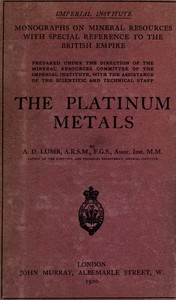
A 1920 Imperial Institute monograph by A. D. Lumb examining the geology, mining, refining, and trade of platinum-group metals, with a focus on Russian Ural deposits and the geopolitical shifts of World War I.
Editorial Edition Score
4.7/5
★★★★★
★★★★★
Calculated from edition completeness, EPUB availability, text structure and catalogue metadata. Not a user rating.
How this score is calculated
- Description quality20 pts
- Title & short description10 pts
- Source metadata20 pts
- Text length15 pts
- Chapters / structure15 pts
- EPUB file integrity20 pts
Total of 100 points, scaled to a 2.5-5.0 range. Editions with an empty description or a missing EPUB file are not scored.
Edition quality
Read the Text
to the report of the Royal Ontario Nickel Commission, the matte produced by the Canadian Copper Co. in 1916 was estimated to contain 4,640 oz. platinum and 8,460 oz. palladium, corresponding to 0·10 oz. platinum and 0·15 oz. palladium per ton of matte, the International Nickel Co. recovering in that year 1,093 oz. platinum and 257 oz. allied metals. This company is now reported to have improved its methods of recovery. In 1918 the total matte shipment by the Canadian Copper Co. is stated to have contained, among other precious metals, 8,677 oz. platinum and 13,016 oz. palladium[38].
According to information supplied by the Mond Nickel Co., their nickel residues derived from the refining of the matte are taken over by Johnson, Matthey & Co., Ltd. During the years 1915–18 the residues disposed of were estimated to contain the following amounts of platinum metals:
(In oz. troy.) ───────────────────┬─────┬─────┬─────┬───── │1915.│1916.│1917.│1918. ───────────────────┼─────┼─────┼─────┼───── Platinum │3,078│3,782│4,913│4,465 Palladium │5,474│ │ │ Iridium and Rhodium│ 973│ │ │ ───────────────────┴─────┴─────┴─────┴─────
Messrs. Johnson, Matthey & Co., Ltd., have kindly supplied the following figures of platinum-extraction from these residues:
Oz. troy. 1916 3,722 1917 4,719 1918 4,958
The British America Nickel Corporation, who are developing some large deposits in the same district, are also erecting a refinery near Hull on the Ottawa River. It is stated that they will employ the Hybinette process of electrolytic refining, and expect to obtain a high recovery of the precious metals[29] p. 425.
With gradual improvements in the refining process, and with the refining of the whole of the matte produced, instead of a portion only, as at present, it seems probable that the production of platinum metals by the three nickel companies may in time exceed 10,000 oz. per annum.
The 1919 report of the Ontario Bureau of Mines shows that in 1918 the International Nickel Co. treated 62,250 tons of matte for 650 fine oz. of platinum, 787 oz. of palladium, and 473 oz. of metals of the rhodium group. This cannot be used as a basis of calculation, as the proportions are not constant.
On the Quinn claims, near the Crœsus Mine, Munro Township, is auriferous quartz containing platinum. Five assays gave a platinum content of value ranging from $180 to $1,800 per ton (with platinum at from $40 to $50 per oz.)[31]. The Abro Mine in the Timiskaming district in 1915 shipped between 5,000 and 6,000 tons of ore, containing 0·03 oz. of palladium and platinum per ton. The ore consists of pyrrhotite, chalcopyrite and pentlandite, in a gangue of altered peridotite and serpentine[7].
_Yukon Territory._—Platinum occurs associated with gold in small quantities in most of the tributaries of the Yukon River, notably at the mouth of the Hootalinqua River, and in the River Lewis[37] p. 12.
Chromite derived from the serpentinized area in the region of Mount Cormack, situated in the central part of the island, has been found to contain small quantities of platinum[39].
The most important occurrences of platinum in the Commonwealth are at Fifield and at Platina, in New South Wales.
The outputs of crude platinum in Australia in recent years were all exported to the United Kingdom as under:
────────────── Year. Troy oz. ────────────── 1910 332 1911 470 1912 610 1913 442 1914 244 1915 56 1916 82 1917 259 1918 607 ──────────────
_Note._—These figures do not include the osmiridium produced in Tasmania.
Recent imports of manufactured platinum were as under:
─────────── Oz. ─────────── 1910 320 1911 504 1912 318 1913 301 1914–15 223 1915–16 89 1917–18 18 ───────────
The question of the refining of platinum in Australia has been under consideration for some time; so far the crude material has all been sent to England. The outlook for future production of crude platinum in Australia is not promising, with the exception of that of Bald Hill district, Tasmania.
_New South Wales._—Platinum is obtained at Platina, in the Fifield division, in the east central part of the State, from a buried gravel channel, in which it occurs in association with gold and osmiridium. The rocks in the vicinity of the “leads” consist chiefly of slates, but the source of the platinum is not known[4] p. 557. These deposits were first exploited in 1894, and from that year to 1918 inclusive, the total output of platinum from New South Wales was 14,680 oz.[40]. The gravels have yielded amounts of 6 dwt. platinum and 2 dwt. gold per ton, but according to Government reports the richer deposits are nearly worked out; mining operations are carried on with great difficulty, as there is a great scarcity of water and a deep overburden, varying from 20 to 80 ft. in depth. It is estimated that there are 200 acres of platinum-country available, sufficiently rich to pay, were it worked on a large scale with an abundant supply of water[41].
A. D. Lumb's 1920 monograph, published as part of the Imperial Institute's series on mineral resources, opens with a precise institutional framing: the work is "prepared under the direction of the Mineral Resources Committee" and draws on the Institute's scientific staff. The author's voice is that of a technical reporter, not a prospector—he writes in measured, declarative sentences, often beginning paragraphs with a year or a place name. The text is dense with tables of troy-ounce outputs and references to official statistics, yet Lumb occasionally lets a geopolitical observation surface, as when he notes that France held "a monopoly of 90 per cent. of the Russian production" until the war. This tension between dry data and strategic implication gives the prose its character.
Geological Framing and the Ural Belt
Lumb devotes considerable space to the geology of the Urals, describing a "platiniferous belt" composed of four parallel bands striking north-south. His language is precise: the westernmost band consists of "crystalline schists" forming the watershed between Europe and Asia; the next includes "olivine- and mica-gabbros, diallage-peridotites, diorites and altered syenites." He notes that these rocks "have been erupted from a great depth," a phrase that hints at the violent origins of the deposits. The third band is made of "Lower Devonian sedimentary rocks, shattered and buried in places by diabasic eruptive rocks." The easternmost band comprises "ancient rocks, which have been eroded by the advancing sea of Lower Tertiary age." This layered description, though technical, reveals Lumb's method: he builds a picture of the landscape from the ground up, treating geology as a kind of historical narrative written in stone.
The Language of Output and Decline
Throughout the monograph, Lumb presents production data in tables that show a steep decline: Russian platinum output fell from 300,000 ounces in 1910 to 50,000 in 1917. His commentary on these figures is terse but telling. He writes that "the platinum industry in Russia has always been mainly in the hands of a few large firms of foreign countries," and traces the shift in refining dominance from Johnson, Matthey & Co. of England to Heraeus & Co. of Germany, then to the Société Anonyme de l'Industrie du Platine of Paris. The prose becomes most animated when Lumb describes the Russian government's response: a 1913 law forbidding export of crude platinum, followed by a 30 percent export tax in 1915, and a 1917 order prohibiting import of "drawn and spun platinum." He reports that miners were "not satisfied" with the fixed price of £16 10s. per ounce, and that later sales reached £22. These details, drawn from official sources, give the reader a sense of an industry in crisis, where policy and market forces collide.
Refining and Foreign Control
Lumb's discussion of refining is notable for its focus on corporate and national competition. He states that "the refining of the crude platinum has been, and still is, almost entirely in foreign hands," with only about 2 percent of output refined domestically. He notes that a refinery at Ekaterinburg was completed in 1915, intended for government control, but the war disrupted its impact. The author's choice of verbs—"controlled," "superseded," "compelled to give first place"—casts the industry as a series of power shifts. He does not editorialize, but the accumulation of facts creates a portrait of dependency: Russian raw material, European processing, and global markets. The outbreak of war in 1914 is a turning point, after which France's near-monopoly collapses and new regulations emerge. Lumb's reliance on numbered references (e.g., "[15] p. 923") underscores his method: he builds his case from cited evidence, not speculation.
Diction and the Institutional Voice
Lumb's prose is shaped by his institutional role. He writes as a representative of the Imperial Institute, whose mission is "the collection, critical revision and arrangement of all important information respecting supplies of minerals especially within the Empire." The language is formal and impersonal: sentences often begin with "It was reported that" or "According to." Yet within this constrained register, Lumb makes choices that reveal his priorities. He uses the passive voice to describe government actions ("an order was issued forbidding the exportation"), which distances the author from policy while still recording it. His paragraphs are short, often no more than three or four sentences, and he moves quickly from one topic to the next—geology, production, trade, refining—without transition. This abruptness mirrors the fragmented nature of his subject: a global industry in wartime, where data is incomplete and control is contested.
Readers should approach this monograph as a primary document of its era—a snapshot of a strategic mineral industry at the end of World War I. Lumb's reliance on official statistics and his avoidance of narrative flourish mean that the work rewards careful attention to its tables and footnotes. The text is best read alongside a map of the Urals and a timeline of Russian industrial policy, as the author assumes familiarity with both. For those interested in the intersection of geology, commerce, and empire, this volume offers a concise, evidence-rich entry point.
There’s something about old technical manuals—the way they quietly assume a world that’s already gone. I felt that with the platinum monograph, its careful notes on Russian mines shifting under wartime pressure. I wonder if Tractor Principles The Action, Mechanism, Handling, Care, Maintenance and Repair of the Gas Engine Tractor — Themes and Context might leave the same faint ache, that sense of machines outlasting their makers.
There are no reviews for this eBook.
There are no comments for this eBook.
Reader reflection
Record your reading impressions
A brief reflection can help important ideas stay with you longer.
Your progress
0
/
10
2
Was reading this book enjoyable?
3
Would you recommend this book to another reader?
4
What was the reading difficulty like?
5
How would you rate its originality?
6
Did you relate to its people, ideas, or situations?
7
How understandable was the text?
8
Did you gain anything practical from the text?
9
What is the main idea you are taking away?
10