1

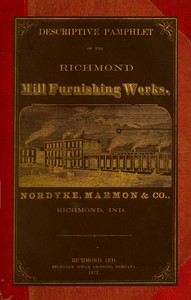
Descriptive Pamphlet of the Richmond Mill Furnishing Works All sizes of mill stones and complete grinding and bolting combined husk or portable flouring mills, portable — Themes and Context
(0 User reviews)
1048
Project Gutenberg
2016
Not confirmed
Nordyke, Marmon & Company -- Catalogs; Flour industry -- Equipment and supplies -- Catalogs; Milling machinery -- Catalogs; Mills and mill-work -- Equipment and supplies -- Catalogs
Readers of public-domain and historical texts
Project Gutenberg digital edition
en
Edition facts
Words
33,388
Reading time
146 min
Text sections
7
The catalog record for Descriptive Pamphlet of the Richmond Mill Furnishing Works All sizes of mill stones and complete grinding and bolting combined husk or portable flouring mills, portable — Themes and Context provides practical reading context through 33,388 words, 2 hr 26 min estimated reading time, and 7 detected text sections.
The text analysis averages about 16.0 words per sentence, while the detected sections provide another way to judge how the source is divided.
Project Gutenberg metadata also associates the work with “Nordyke, Marmon & Company -- Catalogs,” connecting these edition facts with the source record’s subject description.
Source:
Project Gutenberg record #51500
An 1872 industrial catalog from Nordyke, Marmon & Co. detailing mill machinery, from stones and bolting cloth to elevators and water wheels, with technical specifications, prices, and customer testimonials.
Editorial Edition Score
4.7/5
★★★★★
★★★★★
Calculated from edition completeness, EPUB availability, text structure and catalogue metadata. Not a user rating.
How this score is calculated
- Description quality20 pts
- Title & short description10 pts
- Source metadata20 pts
- Text length15 pts
- Chapters / structure15 pts
- EPUB file integrity20 pts
Total of 100 points, scaled to a 2.5-5.0 range. Editions with an empty description or a missing EPUB file are not scored.
Edition quality
Read the Text
Mill Furnishing Works.
Mill Stones and Complete Grinding and Bolting Combined Husk or Portable
Portable Corn and Feed Mills; Smut and Separating Machines; Zigzag and Oat Separators, Dustless Separators, Warehouse Separators, Water Wheels; Mill Shafting; Pulleys; Spur and Bevel, Iron and Core, Gearing.
Bolting Cloth: Flour, Meal, Buckwheat and Rye Bolts. Complete in Chests; Plantation and Farm Mills; Screen Wire; Perforated Zinc; English Steel Mill Picks; Elevator Cups; All kinds of Belting; Hoisting Screws; Proof Staffs, &c.
NORDYKE, MARMON & CO., RICHMOND, IND.
_Factory and Office two Blocks South of Railroad Bridge._
RICHMOND, IND. TELEGRAM STEAM PRINTING COMPANY. 1872.
COPYRIGHT SECURED. Entered according to act of Congress, in the year 1872, by Nordyke, Marmon & Co., in the Office of the Librarian of Congress, at Washington.
Building and Balancing Stones 9
Standing and Running Balance 9
Under-Runner Mills 14
Under-Runner Geared Mills 16
Upper-Runner Mills 17
Attaching and Driving 18
Single Reel Bolt, complete 21
Portable Mill and Bolt 22
Complete Portable Grinding and Belting Flour Mills 24
Combined Mill Husk 31
Grinding and Flouring, and Capacity 35
Directions for Ordering 39
Setting up and Starting 40
Smut and Separating Machines 41
Ordering Smut and Separating Machines 44
Dustless Oat Separator and Zigzag 45
Farm and Plantation Mills 52
Corn and Cob Crusher, and Grinder 54
Weight of various Products 64
Contents of a Hopper, how to find 65
Contents of a Bin, how to find 65
Shafting, Hangers and Boxing 66
Rules to find Speed of Pulleys and Gearing 70
Weight of Round or Square Iron 71
Weight of Sheet Iron 71
Spring Coupling and Driver 72
Measurement of Water in a Stream 75
Self-Tramming Mill Irons 78
Lighter Screws and Hand Wheels 84
Mill Curbs or Hoops 86
Hoisting Screws, Bales and Pins 92
Elevator Cups and Fastenings 95
Perforated Zinc and Iron Plates 97
Prices, Terms, and Weights 98
Table of Logs, reduced to Board Measure 118
We present our customers and those whose names have been given us with our descriptive pamphlet for 1872.
Having now been established over thirty-five years in the construction of machinery in this particular line, and knowing most of the old and new improvements which have been a success and those which have failed, we are offering, after almost a constant course of labor, mill machinery of undoubted superior qualities. And now we invite the attention of those interested to the articles of our designing and make, fully believing a careful investigation and comparison with the work of any manufacturer will convince them of its excellence. Our work being represented in OVER ONE THOUSAND FLOURING MILLS is some evidence of its practical merits. NO EXPERIMENTS, BUT GET THE BEST. We have files of letters and statements that tell of the costly experiences of those having bought new and untried machinery.
The mill of to-day of whatever dimensions must be simple, compact, efficient, durable and cheap.
have claimed our special study to obtain the best results in the different locations, and purposes required.
1st. The best wheat scouring and separating machinery.
2d. The quality of burr stones required, best speed, draft and form of furrows, and best mode of driving them.
3d. Numbers of cloth, amount of bolting surface required, best arrangement of numbers, &c.
4th. Propriety of regrinding, how best to grade the offal for this purpose, as well as other requirements of flour mills.
with two to four run of stones varying from two to four feet diameter, and all in one substantial frame, spindles being long and arranged for the gearing and lower part of husk to be in the basement of the mill-house on an independent foundation, are made complete in our works, carefully put up and adjusted, marked, taken apart, small pieces boxed and otherwise prepared for shipment and ease of putting up. This plan was first adopted by us in the year 1867; since that time we have put out considerably over one hundred run of stone on this plan, all receiving the highest commendations of the owners.
are in extensive use, but by careful observation we have found the means of improvement, and within the last few years have revised our patterns, and we say, with entire confidence, all things being considered, that we make the best heavy husk portable mill in the market, they having none of the objectionable features so common in mills of this class.
is directed to OUR COMPLETE GRINDING AND BOLTING FLOUR MILL adapted to the special demands of a custom mill. Those now made have all the improvements of value to the present date, and furnished at a price so reasonable that every town or neighborhood of sufficient demands can be supplied; good flour and yield guaranteed.
SELF TRAMMING, DRIVING AND BALANCE IRONS
as improved, are extensively used, and in brisk demand. These are no new and doubtful experiment. See the cuts and description, and the defects of other modes of driving irons will readily be understood. We are prepared to execute
The 1872 pamphlet from Nordyke, Marmon & Co. presents itself as a straightforward trade catalog, yet its pages reveal a dense network of technical knowledge and commercial persuasion. The opening claim of being "established over thirty-five years" immediately anchors the firm’s authority, while the detailed table of contents—spanning mill stones, bolting cloth, gearing, and even water power measurement—signals a comprehensive guide for mill operators. The catalog’s structure, moving from product descriptions to practical instructions and finally to testimonials, mirrors the sales strategy of building trust through expertise.
From Mill Stones to Self-Oiling Bushes
The catalog’s core is its machinery descriptions, which blend technical precision with salesmanship. The self-tramming mill irons, for instance, are explained through figures and detailed measurements: the iron is designed so that "the power being transmitted to the stone by the adjustable part of the iron and no weight upon any part of it" ensures durability. Similarly, the oil bush is described as a "simple self-oiling arrangement" with a centrifugal oil chamber, claimed to be "the best thing in use for fast running upright bearings." These passages show how the catalog educates potential buyers while promoting proprietary designs. The inclusion of patent dates, such as "Bullock’ Mill Bush, Patented December 31, 1867," further emphasizes innovation. Yet the excerpts also reveal a practical side: instructions for ordering include sending a plaster cast of the spindle hole to ensure proper fit, indicating a hands-on, custom approach to sales.
Practical Guidance and Customer Assurance
Beyond product listings, the catalog functions as a manual. Sections like "Keeping in Order" and "Directions for Ordering" offer step-by-step advice, while tables for converting logs to board measure and calculating bin contents show an awareness of the miller’s daily needs. The testimonials section, though only listed in the contents, suggests the company leveraged customer endorsements to build credibility. Notably, the catalog includes a warranty: "Every iron is warranted," and offers a trial for skeptical buyers. This combination of technical detail and customer-friendly policies—such as accepting payment via Post Office Order and guaranteeing safe arrival—reflects a business attuned to the concerns of its rural, industrial clientele. The language is direct and instructional, avoiding hype in favor of concrete specifications.
The Catalog as a Historical Artifact
The catalog’s catalog subjects—"Flour industry -- Equipment and supplies -- Catalogs" and "Milling machinery -- Catalogs"—accurately describe its content, but the excerpts also reveal a broader scope. The inclusion of steam engines, water power measurement, and even farm mills indicates that Nordyke, Marmon & Co. served a wide range of customers, from large commercial mills to small plantations. The 1872 date places it in a period of rapid industrialization, and the detailed illustrations (referenced as figures) hint at the visual aids that would have accompanied the text. However, the excerpts do not include images, so the reader must infer their role. The catalog’s survival as a Project Gutenberg eBook, digitized from Internet Archive images, underscores its value as a primary source for understanding 19th-century manufacturing and commerce.
Readers approaching this catalog should treat it as both a technical manual and a historical document. The detailed specifications for machinery, from mill stones to elevators, offer insight into the material culture of milling, while the ordering instructions and testimonials reveal the business practices of the era. The catalog’s structure—moving from products to practical advice to customer endorsements—mirrors the persuasive strategies of industrial sales. For researchers, the pamphlet provides a rare window into the language, technology, and commerce of post-Civil War American industry.
I have shelved that Richmond Mill catalog with its sturdy wheels and earnest prices these many years, admiring that steady belief in progress. It reminds me, somehow, of the quiet dignity I find in Eminent literary and scientific men of Italy, Spain, and Portugal. Vol. 1 (of 3) — Text and Context, where old minds labored over equally honest tools—of ink and thought—with the same patient faith in what their hands could build.
There are no reviews for this eBook.
There are no comments for this eBook.
Reader reflection
Your personal reading reflection
Build a private reading journal entry for this title.
Your progress
0
/
10
2
How much did you enjoy the reading experience?
3
Would you pass this book on to a friend?
4
How much effort did this book require?
5
How valuable was this book for your own interests?
6
Do you expect to return to this book?
7
How strongly did the book affect you emotionally?
8
Did you relate to its people, ideas, or situations?
9
What changed or sharpened your thinking?
10