1

John Deere's Steel Plow — Key Ideas to Explore
(0 User reviews)
495
Project Gutenberg
2010
Not confirmed
Plows; Deere, John, 1804-1886
Readers of public-domain and historical texts
Project Gutenberg digital edition
en
Edition facts
Words
8,749
Reading time
39 min
Text sections
2
John Deere's Steel Plow — Key Ideas to Explore can be approached with a clearer sense of reading commitment from its source measurements: 8,749 words, 39 min estimated reading time, and 2 detected text sections.
The text analysis averages about 21.7 words per sentence, while the detected sections provide another way to judge how the source is divided.
Project Gutenberg metadata also associates the work with “Plows,” connecting these edition facts with the source record’s subject description.
Source:
Project Gutenberg record #34562
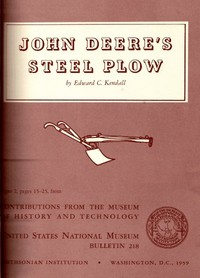
Edward C. Kendall's 1960 monograph examines John Deere's 1837 steel plow invention through surviving artifacts, historical records, and technical analysis of materials like wrought iron and steel, challenging popular assumptions about the plow's construction.
Editorial Edition Score
4.5/5
★★★★★
★★★★★
Calculated from edition completeness, EPUB availability, text structure and catalogue metadata. Not a user rating.
How this score is calculated
- Description quality20 pts
- Title & short description10 pts
- Source metadata20 pts
- Text length15 pts
- Chapters / structure15 pts
- EPUB file integrity20 pts
Total of 100 points, scaled to a 2.5-5.0 range. Editions with an empty description or a missing EPUB file are not scored.
Edition quality
Read the Text
They were used only for the first ploughing, in breaking up the wild sod woven into a tough mass, chiefly by the cord-like roots of perennial grasses, reinforced by the tap roots of oak and hickory bushes, called "grubs," some of which were more than a century old and four or five inches in diameter.... If in good trim, the plough cut through and turned over these grubs as if the century-old wood were soft like the flesh of carrots and turnips; but if not in good trim the grubs promptly tossed the plough out of the ground.
The second and greater problem was that the richer lands of the prairie bottoms, after a few years of continuous cultivation, became so sticky that they clogged the moldboards of the plows. Clogging was such a factor in prairie plowing that farmers in these regions carried a wooden paddle solely for cleaning off the moldboard, a task which had to be repeated so frequently that it seriously interfered with plowing efficiency. It seems probable that by the 1830's blacksmiths in the prairie country were beginning to solve the problem of continuous cultivation of sticky prairie soil by nailing strips of saw steel to the face of wooden moldboard of the traditional plows. Figure 1 is a photograph of an 18th century New England plow in the collection of the U. S. National Museum. This is one type of plow which was brought west by the settlers. It contributed to the development of the prairie breaker shown in figure 2. The first plow on record with strips of steel on the moldboard is attributed to John Lane in Chicago in 1833.[2] Steel presented a smoother surface which shed the sticky loam better than the conventional wooden moldboards covered with wrought iron, or the cast iron moldboards of the newer factory-made plows then coming into use.
It is generally accepted as historical fact that John Deere made his first steel plow in 1837 at Grand Detour, Illinois. The details of the construction of this plow have been variously given by different writers. Ardrey[3] and Davidson[4] describe Deere's original plow as having a wooden moldboard covered with strips of steel cut from a saw, in the manner of the John Lane plow.
[Sidebar: THE AUTHOR:
_Edward C. Kendall is curator of agriculture, Museum of History and Technology, in the Smithsonian Institution's United States National Museum._]
In recent years the 1837 Deere plow has been pictured quite differently. This has apparently come about as the result of the discovery of an old plow identified as one made by John Deere at Grand Detour in 1838 and sold to Joseph Brierton from whose farm it was obtained in 1901 by the maker's son, Charles H. Deere. He brought it to the office of Deere & Company at Moline, Illinois, for preservation and display. This plow is shown in figures 7 and 9. In 1938 Deere & Company presented it to the U. S. National Museum, where it is on display. It can be seen that the moldboard is made of one curved diamond-shaped metal slab. This plow bottom conforms to the description of the "diamond" plows manufactured by Deere in the 1840's.[5] The Company states that according to its records, this was one of three plows made by Deere in 1838 and that it was probably substantially identical with the first one made in 1837.[6] It may be difficult to prove that the Museum's specimen was made in 1838, but a comparison of this plow (fig. 7) with the 1847 moldboard (fig. 5) and the 1855 plow (fig. 6) suggests that the Museum's plow is the earliest of the three, since there is particularly evident an evolution of the shape of the moldboard from a simple, almost crude form to a more sophisticated shape.
Writers of the 20th century describing the making of the first John Deere steel plow have in mind the 1838 plow. One[7] has John Deere pondering the local plowing problem and getting an idea from the polished surface of a broken steel mill saw. Another[8] claims that Leonard Andrus, the founder and leading figure of Grand Detour and part owner of the sawmill, conceived the design of the plow and employed Deere, the blacksmith newly arrived from Vermont, to build it. This idea may have originated with and was certainly promoted by the late Fred A. Wirt, as advertising manager of the J. I. Case Company. It is difficult, at this distance, to determine the parts played at the beginning by Deere and Andrus.
Edward C. Kendall's 1960 monograph, published as a contribution from the Museum of History and Technology, approaches John Deere's 1837 plow not as a folk hero's triumph but as a material puzzle. The text opens by noting that the first Deere plow likely had only a steel share, with a smoothly ground wrought-iron moldboard—a detail that immediately complicates the popular label "steel plow." Kendall's method is forensic: he examines surviving fragments, questions reconstructions, and weighs the evidence of period saw-making practices. The result is a study that values precision over legend.
The Problem of Sticky Soil
Kendall grounds the invention in a specific agricultural crisis: the rich, dark soils of the prairie bottoms became so sticky after a few years of cultivation that they clogged wooden and cast-iron moldboards. Farmers carried wooden paddles solely for cleaning, a task repeated so often it "seriously interfered with plowing efficiency." The author quotes John Muir's boyhood account of prairie-breaking plows that could slice through century-old grubs—but only if kept in good trim. This context makes clear that Deere's innovation was not merely a better material but a solution to a problem of adhesion, a point Kendall reinforces by noting earlier experiments with nailing strips of saw steel to wooden moldboards.
Steel or Iron? The Material Evidence
Kendall carefully dissects the assumption that early Deere plows used steel moldboards. He points out that mill saws in the early 19th century were not necessarily steel; some were wrought iron with a steel edge welded on. Rees' Cyclopaedia describes saws made of either material. Kendall concludes that from Deere's first plow until the mid-1850s, the moldboards were likely highly polished wrought iron, with only the shares made of steel. This distinction matters because it shifts the innovation from a simple material substitution to a precise combination of metals and surface finish—a nuance lost in later popular accounts.
Reconstructions and Their Flaws
Kendall devotes a section to examining full-scale reconstructions of the 1837 plow, all based on the surviving 1838 plow. He finds them unconvincing in details: one uses bolts and nuts where wooden pins would be period-appropriate; another has handles attached to both sides of the beam, though the 1838 original shows no evidence of a landside handle attachment. The author notes that the reconstructions agree only in showing handles on both sides—a feature he doubts. His skepticism extends to a plow stored at Deere & Company, which he judges a likely early reconstruction due to anachronistic beveling and weak bracing. The tone is that of a curator gently correcting well-meaning but inaccurate efforts.
The Language of Plow Naming
Kendall explores how the term "steel plow" came into use, arguing it was a regional label to distinguish these implements from older wooden plows and newer cast-iron factory models. He notes a parallel: "wooden plow" was a retrospective term that emerged only after cast-iron plows became common, leading later writers to mistakenly assume earlier plows had no iron parts. This linguistic analysis reveals how technological change reshapes vocabulary and, in turn, historical understanding. Kendall's attention to naming conventions underscores his broader argument that the history of technology requires careful attention to what words meant at the time.
Kendall's study is best read as a technical detective story, one that rewards attention to physical details—the shape of a tenon, the location of a staple, the composition of a saw blade. Readers interested in the history of invention will find a model of how to interrogate artifacts and documents without leaping to conclusions. The monograph's brevity (under 9,000 words) makes it an efficient introduction to the material culture of 19th-century agriculture, but its value lies in the discipline of its skepticism.
I’ve spent evenings with John Deere’s Steel Plow, tracing how Kendall doubted the shiny myth and instead studied the honest grit of wrought iron. It made me think of another quiet companion on my shelf, The automobile owner’s guide — Inside the Classic, where machines are loved for their stubborn particulars, not their polish. Both books whisper the same secret: things endure not by perfection, but by patient, worn use.
There are no reviews for this eBook.
There are no comments for this eBook.
Reader reflection
Record your reading impressions
A brief reflection can help important ideas stay with you longer.
Your progress
0
/
10
2
What was your overall reaction to the book?
3
How likely are you to recommend this book?
4
How much effort did this book require?
5
What did you appreciate most?
6
Could you apply anything you learned?
7
How closely did the book connect with your experience?
8
How clearly were the main ideas presented?
9
In one sentence, what did you learn?
10