1

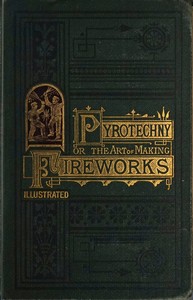
Pyrotechny — Edition Insights
(0 User reviews)
350
Project Gutenberg
2025
Not confirmed
Fireworks
Readers of public-domain and historical texts
Project Gutenberg digital edition
en
Edition facts
Words
60,689
Reading time
264 min
Text sections
22
Before opening Pyrotechny — Edition Insights, the edition data offers a quick orientation: 60,689 words, 4 hr 24 min estimated reading time, and 22 detected text sections.
The text analysis averages about 23.4 words per sentence, while the detected sections provide another way to judge how the source is divided.
Project Gutenberg metadata also associates the work with “Fireworks,” connecting these edition facts with the source record’s subject description.
Source:
Project Gutenberg record #76038
A practical 1873 manual on making fireworks with safety and cleanliness, emphasizing precise compositions, case construction, and wheel design. The author's direct, instructional voice balances technical detail with warnings against unnecessary complexity.
Editorial Edition Score
4.9/5
★★★★★
★★★★★
Calculated from edition completeness, EPUB availability, text structure and catalogue metadata. Not a user rating.
How this score is calculated
- Description quality20 pts
- Title & short description10 pts
- Source metadata20 pts
- Text length15 pts
- Chapters / structure15 pts
- EPUB file integrity20 pts
Total of 100 points, scaled to a 2.5-5.0 range. Editions with an empty description or a missing EPUB file are not scored.
Edition quality
Read the Text
he cases, when arranged in the position of the radii of a circle or spokes of a wheel, will throw a _perfectly straight_ brush of brilliant fire, which will, of course, much more closely represent rays of light emanating from a centre than any fire the sparks of which have a tendency to fall.
3rd.—Another point of difference between the composition containing iron borings and that containing steel filings is that the former should never be employed in the construction of pieces which have motion; for the very motion of the piece, or rather the increased impetus with which the particles of _iron_ are thrown out into the cold air, has the effect of cooling them so rapidly that almost all their beauty is lost. But this is not the case with _steel filings_: they seem almost unaffected by the rapid motion of the piece in which they are employed; and for this reason they possess an advantage which fully makes up for their being so much less showy in their performance than the iron borings.
The cases into which the composition for brilliant fire is rammed need not be so large as those employed for Chinese fire. I employ two sizes—the 1-oz. size for cases that are intended to turn wheels or any revolving pieces, and a smaller size still for those that are to remain perfectly stationary during their combustion.
The fault into which the young pyrotechnist is most likely to fall is that of using a power considerably in advance of his need. In order that you may not do this (for there is always fear of failure when you do), I recommend you _to use no cases for brilliant fire larger than the one-ounce size_. This, you will find, will give you a moving power amply sufficient for any wheels that I suppose you are likely to use, and particularly if you bear in mind the rule, that _increase of power is gained much more safely and much more effectively by an additional number of cases burning at the same time than by any additional force that you can get out of one case_.
The 1-oz. case, as you know by this time, is made round a former exactly half-an-inch in exterior diameter and 12 inches long. The paper for these cases may be cut precisely in the same manner as directed for Chinese fire cases. The imperial board should be cut thus (fig. 52), into twelve equal pieces. Take care that the _long_ side of the board is divided into _three_, and the _short_ into four.
If, however, you think a shorter case sufficient, cut your sheets of paper into eight equal parts, thus (fig. 53), and your imperial board into sixteen pieces—that is, half the length of the strips of paper; this will give you cases about five and a-half inches in length. Both these divisions of paper and board are for the 1-oz. cases.
I will now speak of the smaller sizes, which are used only in fixed pieces, and which are generally called on that account, for the sake of distinction, _fixed cases_.
The former for these is a metal tube 12 inches long and seven-sixteenths of an inch in exterior diameter. For cases of this size you may either use paper and board cut as directed above for the longer 1-oz. cases, or you may divide each sheet of paper into six strips thus (fig. 54), and each sheet of board into twelve pieces half the length of the strips of paper.
For filling either the 1-oz. or the fixed cases it will be evident that you must have at least two drifts for each size that will pass _easily_ into their respective cases—one about 9 inches long in its straight part, and the other from 2 to 3 inches in length.
You must also have a nipple and point over which to ram each different size of case. The exact size of these nipples you will see in the pages of illustrations (figs. 45 and 46).
Use the same mallet and observe the same rules in filling these brilliant fire cases as in filling the cases with Chinese fire.
We are now ready for the compositions. The first given is by far the most beautiful, and most generally used; but being very rapid in its combustion, it must be very carefully and uniformly compressed in the case. No. 2 is of a much quieter character, and may be found useful for some purposes.
BRILLIANT FIRE. No. 1. Meal-powder 4 parts. Bright steel filings 1 part.
No. 2. Meal-powder 16 parts. Nitre 8 „ Sulphur 3 „ Fine Charcoal 3 „ Bright steel filings 10 „
Neither of these compositions should on any account be mixed before their preparation is absolutely necessary, for their whole beauty depends upon the brightness of the filings at the time of firing.
Practicus addresses the reader as a fellow practitioner, not a theorist. The manual opens with a promise of fireworks made “at little cost, and with complete safety and cleanliness,” and the author maintains a brisk, advisory tone throughout. Instructions are given in the imperative or first-person plural (“we will now offer a few remarks”), and the text is punctuated by warnings against “meaningless performance” and “complications” that “deprive your pieces of what would otherwise have been their complete success.” The voice is that of an experienced artisan who values effect over ornament.
The Author’s Direct Address and Emphasis on Simplicity
Practicus writes with a plain, confident voice that assumes the reader has hands and tools ready. He frequently uses the second person (“you must take care”) and the first person plural (“we will now pass on”), creating a sense of shared workshop experience. His advice is consistently practical: when describing how to attach cases to a vertical wheel, he says, “Select the plan which can most easily be carried out by the means that you have at command, and carry it out in the simplest possible way.” This insistence on simplicity recurs throughout the excerpts. He warns that a double triangle wheel with all cases filled with the same composition would be “a very slow sample of pyrotechnic beauty” and “a most meaningless performance,” urging variation instead. The author’s tone is that of a mentor who has seen failed experiments and wants the reader to avoid them.
Precision in Composition and Construction
The manual’s structure reflects a methodical approach: each firework type is given its own section with detailed recipes and step-by-step procedures. The table of contents lists specific compositions—Brilliant, Blue, Green, Yellow, and Red Stars—and the index includes entries for “Scales and Weights,” “Pestle and Mortar,” and “Sieves,” indicating that measurement and preparation are treated as foundational. In the wheel sections, the author distinguishes between compositions that produce “a flame, rather than a jet of sparks” and those that are “sparkling” and effective for horizontal wheels. He notes that for horizontal wheels, “everything depends upon the form that the fire assumes in its outline, and not upon the shape of the wheel itself.” This attention to the behavior of different mixtures shows a writer who understands the physics of combustion and wants the reader to think in terms of effect, not just recipe.
Pacing and Variation in Wheel Design
The excerpts on wheels reveal a keen sense of temporal effect. Practicus discusses duration explicitly: a double triangle wheel “differs from [the single triangle] only in the matter of duration,” and he advises using at least two varieties of composition so that the piece is “capable of lasting a long time in proportion to its size.” He also describes how cases can be fired “singly or doubly,” controlling the pace of the display. In vertical wheels, he recommends making cases “incline outwards” to produce “a much larger circle of fire,” improving the visual impact. The author’s language shifts from instructional to evaluative when he judges effects—“productive of a better effect,” “considerably improved”—showing that his goal is not just to teach construction but to guide the reader toward aesthetic success. The pacing of the text itself mirrors this: dense technical passages are broken by evaluative comments that help the reader prioritize.
Readers should approach Pyrotechny as a working document, best read with materials at hand. The author’s voice rewards attention: his asides about what “would be entirely out of place” or “vastly improved” offer clues to the craft’s unwritten rules. Because the excerpts are incomplete, the full range of compositions and set-piece instructions remains unknown, but the manual’s consistent emphasis on simplicity, variation, and visible effect provides a reliable framework for understanding the rest.
There’s a strange comfort in the Pyrotechny author’s insistence on precision—every gram weighed, every fuse measured—as if chaos could be tamed by care. It reminds me of my grandmother’s hands, counting stitches the same way, building something fragile with quiet patience. Lately, I’ve been leafing through The New Guide to Knitting & Crochet — Key Ideas to Explore, and finding that same gentle arithmetic in its loops and yarns.
There are no reviews for this eBook.
There are no comments for this eBook.
Reader reflection
Take a moment to reflect on this book
Create a short personal record of your experience with this book.
Your progress
0
/
10
2
Did this book hold your interest?
3
How likely are you to recommend this book?
4
Did the language feel accessible?
5
What was its emotional impact?
6
How distinctive were its ideas or approach?
7
How understandable was the text?
8
Did the book meet your expectations?
9
In one sentence, what did you learn?
10