1

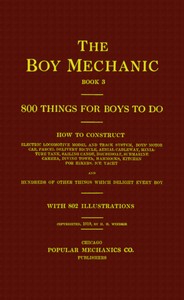
The boy mechanic, book 3 — Text and Context
(0 User reviews)
628
Project Gutenberg
2023
Not confirmed
Handicraft for boys; Handicraft
Readers of public-domain and historical texts
Project Gutenberg digital edition
en
Edition facts
Words
254,648
Reading time
1108 min
Text sections
841
This digital edition of The boy mechanic, book 3 — Text and Context is described by source-level measurements including 254,648 words, 18 hr 28 min estimated reading time, and 841 detected text sections.
The text analysis averages about 20.0 words per sentence, while the detected sections provide another way to judge how the source is divided.
Project Gutenberg metadata also associates the work with “Handicraft for boys,” connecting these edition facts with the source record’s subject description.
Source:
Project Gutenberg record #71856
This 1919 collection presents 800 projects for boys, from building a motor car and ice yacht to crafting a pencil sharpener and weeding tool. Instructions rely on detailed diagrams and step-by-step text, emphasizing practicality and resourcefulness.
Editorial Edition Score
4.9/5
★★★★★
★★★★★
Calculated from edition completeness, EPUB availability, text structure and catalogue metadata. Not a user rating.
How this score is calculated
- Description quality20 pts
- Title & short description10 pts
- Source metadata20 pts
- Text length15 pts
- Chapters / structure15 pts
- EPUB file integrity20 pts
Total of 100 points, scaled to a 2.5-5.0 range. Editions with an empty description or a missing EPUB file are not scored.
Edition quality
Read the Text
small electric lamp, D, is set in the corner, and electrical connection made to it through B and C, the plug connections passing through the back of the cabinet. When the cover is down, the electric circuit is open, and the moment it is raised, connection is made at C, and the lamp lights. The backs of most phonograph cabinets may be removed easily to make these changes.--M. C. Ball, Kansas City, Mo.
Device for Suspending Parcels from Overhead Hooks
To hang small sacks or other articles out of reach overhead, so that they may be easily taken down, I use a double-eye hook which I made of wire. A single piece of wire is used, and twisted into two loops as shown, and then formed into a twisted hook. I use a pole with a nail, hooking it into the lower loop, to raise the parcel; this leaves the upper loop free to be hooked on the nail above.--E. B. Warren, Garnet, Mont.
Steel Wool as Aluminum-Ware Cleaner
It takes little trouble to keep aluminium pots and pans shining if they are cleaned frequently with steel wool, water, and a nonalkaline soap. Use a very fine grade of the wool, and give the utensils a few rubs frequently rather than attempt to clean them only occasionally, when much soiled.--L. P. Langan, Denver, Colo.
How to Make a Model Old-Four Monoplane
The old-four monoplane model, made famous by its wonderful flights, is one of the most graceful that has been built. Its large size and slow, even glide make it a much more desirable flier than the ordinary dartlike model. It gives one a true insight into the phenomena of heavier-than-air flight. This machine, when complete, should weigh 9 oz. and fly 1,200 ft., rising from the ground under its own power and landing lightly. Its construction is simple, and with careful reference to the sketches, an exact reproduction may be made.
For the motor bases, A, Fig. 1, secure two spruce sticks, each 48 in. long, ³⁄₈ in. wide, and ¹⁄₄ in. thick, and fasten a wire hook on one end of each stick with thread wound around after giving it a coat of glue. These hooks are to hold one end of the rubber bands that act as the motive power, and are designated by the letter B. At the opposite ends of the sticks, at C, bearings are provided, which consist of blocks of wood, each 1 in. long, 1 in. wide, and ³⁄₈ in. thick. These are also bound in place with thread after gluing them. Holes are drilled through the blocks lengthwise and then lined with bushings made of brass tubing, ¹⁄₁₆ in. in inside diameter. The two motor bases A are connected with four cross sticks, D, each 9 in. long and ³⁄₁₆ in. square. These are bound and glued on the under side, one near each end and the others equidistant each from the other and from the nearest end stick. The front bumper E is made of round rattan, ¹⁄₈ in. in diameter.
The alighting gear is next in order of construction. This is made as shown entirely of bamboo, ³⁄₁₆ in. square. The pieces marked F are 11 in. long; G, 9¹⁄₂ in. long, and the cross bar H, 11 in. long. At the rear, the pieces J are 13 in. long; K, 4¹⁄₂ in. long, and the cross piece L, 11 in. long. The distance between the points M and N, Fig. 2, is 6 in., and between O and P, 9 in. The bamboo is easily curved by wetting and holding it for an instant in the flame of a candle. It will hold its shape just as soon as it becomes cold. The wheels are made of tin, 1¹⁄₂ in. in diameter, borrowed from a toy automobile. The axles are made from wire, ¹⁄₁₆ in. in diameter.
The wing spars Q are made of spruce, ³⁄₁₆ in. wide and ¹⁄₄ in. thick. Those for the front are 30 in. long, and for the rear, 36 in. long. The ribs R are made of bamboo pieces, ¹⁄₁₆ in. square, 5 in. long for the front plane, and 6 in. for the rear. These are bound and glued on top of the spars, 3 in. apart. They are given a slight upward curve. The round ends are made of ¹⁄₁₆-in. rattan.
The third volume of The Boy Mechanic opens with an elaborate plan for a homemade motor car, complete with sectional side views, brake details, and steering gear. The editor, H. H. Windsor, frames the project not as a replica of manufactured cars but as an opportunity for individuality: the home-built car “has an individuality that puts it in a class by itself.” This tension between amateur construction and professional standards runs through the collection. The book’s 802 illustrations and 841 text sections cover an astonishing range—from a concrete feeding pan for chicks to a spray nozzle made from an acetylene burner. Each project is presented as a self-contained challenge, often contributed by named individuals from across the United States and Canada, lending the volume a collaborative, practical character.
From Motor Cars to Match Safes: The Range of Projects
The book’s subtitle promises “800 things for boys to do,” and the excerpts confirm a remarkable diversity. Major construction projects—a boys’ motor car, an electric locomotive model, a houseboat, an ice yacht—sit alongside small household aids: a cleanly pencil sharpener that traps dust in a box, a slicing board for camp kitchens, and a match safe made from cattle hoofs. The motor car instructions alone run to multiple pages of assembly views and detail drawings, while the weeding tool is described in a single paragraph. This juxtaposition suggests that the intended reader might move from building a miniature tank to fashioning a case-knife weeder without a change in tone. The projects are united by a common method: clear, numbered steps keyed to figures, with materials assumed to be readily available—bicycle wheels, broom handles, old case knives.
Instructions Built on Diagrams and Details
The text is inseparable from its illustrations. Phrases like “as shown in the sketch” and “referring to the assembly views” appear repeatedly, making the written instructions dependent on the 802 figures. The motor car chapter, for example, refers to Figs. 1 through 7 for assembly, brake detail, steering gear, and frame construction. The concrete feeding pan project instructs the reader to “place it in an inverted position in a shallow box, as shown in the sketch.” This reliance on visual information means the book functions as a hybrid of manual and atlas. The prose is terse and technical, avoiding narrative or persuasion. Contributors are credited with full names and locations—S. H. Bosuston of Victoria, B.C., for a bench clamping trick; L. G. Burnand of Lyons, Iowa, for the weeding tool—which adds a layer of authenticity and geographic breadth.
Resourcefulness as a Recurring Theme
Across projects, a pattern of repurposing and improvisation emerges. The spray nozzle is made from an acetylene burner “even though the lava tips are broken off.” The weeding tool uses an old case knife and a broom handle. The pencil sharpener employs emery paper fixed to a box lid. These are not designs for commercial manufacture but solutions for the home workshop. The motor car article explicitly states that “only the essential parts are considered” and that “other useful and ornamental features may be added as the skill and means of the builder make possible.” This open-endedness invites the reader to adapt, not merely replicate. The book thus models a mindset: see what is at hand, and see what it can become.
Readers approaching this volume should treat it as a workshop companion rather than a linear read. The projects vary widely in complexity and required materials; it may be useful to scan the table of contents for a match to one’s current tools and interests. The instructions assume a basic familiarity with hand tools and a willingness to interpret drawings. Because the book is a compilation of contributions, the quality and clarity of directions differ from project to project. Patience with the early twentieth-century terminology—and with the occasional missing step—will be rewarded by the satisfaction of making something functional from scratch.
I’ve often shelved the 1919 Boy Mechanic beside my desk, its diagrams of weeding tools and ice yachts whispering of hands that built before they flew. There’s a quiet kinship there—the same patient resourcefulness that later lifted those boys into cockpits, stitching canvas and wire into the sky. One taught craft, the other, the longing that craft answered. The Story of American Aviation — Context and Discussion holds that second page, but the first always smells of oil and sawdust.
There are no reviews for this eBook.
There are no comments for this eBook.
Reader reflection
Record your reading impressions
A brief reflection can help important ideas stay with you longer.
Your progress
0
/
10
2
How much did you enjoy the reading experience?
3
Is this a title you would suggest to others?
4
How easy was the book to follow?
5
Could you apply anything you learned?
6
How strong was your personal connection to the text?
7
How well did it match your expectations?
8
How understandable was the text?
9
In one sentence, what did you learn?
10