1

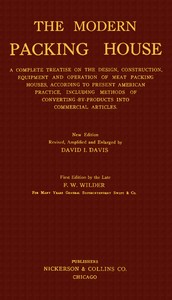
The modern packing house — Reading Companion
(0 User reviews)
1237
Project Gutenberg
2024
Not confirmed
Packing-houses
Readers of public-domain and historical texts
Project Gutenberg digital edition
en
Edition facts
Words
124,182
Reading time
540 min
Text sections
41
Before opening The modern packing house — Reading Companion, the edition data offers a quick orientation: 124,182 words, 9 hr estimated reading time, and 41 detected text sections.
The text analysis averages about 16.1 words per sentence, while the detected sections provide another way to judge how the source is divided.
Project Gutenberg metadata also associates the work with “Packing-houses,” connecting these edition facts with the source record’s subject description.
Source:
Project Gutenberg record #73350
A 1905/1921 treatise on meat packing house design, construction, equipment, and operation, emphasizing practical tables, formulas, and step-by-step processes from animal reception to by-product conversion, with attention to refrigeration and capital investment.
Editorial Edition Score
4.9/5
★★★★★
★★★★★
Calculated from edition completeness, EPUB availability, text structure and catalogue metadata. Not a user rating.
How this score is calculated
- Description quality20 pts
- Title & short description10 pts
- Source metadata20 pts
- Text length15 pts
- Chapters / structure15 pts
- EPUB file integrity20 pts
Total of 100 points, scaled to a 2.5-5.0 range. Editions with an empty description or a missing EPUB file are not scored.
Edition quality
Read the Text
MODERN PACKING HOUSES 1
Introduction and Growth -- Concentration -- Early Methods -- Yankee Ingenuity -- Chicago Yards -- Movement Westward -- Economic Factors -- Saving By-Products -- Pioneer’s Troubles -- Using Box Cars -- Using Refrigerator Cars -- Chilling Rooms -- Mechanical Refrigeration -- Freezing Meats -- Overseas Shipments.
LOCATION AND CONSTRUCTION 9
Location -- Water Supply -- Sewage -- Odors and Prevailing Winds -- Cleanliness -- Designs and Errors -- Character of Business -- Requirements -- Principles of Design.
Description of Plants -- Plant No. 1 -- Plant No. 2 -- Plant No. 3 -- Plant No. 4 -- Type of Plant -- Loading Facilities -- Producing Department -- Abbatoir Building -- Rendering Building -- Live Stock -- Icing Department -- Cooler Building -- Pork House -- Manufacturing Building -- Salt Spaces -- Power Department -- Gravity System -- How to Build -- Fireproof Design -- Advantages -- Slow Burning Construction -- Approval of Plans.
REFRIGERATION EQUIPMENT 29
Ammonia Machines -- Ammonia -- Compressor -- Condenser -- Receiver -- Cooler -- Condensing Water -- Unit Basis -- Computing from Unit Basis -- How Rated -- Freezer Requirements -- Freezers in Small Plants -- Cylinder Arrangement -- Why Brine Circulation -- Air Circulating -- Force Draft -- Coil Room Systems -- Brine Chilling -- Brine Methods -- Types of Brine Coolers -- Balanced Brine System -- Direct Expansion -- Two Stage Compressors.
REFRIGERATION REQUIREMENTS 45
Refrigeration -- Necessities -- Ice Plants -- Natural Ice -- Chilling -- Quantity Refrigeration to Provide -- Space Per Ton Machine -- Machinery Per Head -- For Cooled Meats -- Ice Computation -- Compressor Capacity -- Chilling Lard -- Summary Computations -- Low Temperature Brine System.
POWER PLANT REQUIREMENT 52
Steam Making Equipment -- Uses of Pumps -- Types of Pumps -- Pumps for Brine -- Water Supply -- Pumps for Wells -- Water Distribution Systems -- Pumps for Boiler Feeding -- Heating Boiler Feed Water -- Wells -- Cooling Towers -- Economizers -- Superheaters -- Steam Engines -- Exhaust Steam -- Advice as to Exhaust Steam -- Boilers -- Conclusion.
Meat Chilling -- Dividing Beef Coolers -- Regular Temperatures -- Main Cooler -- Handling Beef -- Fore-Cooler -- Heavy Cattle -- Domestic Beef -- Trimming of Beef -- Skirt Trimming -- Ribbing Beef -- Freezing Beef -- Loading Beef -- Weighing and Tagging -- Care of Coolers -- Mutton and Veal -- Chilling Hogs -- Cellars -- Freezing Meat.
Warehouse Design -- Floor Area -- Fire Proof Buildings -- Floor Construction -- Coolers -- Fan and Ventilation -- Spray System -- Galvanized Sheet Iron Pipes -- Coil Rooms -- Quantity of Pipe -- Method of Erecting -- Life of Pipe -- Cellar Ceiling Suspension -- Ratio of Piping -- Defrosting -- Gardner Curtain System -- Direct Expansion Piping -- Chill-Room Bunkers -- Low Temperature Brine System -- Freezer and Storage Buildings.
SLAUGHTERING CATTLE 92
Receiving Live Stock -- Watering -- Driving Cattle -- Knocking Cattle -- Sticking -- Heading -- Pritch Sticks -- Foot Skinning -- Ripping and Leg Breaking -- Flooring Cattle -- Breast Sawing -- Fell Cutting -- Rumping -- Beef Spreaders -- Fell Beating -- Gutting -- Backing -- Tail Sawing -- Splitting -- Splitting Cleavers -- Clearing Out and Hide Dropping -- Neck Splitting -- Bruise Trimming -- Skirt Trimming -- Washing Cattle -- Fountain Brushes -- Dressing Cattle -- Conveyors.
DRESSING YIELDS AND CATTLE CUTTING 106
Yields of Cattle -- Yield from Twenty-two Native Cattle -- Yield from Fifty-nine Texas Cattle -- Yield from Twenty Heavy Cattle -- Yield from Thirty-four Cattle -- Percentage of Various Cuts -- Beef Cuts -- Diagram of Cutting -- Grading -- Loins -- Ribs -- Rounds -- Chucks -- Plates, Shanks and Flanks -- Barreled Beef.
Green Hides -- Condition -- Scores -- Prod Pole Damage -- Clean Floors -- Leather Yields -- Pattern -- Proper Storage for Hides -- Grading -- Grubs in Hides -- Salt to Be Used -- Building of Packs of Hides -- Trimming of Green Hides -- Switches -- Shrinkage of Hides -- Sheep Pelts.
OLEO OIL AND STEARINE 136
Fats -- Origin of Butterine -- Oleo Oil -- Oleo Fats -- Selection and Care -- Cleanliness and Collection -- Chilling Fat -- Cooling Water -- Melting -- Settling the Oil -- Clarifiers -- Scrap Vat -- Seeding or Graining Oil -- Press Room -- Collecting Oil -- Oil Receivers -- Temperature of Oil Drawn to Tierce -- Stearine -- Oil House Yields -- Grading Fats -- Tests on Oil Fats -- Butcher Fats -- Mutton Fat -- Oil Selection -- Oil House Operation.
The preface frames this work as a practical manual for both established packers and beginners, promising 'valuable information' that will 'aid him in conducting his business.' The authors organize chapters sequentially, following the order of operations from unloading animals to finished product. The text repeatedly stresses the shift from seasonal 'winter packing' to year-round operation, crediting the refrigerating machine as the key innovation. The editor, David I. Davis, revised and enlarged F. W. Wilder's original edition, retaining the original scheme while updating content.
From Winter to All-Year Packing
The historical section contrasts older methods—where hogs were killed only in winter and cured meat emerged 'in inferior condition'—with modern practices that allow fresh pork to be shipped to England 'in good condition.' The text emphasizes that refrigeration made this possible: 'little or no regard is paid to the outside temperature.' Transportation facilities also expanded distribution, enabling fresh pork sales year-round. The authors note that a few years earlier, fresh pork was unavailable in warmer seasons except near slaughterhouses. This transformation is presented as a direct result of technological and logistical advances, not as a gradual evolution.
Capital and Space Requirements
The investment section provides specific ratios: pork packing requires 'much greater' capital than beef because 'fully seventy per cent of the carcass goes into the curing department, to stay from thirty to ninety days.' The authors recommend cooler space for 'twice or three times the killing capacity' and storage area equal to 'five times the hog hanging area.' For a plant killing a thousand hogs daily, that means hanging capacity for 2,500 and five times the floor area for curing. They caution that if product is held longer, a greater ratio than five to one should be used. These figures are presented as practical guidelines, not theoretical ideals.
Handling and Slaughtering Hogs
The hog yarding section insists that hogs 'should be rested in closed covered pens' with summer ventilation and winter warmth. Resting twenty-four hours is 'by no means detrimental.' Drivers should use a 'flat canvass belt attached to a short wooden handle' to avoid clubbing. The text states plainly: 'More care should be used in handling hogs than any other live stock, as hogs are more easily injured.' Special pens are required, and hogs must never be killed until 'thoroughly rested and in normal condition.' In summer, they should be sprinkled. The dressing section then lists critical points under headings like Hoisting, Sticking, and Scalding, reflecting the treatise's systematic, step-by-step approach.
Readers should note that the text combines general principles with specific, quantified recommendations—such as cooler ratios and resting times—that reflect early twentieth-century American practice. The authors assume a reader who wants to apply these methods directly, not merely understand them historically. The numerous formulas and tables, though based on prices of the time, are presented as adaptable by substituting current commercial prices. This is a working manual, not a retrospective account.
Leafing through these tables of chilling rooms and by-product yields, I remembered my grandfather’s ledger of a small-town butcher shop. Odd, how precision feels like affection. That same quiet thrift surfaced when I first read Comparison of Methods of Sewage Purification — Text and Context — both books treat waste and loss as something worthy of careful, unhurried thought.
There are no reviews for this eBook.
There are no comments for this eBook.
Reader reflection
Take a moment to reflect on this book
Create a short personal record of your experience with this book.
Your progress
0
/
10
2
How did the book work for you overall?
3
How likely are you to recommend this book?
4
How much effort did this book require?
5
How distinctive were its ideas or approach?
6
How well did it match your expectations?
7
Was the book easy to understand?
8
How valuable was this book for your own interests?
9
In one sentence, what did you learn?
10