1

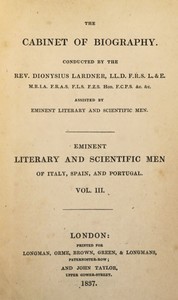
Eminent literary and scientific men of Italy, Spain, and Portugal. Vol. 3 (of 3) — Text and Context
(0 User reviews)
84
Project Gutenberg
2021
Not confirmed
Authors -- Biography; Scientists -- Biography
Readers of public-domain and historical texts
Project Gutenberg digital edition
en
Edition facts
Words
142,011
Reading time
618 min
Text sections
27
Eminent literary and scientific men of Italy, Spain, and Portugal. Vol. 3 (of 3) — Text and Context can be approached with a clearer sense of reading commitment from its source measurements: 142,011 words, 10 hr 18 min estimated reading time, and 27 detected text sections.
The text analysis averages about 22.5 words per sentence, while the detected sections provide another way to judge how the source is divided.
Project Gutenberg metadata also associates the work with “Authors -- Biography,” connecting these edition facts with the source record’s subject description.
Source:
Project Gutenberg record #65228
This editorial note examines how the opening, middle, and later excerpts of Volume 3 of Lardner's biographical series guide a first reading, focusing on the transition from Dante's political exile to Cervantes' literary criticism and the dramatic siege of Numantia.
Editorial Edition Score
4.9/5
★★★★★
★★★★★
Calculated from edition completeness, EPUB availability, text structure and catalogue metadata. Not a user rating.
How this score is calculated
- Description quality20 pts
- Title & short description10 pts
- Source metadata20 pts
- Text length15 pts
- Chapters / structure15 pts
- EPUB file integrity20 pts
Total of 100 points, scaled to a 2.5-5.0 range. Editions with an empty description or a missing EPUB file are not scored.
Edition quality
Read the Text
; Now that I have learnt to love thee. Seeking thee in vain I rove.'
'But the fault was thine, young warrior, Thine it was--it was not mine; He who brought thy earliest letter, Was a messenger of thine; And he told me--graceless traitor-- Yes! he told me--lying one-- That thou wert already married In the province of Leon; Where thou hadst a lovely lady, And, like flowers too, many a son.'
'Lady! he was but a traitor. And his tale was all untrue, In Castille I never entered-- From Leon too, I withdrew When I was in early boyhood, And of love I nothing knew.'"[7]
In addition to these ballads we must mention the romances of chivalry. There is an undying discussion as to the nation in which these works originated. According to Spanish writers, the real author of the first or genuine Amadis was Vasco Lobeira, a native of Portugal, who flourished at the end of the thirteenth century, and lived till the year 1325. Perverted as history and geography are in this and other similar works, they are full of invention, and alive with human feeling. Heroic deeds are blended with fairy machinery, borrowed from Arabian tales; every thing is brought in to adorn and to exalt the character of the knight, in war and in love. Even now Amadis preserves its charm; hew great must have been its influence among nobles whose lives were dedicated to the hardships of war, and whose own hearts were the birthplace of passion, as sincere and vehement as any that warmed the heart of fictitious cavalier.
Already, however, had various kings and nobles of Spain cultivated letters. The first authors whose names appear were less of poets than many whose works appear in the various Cancioneros. Elevated in rank, they addicted themselves to study from a love of knowledge. Eagerly curious about the secrets of nature, or observant of the philosophy of life, they were desirous of instructing their countrymen. They deserve infinite praise for their exertions, and the motives that animated them; but their productions cannot have the same interest for us as the genuine emanations of the feelings. The heart of man, its passions and its emotions, endures for ever the same, and the poet who touches with truth the simplest of its chords remains immortal; but our heads change their fashion and furniture. We disregard obsolete knowledge as a ruin, out of proportion and fallen to pieces; while the language of the passions, like vegetation for ever growing, is always fresh. Alphonso X., surnamed the Wise, loved learning. He rendered a great service to his country by the cultivation he bestowed on the Castillian language. His verses bear the marks of the attention he paid to correctness, and by his command the Spanish language was substituted for Latin in public instruments. Through him the Bible was translated into Castillian, and a Chronicle of Spain was commenced under his directions. He favoured the troubadours, and himself aspired to write verses. There is an entire book of Cantigas or Letras, composed in the Gallician dialect, by him. El Teroso is his principal work; it detailed his alchymical secrets, and is written in Castillian, in versos de arte mayor: much of this work remains still undeciphered. To him also is attributed a poem called Las Querellas, of which two stanzas only are preserved, and those so superior in versification to the Tesoro, that it is doubted whether they can be the production of the same man and age. The most useful work that owed its existence to his superintendence was the Alphonsine Tables, containing calculations truly extraordinary for that period.
Alphonso XI. followed in his footsteps in the cultivation of the Castillian language. He is said to have composed a General Chronicle of Redondillas, which is lost.
It was in the time of Alphonso XI. that Don Juan Manuel wrote his Count Lucanor, a series of tales put together somewhat in the style of the "Seven Wise Masters." An inexperienced prince, when in any difficulty, applies to his minister for advice, who replies by relating some tale or fable, concluded by a maxim in verse, as the moral of the story. These show his knowledge of the world; and one, in opposition to that of the Grecian sage, who said, men were to treat their friends as if they were one day to become their enemies, deserves to be recorded in honour of the more noble-minded Castilian;
"Quien te conseja encobrir de tus amigos, engañarte quiera assaz, y sin testigos."
The volume opens with a detailed table of contents listing lives from Dante to Camoens, immediately signaling a chronological and national structure. The first excerpt, on Dante, begins with his descent and birth, then moves to his mother's dream and early love for Beatrice. The narrative voice is factual yet engaged, quoting from the Inferno and Purgatorio to illustrate political and personal turmoil. This early section establishes a pattern: biographical facts are interwoven with literary excerpts, and the author does not shy from judgment—Dante is accused of self-confidence by Boccaccio. The reader is thus prepared for a work that combines historical detail with critical commentary.
From Dante's Exile to Cervantes' Critique
The middle excerpt shifts to Cervantes, where the tone becomes more evaluative. The author declares that Cervantes 'was not a poet,' despite his imagination and invention, and quotes Coleridge to define poetry as 'the best words in the best places.' This direct critical stance contrasts with the earlier biographical narrative. The excerpt then praises the play Numantia for its 'poetry of conception and passion,' suggesting a nuanced view: Cervantes fails as a poet in general but succeeds in this particular work. The reader sees that the volume does not merely recount lives but also judges literary merit, often with specific criteria.
The Siege of Numantia as Dramatic Evidence
The longest excerpt from the Cervantes section describes the plot of Numantia, focusing on the siege and the inhabitants' self-destruction. The author provides a detailed summary: Scipio digs a trench, famine ensues, and lovers Morandro and Lira exchange despairing dialogue. The excerpt includes a verse translation where Lira says, 'I am worn with hunger so, / That quickly will th' o'erpowering woe / For ever break my vital thread.' This passage illustrates how the volume uses extended quotations to support its critical claims. The reader can assess the play's emotional power directly, rather than relying solely on the author's opinion.
Structural Clues from the Table of Contents
The table of contents reveals that the volume covers Spanish and Portuguese figures, from Mosen Jordi to Camoens, with analytical and chronological tables for all three volumes. The entries are not uniform: some, like Dante, receive extensive subheadings (e.g., 'His Mother's Dream,' 'The Battle of Campaldino'), while others are listed only by name. This suggests varying depth of treatment. The reader can anticipate that later lives may be shorter or less detailed. The inclusion of 'Early Poets of Portugal' and 'Gil Vicente' indicates a deliberate effort to include lesser-known figures alongside major ones like Cervantes and Calderon.
The Authorial Voice and Its Limits
Throughout the excerpts, the authorial voice is authoritative but not omniscient. In the Dante section, the author notes 'uncertain traditions' and admits that some details are disputed. For Cervantes, the judgment that his first publication 'Galatea' is 'beautiful in its spirit' but 'not original' shows a willingness to critique. However, the excerpts are incomplete; the reader does not see how the volume treats later figures like Quevedo or Camoens. The editorial note must therefore caution that the sample may not represent the whole. The volume's structure—biography interspersed with literary analysis—is clear, but the balance between these elements may shift in later sections.
Readers approaching this volume should note that it is neither a pure reference work nor a continuous narrative. The excerpts suggest a hybrid form: biographical facts are presented alongside literary criticism, often supported by quotations. The table of contents is a useful guide for selecting lives of interest, but the depth of treatment varies. Pay attention to the author's evaluative language—phrases like 'not a poet' or 'beautiful in its spirit' signal critical judgments that may provoke further reading of the works discussed.
This volume’s turn from Dante’s exile to Cervantes’ criticism felt like stepping from a cold stone stairway into a warm kitchen. I remembered, strangely, the quiet pragmatism of The modern packing house — Reading Companion, which once offered a similar grounding—not escape from struggle, but a gentle way to work within it. Both texts breathe with lives still being lived. Midway, I paused, just to let the old pages settle. They felt like friends.
There are no reviews for this eBook.
There are no comments for this eBook.
Reader reflection
Take a moment to reflect on this book
Create a short personal record of your experience with this book.
Your progress
0
/
10
2
Was reading this book enjoyable?
3
Would you recommend this book to another reader?
4
How demanding did the text feel?
5
How clearly were the main ideas presented?
6
Is this a title worth rereading?
7
Which part made the strongest impression?
8
What was its emotional impact?
9
In one sentence, what did you learn?
10