1

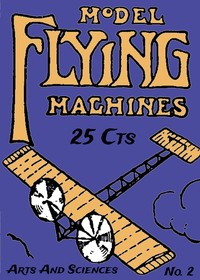
Model Flying Machines — Edition Insights
(0 User reviews)
52
Project Gutenberg
2021
Not confirmed
Airplanes -- Models
Readers of public-domain and historical texts
Project Gutenberg digital edition
en
Edition facts
Words
23,918
Reading time
104 min
Text sections
11
The catalog record for Model Flying Machines — Edition Insights provides practical reading context through 23,918 words, 1 hr 44 min estimated reading time, and 11 detected text sections.
The text analysis averages about 17.8 words per sentence, while the detected sections provide another way to judge how the source is divided.
Project Gutenberg metadata also associates the work with “Airplanes -- Models,” connecting these edition facts with the source record’s subject description.
Source:
Project Gutenberg record #64296
This 1913 manual by A. P. Morgan offers precise, hands-on instructions for building and flying model aeroplanes, emphasizing practical adjustments over appearance. Detailed plans for six models, from simple monoplanes to twin-prop racers, reveal the author's focus on balance, stability, and iterative tuning through wire bending and rubber motor tension.
Editorial Edition Score
4.8/5
★★★★★
★★★★★
Calculated from edition completeness, EPUB availability, text structure and catalogue metadata. Not a user rating.
How this score is calculated
- Description quality20 pts
- Title & short description10 pts
- Source metadata20 pts
- Text length15 pts
- Chapters / structure15 pts
- EPUB file integrity20 pts
Total of 100 points, scaled to a 2.5-5.0 range. Editions with an empty description or a missing EPUB file are not scored.
Edition quality
Read the Text
CHAPTER I. GENERAL PRINCIPLES UNDERLYING AEROPLANE FLIGHT. ........ CHAPTER II. GENERAL REMARKS REGARDING MODEL AEROPLANE CONSTRUCTION. THE QUESTION OF RESISTANCE. WEIGHT. STABILITY. .................... CHAPTER III. PLANES AND RUDDERS. ELEVATORS AND TAILS. ............. CHAPTER IV. THE FUSELLAGE OR FRAMEWORK. ........................... CHAPTER V. MOTIVE POWER. .......................................... CHAPTER VI. SCREW PROPELLERS. ..................................... CHAPTER VII. BEARINGS, THRUST BLOCKS AND GEARS. ................... CHAPTER VIII. BUILDING AND FLYING MODEL AEROPLANES. ............... The Blerioplane Flyer. (Plate II.) .............................. The Monoplane Flyer. (Plate III.) ............................... The Baby Racer. (Plate IV.) ..................................... The Peerless Racer. (Plate V.) .................................. The Competition Flyer. (Plates VI and VII.) ..................... The Long Distance Racer. (Plates VIII and IX.) .................. Fleming-Williams Flyer. (Plate X.) .............................. FLYING THE MODELS. ..............................................
Alfred Powell Morgan's 1913 manual Model Flying Machines opens with a direct claim: constructing model aeroplanes is 'essentially simple' and an 'ideal method of gaining practical knowledge of the new science of aeronautics.' The author immediately distinguishes his approach from mere imitation, stating that the included plans are 'designed rather to fly greater distances than to appear like some man carrying prototype.' This utilitarian emphasis shapes every subsequent instruction, from the choice of materials—fine steel piano wire, rattan reed, aluminum tubing—to the repeated insistence on experimental adjustment. Morgan writes not as a theorist but as a builder who expects his reader to bend, lash, and test.
Diction of the Workshop
Morgan's vocabulary is that of a practical mechanic, not a classroom instructor. He uses 'fusellage' (a variant spelling he retains throughout) for the framework, 'motor base' for the central spar, and 'bamboo varnish' as a sealant. Instructions are terse and physical: 'bend the wire edge,' 'lash with a wire,' 'close it around the reed tightly with a pair of pliers.' The prose avoids abstraction; even the explanation of lift relies on a kite diagram (Fig. 1) rather than Bernoulli. This lexical choice positions the reader as a fellow tinkerer, expected to understand terms like 'dihedral angle' and 'centre of pressure' through context and experimentation.
Voice of the Experimenter
The authorial voice is confident but provisional. Morgan frequently qualifies his instructions with phrases like 'in some cases,' 'a little experimental work will determine,' and 'if the aeroplane tends to rise too abruptly.' He presents adjustments as conditional responses: 'bend the rear edge of the main planes up' to correct a too-steep climb, or 'bend them down' if the model dives. This voice treats the reader as a collaborator in discovery, not a passive follower. The repeated use of 'will'—'the machine will take a downward path'—suggests predictable outcomes, yet the manual's structure, with separate chapters for each component, implies that success depends on the builder's judgment.
Structure as a Teaching Tool
The book's organization mirrors the building process. After introductory chapters on principles and general construction, Morgan devotes individual chapters to planes, rudders, fusellage, motive power, propellers, and bearings. Each chapter builds on the previous one, but the final chapter—'Building and Flying Model Aeroplanes'—presents six distinct plans in sequence, from the simple Blerioplane Flyer to the twin-propeller Competition Flyer. The plans are not mere blueprints; they include troubleshooting notes. For the Blerioplane, Morgan notes that 'one side of the main plane will have to be made slightly larger than the other in some cases to counteract the twisting action of the propeller.' This structural choice—theory first, then applied examples—allows the novice to progress from understanding to hands-on construction.
Recurring Details of Adjustment
Throughout the excerpts, a single theme recurs: the need for iterative tuning. Morgan describes adjusting the 'front edge of the elevator' to control ascent, bending the wire edges of planes to alter flight path, and adding 'glass beads' between bearing and propeller to reduce friction. The Monoplane Flyer instructions include a vertical fin 'to act as a keel or rudder and hold the machine to a straight course.' Even the rubber motor's tension is variable: '8 strands of 3/32 x 3/32 inch rubber' for one model, while another uses strands 'connected at one end to the propeller and at the other to a hook.' These details reveal a design philosophy where stability is achieved not through fixed geometry but through responsive, material-specific adjustments.
Morgan's manual rewards the reader who treats it as a starting point rather than a script. The plans are deliberately minimal, often relying on a single plate and a few paragraphs of text. The builder is expected to supply judgment, patience, and a willingness to bend wire until the machine 'soar away under its own power.' For the modern reader, the book offers a window into early twentieth-century hobbyist culture, where aeronautical knowledge was gained through trial, error, and the careful observation of a small model's flight.
There’s something quietly grounding about a book that treats making as a kind of conversation—tuning, adjusting, listening to what doesn’t hold. That old model-building manual felt just that way, each wire bend a small act of patience. I found a similar steadiness in The Memoirs of Charles H. Cramp — A Closer Reading, where craft and memory settle together, unhurried.
There are no reviews for this eBook.
There are no comments for this eBook.
Reader reflection
Before you leave, reflect on the book
Use these questions to collect your thoughts before moving on.
Your progress
0
/
10
2
How did the book work for you overall?
3
Would you pass this book on to a friend?
4
How demanding did the text feel?
5
Would a second reading be valuable?
6
How distinctive were its ideas or approach?
7
Could you apply anything you learned?
8
Which part made the strongest impression?
9
What is the main idea you are taking away?
10