1

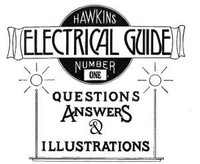
Hawkins Electrical Guide v. 01 (of 10) Questions, Answers, & Illustrations, A progressive course of study for engineers, electricians, students and those desiring to — A Closer Reading
(0 User reviews)
2062
Project Gutenberg
2011
Not confirmed
Electrical engineering -- Handbooks, manuals, etc.
Readers of public-domain and historical texts
Project Gutenberg digital edition
en
Edition facts
Words
56,476
Reading time
246 min
Text sections
10
Hawkins Electrical Guide v. 01 (of 10) Questions, Answers, & Illustrations, A progressive course of study for engineers, electricians, students and those desiring to — A Closer Reading can be approached with a clearer sense of reading commitment from its source measurements: 56,476 words, 4 hr 6 min estimated reading time, and 10 detected text sections.
The text analysis averages about 20.0 words per sentence, while the detected sections provide another way to judge how the source is divided.
Project Gutenberg metadata also associates the work with “Electrical engineering -- Handbooks, manuals, etc.,” connecting these edition facts with the source record’s subject description.
Source:
Project Gutenberg record #38384
This editorial note examines the instructional design and language of Hawkins Electrical Guide v. 01, focusing on its question-and-answer format, use of analogies, and pedagogical pacing as seen in excerpts on magnetism and magnetic fields.
Editorial Edition Score
4.8/5
★★★★★
★★★★★
Calculated from edition completeness, EPUB availability, text structure and catalogue metadata. Not a user rating.
How this score is calculated
- Description quality20 pts
- Title & short description10 pts
- Source metadata20 pts
- Text length15 pts
- Chapters / structure15 pts
- EPUB file integrity20 pts
Total of 100 points, scaled to a 2.5-5.0 range. Editions with an empty description or a missing EPUB file are not scored.
Edition quality
Read the Text
Produced by Juliet Sutherland, Henry Gardiner and the Online Distributed Proofreading Team at https://www.pgdp.net
Transcriber’s Note: The original publication has been replicated faithfully except as shown in the TRANSCRIBER’S AMENDMENTS at the end of the text. This etext presumes a mono-spaced font on the user’s device, such as Courier New. Words in italics are indicated like _this_. Text emphasized with bold characters or other treatment is shown like =this=. Superscripts are indicated like this: S^{ta} Maria. Subscripts are indicated like this: H_{2}O. Footnotes are located near the end of the work.
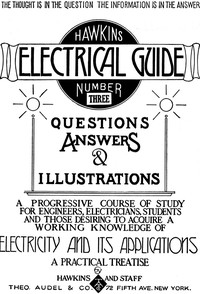
THE THOUGHT IS IN THE QUESTION THE INFORMATION IS IN THE ANSWER
QUESTIONS ANSWERS & ILLUSTRATIONS
A PROGRESSIVE COURSE OF STUDY FOR ENGINEERS, ELECTRICIANS, STUDENTS AND THOSE DESIRING TO ACQUIRE A WORKING KNOWLEDGE OF
ELECTRICITY AND ITS APPLICATIONS
THEO. AUDEL & CO. 72 FIFTH AVE. NEW YORK.
COPYRIGHTED, 1914, BY THEO. AUDEL & CO., NEW YORK.
Printed in the United States.
_The word “guide” is defined as:_
=_One who leads another in any path or direction; a person who shows or points out the way, especially by accompanying or going before; more particularly, one who shows strangers or tourists about; a conductor; leader, as “let us follow our guide.”_=
_This book, or =“Guide,”= is so called because it =leads= or =points out the way= to the acquirement of a theoretical and practical knowledge of Electricity._
_There are several guides, each covering in detail a certain phase of the broad subject of Electricity and leading the reader progressively, and in such a way, that he easily grasps, not only the simple fundamental facts, but the more complex problems, encountered in the study of Electricity. This is accomplished by the aid of a =very large number of illustrations=, together with specific explanations, worded in =concise and simple language=._
_The Guides are written partly in the question and answer form, as this style of presentation has met with hearty approval, not only from those of limited education, but also from the better informed._
_Where recourse is had to the question and answer form, the special aim of the author has been to give short and direct answers, in such plain language as to preclude a misconception of the meaning. With this in view, =the answer gives= simply =the information sought by the question=._
_=The answer is limited to one paragraph= so that the reader may concentrate upon the fact or facts demanded by the question._
_Any enlargement of the answer or specific explanations of items contained therein, are presented in separate paragraphs printed, in smaller type._
_With this plan of =separating the answer=, as it were, from items of secondary importance, and making it short and simple, its content is more forcibly impressed upon the mind of the reader._
_In a text book, it is necessary to illustrate and explain the various species of commercial apparatus met with in practice, and in this connection the Publishers desire to call attention to the manner in which the author has treated what may be classed as the =“descriptive matter.”= Contrary to the usual custom of giving descriptions of commercial machines in the main text, where they would occupy considerable space, to the exclusion of the more important matter, all such descriptions are placed in small type directly under the illustrations, leaving space for an adequate presentation of the underlying =principles=, =theories=, and for the large amount of =practical information= that is essential to obtain a general knowledge of Electricity and its numerous applications._
_Credit is largely due to Frank D. Graham, B.S., M.S. (Princeton University), and M.E. (Stevens Institute), practical engineer, for the authorship of the =Guides=, and for original sketches illustrating electrical principles and construction._
TABLE OF CONTENTS GUIDE NO. 1.
=INTRODUCTORY CHAPTER=
=ELECTRICITY= =1 to 4=
Nature and source--=kinds of electricity:= static, current, dynamic, radiated, positive, negative, atmospheric, frictional, resinous, vitreous.
=STATIC ELECTRICITY= =5 to 26=
Electrical =attraction and repulsion=--the charge--distribution of the charge--free and bound electricity--conductors and insulators--=electroscopes=--gold leaf electroscope--electric screens--electrification by induction--nature of the induced charge--the electrophorus--=condensers=; Leyden jar--=electric machines=--action of Toepler-Holtz machine--Wimshurst machines.
=THE ELECTRIC CURRENT= =27 to 34=
Volt--ampere--ohm--=Ohm’s law=--production of the electric current--current strength--voltage drop in an electric current.
=PRIMARY CELLS= =35 to 67=
=The word “battery”=--action of cell--chemical changes; polarization--effects of polarization--methods of depolarization-- depolarizers--depolarizer bag--Volta’s contact law--contact series of metals--=laws of chemical action in cell=-- requirements of a good cell--=single and two fluid cells=-- the Leclanche cell--Fuller bichromate cell--the Edison cell--Grenet bichromate cell--Daniell cell--directions for making a Daniell cell--gravity cells--Daniell gravity cell--so-called “dry” cells--=points relating to dry cells=-- care of cells--cleanliness--separating the elements--creeping-- amalgamated zinc--battery connections.
=CONDUCTORS AND INSULATORS= =68 to 74=
Nehemiah Hawkins’s Electrical Guide opens with a declaration of purpose: “THE THOUGHT IS IN THE QUESTION THE INFORMATION IS IN THE ANSWER.” This motto encapsulates the book’s distinctive structure. Rather than a continuous narrative, the text proceeds through numbered questions and concise answers, each typically confined to a single paragraph. The preface explains that this format aims to “give short and direct answers, in such plain language as to preclude a misconception of the meaning.” Supplementary explanations appear in smaller type, creating a layered reading experience where the core fact is immediately visible and elaboration is optional.
Question-and-Answer as a Pedagogical Device
The question-and-answer form dominates the excerpts. For instance, the text asks “How is magnetic flux measured?” and answers “By a unit called the maxwell,” then immediately defines the maxwell and the gauss in subsequent Q&A pairs. This rhythm—question, short answer, optional detail—mirrors a classroom drill or self-test. The preface notes that this style “has met with hearty approval, not only from those of limited education, but also from the better informed.” By separating the answer from secondary items, Hawkins forces the reader to focus on one fact at a time. The result is a text that feels less like a treatise and more like a guided interrogation of the subject.
Analogies and Mnemonics in Explanations
Hawkins relies heavily on analogies to make abstract concepts tangible. The most striking is Maxwell’s “corkscrew rule,” which relates the direction of current to magnetic lines of force: “the direction of the current and that of the resulting magnetic force are in the same relation to each other as is the forward travel and rotation of an ordinary corkscrew.” This mechanical image is reinforced by a diagram and a step-by-step description. Similarly, the text uses iron filings on cardboard to visualize magnetic fields, and a suspended magnet to trace lines of force. These concrete, everyday references—corkscrews, filings, compass needles—anchor theoretical principles in physical experience, a strategy that likely aided readers with limited mathematical background.
Pacing and the Role of Illustrations
The excerpts reveal a deliberate alternation between dense definition and experimental demonstration. After defining magnetic force and its laws, the text shifts to a hands-on experiment: “placing a piece of cardboard over the magnet and sprinkling iron filings on the paper, gently tapping at the same time.” This change in pace—from abstract law to physical action—breaks up the instructional monotony. The preface emphasizes that “a very large number of illustrations” accompany the text, and the excerpts include figures such as “Fig. 109.—Tracing lines of force with a suspended magnet.” Each figure is tightly integrated with the surrounding prose, often serving as the visual answer to a question. The result is a multimodal learning experience where text and image work in tandem.
Readers approaching this guide should note its dual-layer structure: the bold Q&A core for quick reference, and the smaller-type expansions for deeper study. The analogies and experiments are not decorative but functional, designed to bridge theory and practice. Because the excerpts cover only the first volume’s early chapters on magnetism, the full work likely extends this method to circuits, motors, and generators. The guide rewards those who engage with both its questions and its illustrations.
This guide’s careful question-and-answer pacing reminds me of winter evenings spent puzzling over Model aeroplanes The building of model monoplanes, biplanes, etc., together with a chapter on building a model airship — A Closer Reading, where each diagram felt like a quiet hand leading mine. Both books trust that understanding arrives slowly, through patient, repeated strokes rather than sudden leaps.
There are no reviews for this eBook.
There are no comments for this eBook.
Reader reflection
Record your reading impressions
A brief reflection can help important ideas stay with you longer.
Your progress
0
/
10
2
Did this book hold your interest?
3
Would you encourage someone else to read it?
4
How much effort did this book require?
5
How clear did the writing feel?
6
How much did the book move you?
7
Did any part of the book feel personally relevant?
8
Did the book meet your expectations?
9
What did this book teach you most?
10