1

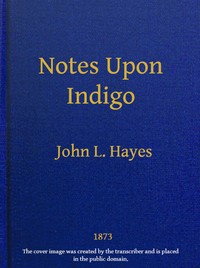
Notes Upon Indigo — Text and Context
(0 User reviews)
1916
Project Gutenberg
2020
Not confirmed
Indigo
Readers of public-domain and historical texts
Project Gutenberg digital edition
en
Edition facts
Words
32,049
Reading time
140 min
Text sections
7
The catalog record for Notes Upon Indigo — Text and Context provides practical reading context through 32,049 words, 2 hr 20 min estimated reading time, and 7 detected text sections.
The text analysis averages about 22.2 words per sentence, while the detected sections provide another way to judge how the source is divided.
Project Gutenberg metadata also associates the work with “Indigo,” connecting these edition facts with the source record’s subject description.
Source:
Project Gutenberg record #62008
An 1873 technical essay advocating for the revival of natural indigo dye in American wool manufacturing, contrasting its stability with aniline dyes and linking dye quality to national reputation.
Editorial Edition Score
4.6/5
★★★★★
★★★★★
Calculated from edition completeness, EPUB availability, text structure and catalogue metadata. Not a user rating.
How this score is calculated
- Description quality20 pts
- Title & short description10 pts
- Source metadata20 pts
- Text length15 pts
- Chapters / structure15 pts
- EPUB file integrity20 pts
Total of 100 points, scaled to a 2.5-5.0 range. Editions with an empty description or a missing EPUB file are not scored.
Edition quality
Read the Text
wn manufactures. In the hands of the English this product rapidly rose to be the most important of India, in a commercial view, except that of rice. The small cost of a factory, and the comparatively small capital required for this production, caused the indigo culture to be preferred to sugar planting. The importation and sale of this commodity at the East India House, in 1792, amounted to 581,827 lbs., while the importation into Great Britain from other parts of the world amounted to 1,285,927 lbs. In 1806 the importation from the East Indies, and sales at the East India House, amounted to 4,811,700 lbs., and produced in sterling money £1,685,275. In the year 1862–63, the export from India, and the destination of supplies, were as follows:—
Destination. Quantity. Value. ---------------------------------------------------- United Kingdom 8,537,133 lbs. $1,627,035 America 134,064 26,949 Arabian and Persian Gulfs 343,037 33,385 France 1,922,120 371,396 Germany 85,680 15,504 Suez 295,269 51,730 Other places 9,577 815 ---------------------------------------------------- Total 11,326,880 lbs. $2,126,814
The value of exports in 1866 was £1,861,501. In the same year the imports of indigo from the whole of Central America, including Honduras, was 672,480 lbs. The consumption of indigo in Great Britain did not increase during the ten years ending with 1867. This stationary demand, notwithstanding the fall in the price of the drug and increase of population, is attributed by McCulloch principally to the decreasing use of blue cloth. It is more probably due to the substitution of cheaper dyes. The average home consumption in Great Britain for seven years ending in 1867, was 1,675,072 lbs. per year.
The importation into this country for the twenty years last past is shown by the following table, kindly prepared at our request by the chief of the Bureau of Statistics:—
_Statement of Imports of Indigo into the United States during the Fiscal Years ended June 30, 1853–1872._
INDIGO. Fiscal Year ended June 30 FREE OF DUTY. DUTIABLE. -------------------------------------------------- Pounds. Dollars. Pounds. Dollars. 1853 1,387,847 947,367 1854 1,965,789 1,282,367 1855 2,097,397 1,151,516 1856 1,732,290 1,063,743 1857 1,533,037 1,010,509 1858 1,647,767 945,083 1859 1,773,868 1,441,429 1860 1,707,116 1,413,790 1861 185,039 160,138 719,563 505,766 1862 2,501,052 3,281,441 1863 885,834 1,008,187 178,364 219,169 1864 684,813 623,406 897,821 671,899 1865 741,438 601,283 415,575 324,207 1866 798,855 609,160 44,660 41,268 1867 1,069,506 816,974 1868 870,164 775,751 1869 1,574,449 1,649,550 1870 1,270,579 1,203,664 1871 1,994,172 2,052,222 1872 1,526,869 1,484,744
EDWARD YOUNG, _Chief of Bureau_. Bureau of Statistics, Nov. 16, 1872.
The extraordinary quantity imported in 1862, we hardly need remark, was due to the demand for consumption in army cloths. Indigo imported directly, was made free of duty in 1861. The duty which appears by the above table to have been charged since that period, was upon indigo, the product of India, imported by way of England, which was subject to an extra duty of ten per cent.
The indigo consumed in the United States is generally supplied by the Boston and New York Calcutta houses, who have either an American partner resident in Calcutta, or who employ a resident American as agent. Indigo, like other Calcutta goods, is sold through the agency of brokers, who receive on this article a commission of one per cent. The value of the article is known almost daily in these cities by telegrams, giving exact information of the state of the trade, transmitted from Calcutta as often as every five days. Some of the brokers publish monthly circulars, showing the stock of indigo with other Calcutta goods on hand in our market. The regular trade reports issued by the India merchants show that The higher qualities of indigo do not come to our market. The following is an extract from a report of Whitney, Brother, & Co., of 1871:—
Indigo for Continent fine 350 to 362 rupees. „ „ „ good 330 „ 345 „ „ „ „ middling 310 „ 325 „ American consuming fine 280 „ 300 „ „ „ good 250 „ 275 „ „ „ middling 200 „ 240 „ „ „ low and ordinary 150 „ 170 „
At the present moment there is great depression in the trade in this article. The last telegrams show a decline of price in the Indian trade in this article of from fifty to seventy-five per cent from the prices of last year; and the apprehension is even entertained that indigo is going out of use, the dreaded competitors being the aniline dyes, and particularly the Nicholson blue. We maybe presumptuous in giving our opinion on the question, but we hazard the prediction that, notwithstanding the temporary popularity of the cheap substitutes, a reaction will take place in favor of that “wonderful and most valuable production,” whose importance as a dye has been held in India for thousands of years and Europe for two centuries, “greatly to exceed any other.”[2]
------------------------------------------------------------- [2] The “Dictionnaire Universel du Commerce,” &c., published in 1861, contains an exhaustive article on the commerce in indigo, by M. S. Beekrode. From the statements of this writer, it appears that the consumption of indigo was estimated, in 1835, as follows:—
Great Britain 1,214,380 kilograms (2,683,779) lbs. France 912,915 „ (2,017,542) „ United States 130,000 „ (277,300) „ Other countries 2,435,473 „ (5,382,395) „ --------- ----------- Total 4,692,768 kilograms (10,362,016) lbs.
The approximate consumption in 1859 is stated as follows:—
Great Britain 800,000 kilograms (1,768,000) lbs. France 800,000 „ (1,768,000) „ United States 400,000 „ ( 884,000) „ Russia 860,000 „ (1,900,600) „ The Zollverein 1,250,000 „ (2,762,500) „ Switzerland 150,000 „ ( 331,500) „ Austria 400,000 „ ( 884,000) „ Other countries 300,000 „ ( 663,000) „ --------- ----------- Total 4,960,000 kilograms(10,961,600) lbs.
The average production in 1859 is estimated as follows:—
Bengal, Madras, &c. 3,500,000 kilograms (7,735,000) lbs. Java 550,000 „ (1,215,500) „ Central America 300,000 „ ( 663,000) „ Other sources 100,000 „ ( 221,000) „ --------- ----------- Total 4,450,000 kilograms (9,834,500) lbs.
As the maximum annual consumption in 1859 is set down at 5,000,000 kilograms, the author concludes that the average production at that time did not surpass the requirements of the dyers of the whole world. -------------------------------------------------------------
John L. Hayes, secretary of the National Association of Wool Manufacturers, opens his essay with a pointed economic argument: the reproach of unstable dyes against American fabrics is not unique to the United States, but is a consequence of cheapening dyestuffs practiced across manufacturing nations. He contrasts this with the East, from which dyeing arts were derived, and whose people are “despised as barbarous” yet produce stable colors. The essay thus frames dye quality as both a technical and a moral issue, with indigo as the exemplar of permanence.
Stability as a Technical and Social Virtue
Hayes repeatedly emphasizes that indigo’s value lies in its resistance to air and light, the two agents that destroy vegetable colors. He cites chemist De Kæppelin, who laments that indigo’s use is becoming rare despite its superior stability. The essay’s technical argument is intertwined with a social one: stable dyes benefit the masses, especially the working poor who buy ready-made clothing. Hayes reports a conversation with a mercantile house head who asserts that the failure to use indigo “costs the laboring people of this country millions of dollars every year.” The phrase “true blue” becomes a proverbial standard of excellence, adopted from the dye-house itself.
The Chemistry of Indigo and Its Rivals
Hayes explains that indigo’s blue is not only valuable on its own but serves as the best foundation for blacks, greens, purples, and browns. He contrasts natural indigo with the “marvellous products of modern chemistry,” specifically aniline dyes, which he implies are less stable. The essay includes a detailed bibliography of contemporary sources, from Schutzenberger’s Traité des Matières Colorantes to Ure’s Dictionary of Manufactures, grounding his argument in the scientific literature of the 1860s and 1870s. This scholarly apparatus reinforces his credibility as a Fellow of the American Academy and corresponding member of the Academy of Natural Sciences.
A Call for Industrial Reform
Hayes addresses manufacturers of ready-made clothing directly, urging them to demand permanently dyed cloths from producers. He notes that one large mill under the direction of his mercantile contact already stamps its heavy blue cloths “Warranted indigo dyed.” The essay’s closing vision is that American manufacturers should embrace the sentiment that all their productions should be “true blue.” Hayes positions his essay as part of a broader wave of public opinion, claiming that responses to his earlier article confirm a growing conviction in favor of reviving natural indigo dyes.
Hayes’s essay is best read as a period piece that blends technical chemistry, economic nationalism, and social advocacy. Readers interested in the history of dyeing or 19th-century industrial reform will find a concise argument for why a single natural dye was seen as a linchpin of quality and national pride. The bibliography offers a gateway to contemporary sources, while the conversational tone—including a reported street-corner exchange—reveals how Hayes sought to persuade both manufacturers and the public.
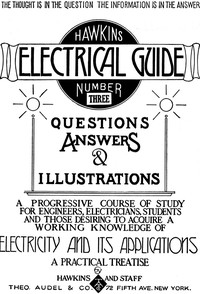
That rainy afternoon, Notes Upon Indigo kept me company—its fussy 1873 insistence on stability over flashy aniline dyes felt almost stubborn, like a craftsman eyeing a cheap shortcut. The book’s quiet reverence for precise, dependable process lingered as I set it down. My hand drifted to a mismatched volume on the shelf, the Hawkins Electrical Guide v. 03 (of 10) Questions, Answers, & Illustrations, A progressive course of study for engineers, electricians, students and those desiring to — Story, Setting & Ideas, and the same patience hummed there, page after page.
There are no reviews for this eBook.
There are no comments for this eBook.
Reader reflection
How did this book work for you?
Your answers remain private and are stored only in this browser.
Your progress
0
/
10
2
Was reading this book enjoyable?
3
How likely are you to recommend this book?
4
How demanding did the text feel?
5
Was the book what you thought it would be?
6
What did you appreciate most?
7
Would you start a conversation about this book?
8
How original did the book feel?
9
What is the main idea you are taking away?
10