1

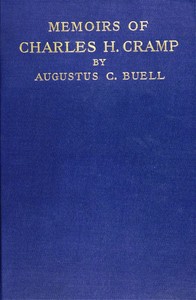
The Memoirs of Charles H. Cramp — A Closer Reading
(0 User reviews)
73
Project Gutenberg
2018
Not confirmed
Cramp, Charles Henry, 1828-1913; Naval architects -- United States -- Biography
Readers of public-domain and historical texts
Project Gutenberg digital edition
en
Edition facts
Words
66,658
Reading time
290 min
Text sections
14
The source record for The Memoirs of Charles H. Cramp — A Closer Reading measures this digital text at 66,658 words, 4 hr 50 min estimated reading time, and 14 detected text sections.
The text analysis averages about 25.4 words per sentence, while the detected sections provide another way to judge how the source is divided.
Project Gutenberg metadata also associates the work with “Cramp, Charles Henry, 1828-1913,” connecting these edition facts with the source record’s subject description.
Source:
Project Gutenberg record #57081
Augustus C. Buell's memoir of Charles H. Cramp traces the shipbuilder's career from wood-and-canvas vessels to steel warships, using Cramp's testimony and public records to argue for American industrial independence. The narrative moves between technical detail, historical context, and patriotic polemic, with recurring emphasis on the symbolic weight of ships.
Editorial Edition Score
4.8/5
★★★★★
★★★★★
Calculated from edition completeness, EPUB availability, text structure and catalogue metadata. Not a user rating.
How this score is calculated
- Description quality20 pts
- Title & short description10 pts
- Source metadata20 pts
- Text length15 pts
- Chapters / structure15 pts
- EPUB file integrity20 pts
Total of 100 points, scaled to a 2.5-5.0 range. Editions with an empty description or a missing EPUB file are not scored.
Edition quality
Read the Text
the neutral carrying trade of the United States, and with it a corresponding stimulus to ship-building all along the coast, though most pronounced and on a larger scale at Philadelphia than elsewhere. Between the above date and 1812 nine more shipyards were established, making twenty-three all told in operation at one time. The largest merchant vessel up to that time built in America was one of seven hundred and five tons, constructed by Samuel Bowers for the East India trade, and her dimensions were not exceeded in merchant construction until after the War of 1812-15. Her contract price was $24,000; at the rate of $34 per ton gross measurement. At that time vessels of similar class cost ten guineas ($50) per gross ton in British shipyards.
In a public document on the statistics of ship-building, we find a statement that “in June, 1787, the ship ‘Alliance,’ owned by Robert Morris and commanded by Captain Thomas Read, sailed from Philadelphia for Canton and Batavia. She was of seven hundred tons burthen, and the largest ship built for commerce in America at that time.”
The statement that the “Alliance” was “built for commerce” is an error. She was the famous old Revolutionary frigate which Paul Jones and John Barry had commanded at different times. After the peace of 1783 she was sold to Mr. Morris, or rather turned over to him in part payment for advance he had made to the Continental government. She was converted into a merchant ship and made several China voyages. The government then bought her back again in 1790, but she was not refitted as a war vessel.
During the general period under consideration, that is to say, from the end of the Revolution to the beginning of the War of 1812, a new and highly important deep-sea traffic came into existence, of which Philadelphia soon obtained the supreme command. This was the East India and China trade. The first vessel to clear from Philadelphia for China direct was the new ship “Canton,” built by Humphreys and commanded by Captain, afterward Commodore, Thomas Truxtun.
This was the same Thomas Truxtun who, during the Revolution, had seen more service in privateers than any other sailor then afloat. He served either as mate or commander in the Philadelphia privateers, “Andrew Caldwell,” “Congress,” “Independence,” “Mars,” and “St. James,” from 1775 to 1782. His ships made altogether sixty-five captures of British merchantmen and transports. While commanding the “St. James,” of twenty guns, in 1781, he beat off and disabled a British 28-gun frigate. After the Revolution he commanded Philadelphia Indiamen from 1785 to 1798, when he was commissioned one of the original six captains in the regular navy. In the short war with France in 1799 he commanded the “Constellation,” 38-gun frigate, and took the French frigate “l’Insurgente,” of forty guns.
The memoir opens with a striking claim: Charles H. Cramp is presented not merely as a prominent shipbuilder but as a man who has become “a symbol” of his art, his name “a synonym” for naval architecture. The preface immediately establishes a structural pattern that recurs throughout the text—a movement between personal achievement and national significance. Buell frames Cramp as the “only surviving link” between the era of wood and canvas and the age of steel and steam, a bridge across sixty years of technological transformation. This binary opposition—old versus new, domestic versus foreign, independence versus dependence—shapes the argument that follows.
The Structure of a Career as National Allegory
The memoir’s organization is not strictly chronological. Instead, Buell groups material around themes: the transition from wooden to iron ships, the politics of naval procurement, and the defense of American industry. The preface announces this design by declaring that Cramp’s career is “inextricably interwoven” with the history of naval architecture. Each chapter tends to open with a general historical statement before narrowing to Cramp’s specific role. For instance, the discussion of Secretary Whitney’s 1885 policy on naval engines begins with a broad assertion about “the wisdom of his policy” and then moves into Cramp’s own testimony before a committee. This structure—context, then evidence—gives the memoir a dual voice: the biographer’s sweeping claims and the subject’s practical details.
Recurring Images: Ships as Symbols of Independence
Buell repeatedly treats ships not just as vessels but as emblems of national sovereignty. In the preface, Cramp’s career is said to have left “an impress” on the nation’s “greatest and most vital public interests.” Later, the battleship Iowa is invoked in a polemic against “English free ships,” with Buell asking: “Our ships and our capacity to create them are as much a symbol of independence as our laws are.” This image recurs in the contrast between “the romantic memories of wood and canvas” and “the grim realities of steel and steam.” The physical vessel becomes a stand-in for political autonomy, and the memoir’s movement between technical description and patriotic rhetoric reinforces this symbolic weight.
Movement Between Testimony and History
A distinctive feature of the memoir is its alternation between Cramp’s first-person statements and Buell’s third-person historical narrative. The excerpt from Cramp’s committee testimony—beginning “If the committee will permit me to make the suggestion”—is a direct quotation, set off from Buell’s commentary. This creates a layered effect: the reader hears Cramp’s own voice, then Buell’s interpretation. For example, after quoting Cramp on the readiness of American engine-builders, Buell adds: “At this writing (1903), only eighteen years have elapsed… The wisdom of his policy needs no eulogy beyond the history.” The movement is from specific testimony to broad historical judgment, a pattern that gives the memoir a persuasive, almost legalistic tone.
The Rhetoric of Contrast and Continuity
Buell frequently uses contrast to structure his argument. The preface sets up a series of oppositions: “the romantic memories of wood and canvas” versus “the grim realities of steel and steam”; the navy of the Civil War versus the navy of Santiago and Manila Bay; Cramp as “the only surviving link.” Later, in the discussion of British competition, the contrast sharpens into a direct attack: “If national independence is valueless, and if everything is to be subordinated to cheapness, why not get our laws made in the House of Commons?” This rhetorical strategy ties the memoir’s structure to its patriotic purpose. The recurring image of Cramp as a bridge between eras reinforces the idea of continuity amid change, a theme that Buell returns to at each major transition in the narrative.
Readers should attend to the way Buell weaves Cramp’s own words into a broader historical argument. The memoir is as much a defense of American industrial policy as it is a biography. The movement between personal testimony and national narrative, and between technical detail and patriotic rhetoric, gives the work a distinctive rhythm. Pay particular attention to the moments when Cramp’s voice breaks into the text—these passages offer the most direct evidence of his perspective on the events he helped shape.
I found myself drifting back to that old book, The Memoirs of Charles H. Cramp, especially a passage where he speaks of ships as living things. The weight of iron and the whisper of sails felt so present. That same quiet awe surfaced later when I opened The history of steam navigation — Background and Themes; there it was again, the same patient hand tracing water, engine, and hull across time.
There are no reviews for this eBook.
There are no comments for this eBook.
Reader reflection
How did this book work for you?
Your answers remain private and are stored only in this browser.
Your progress
0
/
10
2
Did this book hold your interest?
3
Is this a title you would suggest to others?
4
How much effort did this book require?
5
Did anything about the book feel genuinely new?
6
How closely did the book connect with your experience?
7
Could you apply anything you learned?
8
Which part made the strongest impression?
9
What changed or sharpened your thinking?
10