1

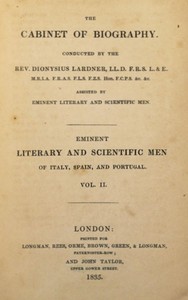
Eminent literary and scientific men of Italy, Spain, and Portugal. Vol. 2 (of 3) — Edition Insights
(0 User reviews)
1264
Project Gutenberg
2021
Not confirmed
Authors -- Biography; Scientists -- Biography
Readers of public-domain and historical texts
Project Gutenberg digital edition
en
Edition facts
Words
139,291
Reading time
606 min
Text sections
14
This digital edition of Eminent literary and scientific men of Italy, Spain, and Portugal. Vol. 2 (of 3) — Edition Insights is described by source-level measurements including 139,291 words, 10 hr 6 min estimated reading time, and 14 detected text sections.
The text analysis averages about 30.9 words per sentence, while the detected sections provide another way to judge how the source is divided.
Project Gutenberg metadata also associates the work with “Authors -- Biography,” connecting these edition facts with the source record’s subject description.
Source:
Project Gutenberg record #65110
Mary Shelley's biographical sketches of Galileo, Metastasio, and other Italian figures reveal her authorial choices in diction, dialogue, and description, blending scientific precision with dramatic narrative.
Editorial Edition Score
4.8/5
★★★★★
★★★★★
Calculated from edition completeness, EPUB availability, text structure and catalogue metadata. Not a user rating.
How this score is calculated
- Description quality20 pts
- Title & short description10 pts
- Source metadata20 pts
- Text length15 pts
- Chapters / structure15 pts
- EPUB file integrity20 pts
Total of 100 points, scaled to a 2.5-5.0 range. Editions with an empty description or a missing EPUB file are not scored.
Edition quality
Read the Text
Such were the lights and shadows in which history delineates
"The starry Galileo with his woes."[1]
But, however powerful be their contrasts, they are not unusual in their proportions. The balance which has been struck between his days of good and evil, is that which regulates the lot of man, whether we study it in the despotic sway of the autocrat, in the peaceful enquiries of the philosopher, or in the humbler toils of ordinary life.
Galileo Galilei was born at Pisa, on the 15th of February, 1564, and was the eldest of a family of three sons and three daughters. Under the name of Bonajuti, his noble ancestors had filled high offices at Florence; but about the middle of the 14th century they seem to have abandoned this surname for that of Galileo. Vincenzo Galilei, our author's father, was himself a philosopher of no mean powers; and though his talents seem to have been applied only in the composition of treatises on the theory and practice of music, yet he appears to have anticipated even his son in a just estimate of the philosophy of the age, and in a distinct perception of the true method of investigating truth.[2]
The early years of Galileo were, like those of almost all great experimental philosophers, spent in the construction of instruments and pieces of machinery, which were calculated chiefly to amuse himself and his school-fellows. This occupation of his hands, however, did not interfere with his regular studies; and though, from the straitened circumstances of his father, he was educated under considerable disadvantages, yet he acquired the elements of classical literature, and was initiated into all the learning of the times. Music, drawing, and painting were the occupations of his leisure hours; and such was his proficiency in these arts, that he was reckoned a skilful performer on several musical instruments, especially the lute; and his knowledge of pictures was held in great esteem by some of the best artists of his day.
Galileo seems to have been desirous, of following the profession of a painter: but his father had observed decided indications of early genius; and, though by no means able to afford it, he resolved to send him to the university to pursue the study of medicine. He accordingly enrolled himself as a scholar in arts at the university of Pisa, on the 5th of November, 1581, and pursued his medical studies under the celebrated botanist Andrew Cæsalpinus, who filled the chair of medicine from 1567 to 1592.
In order to study the principles of music and drawing, Galileo found it necessary to acquire some knowledge of geometry. His father seems to have foreseen the consequences of following this new pursuit, and though he did not prohibit him from reading Euclid under Ostilio Ricci, one of the professors at Pisa, yet he watched his progress with the utmost jealousy, and had resolved that it should not interfere with his medical studies. The demonstrations, however, of the Greek mathematician had too many charms for the ardent mind of Galileo. His whole attention was engrossed with the new truths which burst upon his understanding; and after many fruitless attempts to check his ardour and direct his thoughts to professional objects, his father was obliged to surrender his parental control, and allow the fullest scope to the genius of his son.
From the elementary works of geometry, Galileo passed to the writings of Archimedes; and while he was studying the hydrostatical treatise[3] of the Syracusan philosopher, he wrote his essay on the hydrostatical balance[4], in which he describes the construction of the instrument, and the method by which Archimedes detected the fraud committed by the jeweller in the composition of Hiero's crown. This work gained for its author the esteem of Guido Ubaldi, who had distinguished himself by his mechanical and mathematical acquirements, and who engaged his young friend to investigate the subject of the centre of gravity in solid bodies. The treatise on this subject, which Galileo presented to his patron, was the source of his future success.
Through the cardinal del Monte, the brother-in-law of Ubaldi, the reigning duke of Tuscany, Ferdinand de' Medici, was made acquainted with the merits of our young philosopher; and, in 1589, he was appointed lecturer on mathematics at Pisa. By the drudgery of private teaching he was obliged to add to the small salary of sixty crowns which was attached to the office.
Mary Shelley's contributions to this volume of the Cabinet Cyclopaedia reveal a distinctive authorial voice that merges scientific exposition with dramatic biography. In the life of Galileo, she describes his discoveries as 'emblazoned with achievements of transcendent magnitude' while noting that they 'were the derision of his contemporaries'—a balanced judgment that characterizes her approach. Her prose often shifts between analytical observation and emotional resonance, as when she notes that Galileo's eyes, which 'descry unknown worlds,' were 'doomed to be closed in darkness.' This interplay of light and shadow, triumph and persecution, is a recurring structural device.
Diction and the Balance of Triumph and Adversity
Shelley frequently employs contrasting pairs to frame her subjects' lives. In the Galileo entry, she writes of 'the triumphs and the reverses of his eventful life' and 'the lights and shadows' of his history. This antithetical diction is not mere ornament; it structures the narrative around a moral equilibrium. She explicitly states that the balance between good and evil in Galileo's life 'is that which regulates the lot of man,' whether in 'the despotic sway of the autocrat' or 'the humbler toils of ordinary life.' Such phrasing elevates biography to philosophical reflection. The choice of words like 'pregnant with a peculiar interest' and 'rugged outline' further suggests a deliberate, almost poetic, precision.
Dialogue and Reported Speech as Characterization
Shelley rarely invents direct dialogue, but she uses reported speech and indirect discourse to convey character. In the Metastasio section, she notes that the poet's verses of adieu for a public singer were 'full of passion, tenderness, and beauty,' and that the lover 'must have been satisfied, and the lady charmed.' This speculative yet confident tone allows her to infer emotional states without fabricating quotations. She also reports Metastasio's own reasoning for staying with Maria Teresa during her adversity: 'fidelity and gratitude alike forbade him to change masters.' Such paraphrased sentiments give the reader access to the subject's inner life while maintaining historical decorum.
Descriptive Patterns: Climate and Health as Narrative Drivers
Shelley uses environmental description to explain personal decline. In the Metastasio entry, she attributes his nervous malady to the 'dreary contrast' between the 'clear skies' and 'perpetual summer' of southern Italy and the 'gloom of the freezing north' of Vienna. She details the 'stoves, closed windows, and consequent want of fresh air' as injurious to 'the health and spirits of those who are accustomed to regard the skiey influences as friendly.' This attention to climate as a causal force is a recurring motif; it transforms biography into a study of how place shapes temperament. The phrase 'skiey influences' (borrowed from Shakespeare) adds a literary layer to the scientific observation.
Structural Choices: From General to Particular
Shelley often opens a life with a broad, almost aphoristic statement before narrowing to specific details. The Galileo entry begins: 'The history of the life and labours of Galileo is pregnant with a peculiar interest to the general reader, as well as to the philosopher.' This general claim is then supported by a series of contrasts—'brilliant discoveries' versus 'derision,' 'idol of his friends' versus 'victim of persecution.' The structure mirrors the content: a balanced framework that contains dramatic swings. Similarly, the Metastasio section moves from a general observation about his 'tranquil and prosperous life' to the specific disruption of Charles VI's death by 'poison or indigestion, after eating mushrooms.' This juxtaposition of the mundane and the momentous is a hallmark of her biographical method.
Readers attentive to Shelley's authorial choices will find a biographer who treats her subjects with both scientific detachment and novelistic empathy. Her diction, use of reported speech, and environmental descriptions are not neutral; they shape the reader's understanding of each figure's character and fate. By observing how she balances triumph with adversity, or how she links climate to health, one gains insight into the craft of early nineteenth-century biographical writing. This volume rewards those who read not only for content but for the subtle artistry of its prose.
Reading of Shelley’s Galileo, I remembered my grandfather’s cracked leather workshop stool, where he’d whisper about dials and escapements as if they were living things. That same tenderness returned with The watchmakers' hand book — Reading Notes, where precision felt less like mechanics and more like prayer. Both books gently showed me that true devotion often hides in measurements and patient, quiet hands.
There are no reviews for this eBook.
There are no comments for this eBook.
Reader reflection
Record your reading impressions
A brief reflection can help important ideas stay with you longer.
Your progress
0
/
10
2
How much did you enjoy the reading experience?
3
Would you encourage someone else to read it?
4
Did the language feel accessible?
5
How understandable was the text?
6
What was the strongest part of the book?
7
How did the reading compare with what you expected?
8
Did you gain anything practical from the text?
9
What changed or sharpened your thinking?
10