1

Stokers and pokers — Story, Setting & Ideas
(0 User reviews)
806
Project Gutenberg
2024
Not confirmed
London and North-Western Railway; Telegraph -- Great Britain; Railway Clearing House (London, England)
Readers of public-domain and historical texts
Project Gutenberg digital edition
en
Edition facts
Words
69,405
Reading time
302 min
Text sections
38
For Stokers and pokers — Story, Setting & Ideas, the stored edition analysis reports 69,405 words, 5 hr 2 min estimated reading time, and 38 detected text sections.
The text analysis averages about 36.5 words per sentence, while the detected sections provide another way to judge how the source is divided.
Project Gutenberg metadata also associates the work with “London and North-Western Railway,” connecting these edition facts with the source record’s subject description.
Source:
Project Gutenberg record #74809
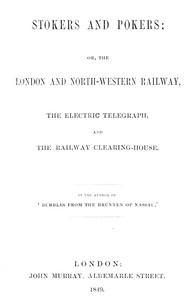
Sir Francis Bond Head's 1849 account of the London and North-Western Railway examines construction, maintenance, and operation, with detailed descriptions of locomotive works, carriage repair, the electric telegraph, and the Railway Clearing-House, blending technical observation with social commentary.
Editorial Edition Score
4.9/5
★★★★★
★★★★★
Calculated from edition completeness, EPUB availability, text structure and catalogue metadata. Not a user rating.
How this score is calculated
- Description quality20 pts
- Title & short description10 pts
- Source metadata20 pts
- Text length15 pts
- Chapters / structure15 pts
- EPUB file integrity20 pts
Total of 100 points, scaled to a 2.5-5.0 range. Editions with an empty description or a missing EPUB file are not scored.
Edition quality
Read the Text
ON THE CONSTRUCTION OF A RAILWAY.
At the grand inauguration dinner eaten in Paris on the 28th of December, 1848, for the express purpose of celebrating the installation of the new President of the French Republic, it has been recorded by the reporters present, that among the numerous guests assembled, there was no one whose presence engrossed such universal attention as that of an erect emaciated member of “_La Vieille Garde_.”
The old soldier, it is stated, as he sat at table, scarcely noticed the constellations of bright, black, and hazel-coloured eyes that from all directions were concentrated upon him, but, addressing himself first to his own black bottle, and then with the utmost good humour to those of his neighbours, he drank and ate--drank--swigged--reflected,--and then, as if to refresh himself, drank again, again, and again, until, according to pre-arrangement, he stood up on the tribune to re-propose the health of “LOUIS NAPOLEON,” to which--coupling the meteor now shining in its zenith with the “sun of Austerlitz,” which, though sunk for ever below the horizon, still beamed as resplendently as ever within his heart--he added, with great naïveté, “MAIS SANS OUBLIER L’AUTRE!”
The French people, or rather the representatives of the French nation who were assembled, had received the consecutive orations of several of the most illustrious of their fellow-citizens with considerable marks of approbation; but when the veteran in question, who was about seventy years of age, with hair white as snow, rose to address to them a short speech that would scarcely have filled his empty wine-glass, the sight of the uniform so dear to Frenchmen--the tall bear-skin cap, the crimson feather, blue coat, red facings, red worsted epaulettes, white breast, white breeches, long black gaiters reaching over the knee, and, above all, buttons with an eagle supporting the imperial crown--created a storm of applause which it would be utterly impossible to describe. For nearly a quarter of an hour shouts and clappings of hands prevented the old warrior from opening his lips, and the applause if possible increased when the veteran, with the palm of his hand turned outwards, stiffly saluted the company in correct martial style: and yet, strange to record, at the very moment of all this military enthusiasm, so characteristic of a nation of whom it was lately very eloquently stated “that it had been its ambition to be the world’s guide and its destiny to be the world’s warning,” the French Government was not only without funds to protect public or private property, but, in fact, had nothing but the plunder of both to conciliate and feed the multitude of misguided and misguiding people who, by the ruin of commerce and by the stagnation of trade, were literally all over France starving from cold and hunger. Of their enthusiasm, therefore, as of that of the veteran standing up before them, it may truly be said or sung--
“Happy’s the soldier that lives on his pay, And spends half-a-crown out of sixpence a-day!”
Having related, or rather merely repeated, this curious little anecdote, we will now endeavour to explain in what manner it applies to the subject of our chapter, namely, “_the construction of a railway_.”
It has been justly observed that “England is bound over to keep the peace by a national debt, or penalty, of 800 millions.” During the glorious expenditure of all this money, the attention of the country was solely engrossed with the art, employment, occupation, and victories of war. Our great statesmen were war-ministers--our great men were naval and military warriors of all ranks, whose noble bearing and gallant feats were joyfully announced, and, by universal acclamation, as gratefully rewarded; and if every man who took a government contract, or who in any way came into contact with government, easily made a large fortune by war, he, generally speaking, as rapidly spent it; and thus an artificial circulation of wealth was kept up, which, like the schoolboy’s mode of warming himself, commonly called “beating the booby,” produced a temporary glow, estimated at the moment to be of as much value as if it had naturally proceeded from the heart.
The English people during the period in question drank hard. The rule had scarcely an exception. As regularly as four o’clock P.M. struck, our noblemen, magistrates, judges, hunting squires, and country gentlemen, began to look a little flushed--the colour gradually increasing, until in due time they all became, like their sun in a fog, red in the face. Before bedtime the semi-rulers of the nation were half inebriated--some of our leading statesmen being, alas! notoriously, very nearly in the same state.
Sir Francis Bond Head opens Stokers and Pokers with a striking analogy: a Leicestershire squire riding 200 miles in ten hours on a succession of thoroughbred horses. This feat, Head suggests, will be dwarfed by the railway's capacity to carry passengers and goods over far greater distances with mechanical regularity. The book then shifts abruptly from sporting spectacle to the gritty realities of railway construction, maintenance, and daily operation. Head's method is to walk through the London and North-Western Railway's facilities—Euston, Camden, Wolverton, Crewe—recording what he sees with an engineer's eye for detail and a reformer's concern for the workers' welfare.
The Grease House and the Flying Post-Office
Head's descriptions of the Crewe workshops are among the most vivid in the book. In the coach department's hospital—a shed 600 feet long—he notes eighty carriages under repair, including several flying post-offices bearing the Royal arms. But it is the grease house that captures his curiosity. He had long wondered about the yellow mixture applied to carriage axles, and from the grease-master he obtains the recipe: 200 lbs. of Russia tallow, 70 lbs. of palm-oil, 20 lbs. of soda, and 50 gallons of water. The steam-boiler that heats this compound also keeps two casks of sperm-oil fluid, preventing crystallization in cold weather. Head's willingness to record such mundane but essential details—the cost of yellow soap, the thickness of coupé front glass at half an inch—gives the book its peculiar authority.
Baths, Doctors, and the Price of Cleanliness
Having toured the workshops, Head turns to the domestic lives of the workmen at Crewe. The Company has erected a bathhouse where men and women wash at separate hours—'the women may wash while the men are working, and vice versâ'—for 1½d. per person. Head calculates that even the Hercules who works the steam-hammer can be 'scrubbed perfectly clean and white for three half-pence.' A medical man receives a house and surgery, paid by weekly deductions from the workers: 1d. from unmarried men, 1½d. from married men without children, 2d. from those with families. A clergyman, salaried by the Company, oversees three large day-schools. Head's tone is approving but not sentimental; he presents these provisions as practical arrangements rather than philanthropy.
The Electric Telegraph and the Clearing-House
Two chapters address systems that made the railway network coherent. The electric telegraph, still novel in 1849, is described as a means of transmitting messages almost instantaneously along the line, enabling the coordination of train movements. Head explains its principles without condescension, noting how wires and signals replace the old reliance on timetables and guesswork. The Railway Clearing-House, meanwhile, is the financial mechanism that apportions revenue among competing companies when passengers or goods travel over multiple lines. Head presents it as a bureaucratic marvel—a central office where accounts are settled, disputes resolved, and the chaos of dozens of independent railways reduced to orderly ledgers. These chapters reveal Head's fascination with the invisible infrastructure of Victorian transport.
Head's book is neither a technical manual nor a travelogue, but a hybrid: a gentleman-amateur's survey of a system in rapid transformation. Readers interested in the social history of Victorian engineering will find his observations on working conditions, industrial processes, and corporate organization unusually concrete. The book rewards those who read slowly, attending to the weights, measures, and prices that Head records with such care. It is a document of a moment when the railway was still a wonder, and its stokers and pokers were the heroes of a new age.
There’s something grounding about reading Sir Francis Head’s railway days—the patience of fixing a locomotive, the quiet hum of the telegraph. It makes me think of brickmaking in the same way: slow, hand-worn knowledge, passed along without fanfare. I found myself lingering on The Science of Brickmaking — A Closer Reading afterward, missing that same unhurried care.
There are no reviews for this eBook.
There are no comments for this eBook.
Reader reflection
Before you leave, reflect on the book
Use these questions to collect your thoughts before moving on.
Your progress
0
/
10
2
Was reading this book enjoyable?
3
How likely are you to recommend this book?
4
What was the reading difficulty like?
5
How would you rate its originality?
6
How valuable was this book for your own interests?
7
Did you relate to its people, ideas, or situations?
8
Would you read this book again?
9
Which lesson or insight stayed with you?
10