1

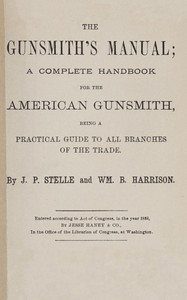
The gunsmith's manual — Context and Discussion
(0 User reviews)
200
Project Gutenberg
2023
Not confirmed
Gunsmithing
Readers of public-domain and historical texts
Project Gutenberg digital edition
en
Edition facts
Words
92,770
Reading time
404 min
Text sections
45
For The gunsmith's manual — Context and Discussion, the stored edition analysis reports 92,770 words, 6 hr 44 min estimated reading time, and 45 detected text sections.
The text analysis averages about 21.9 words per sentence, while the detected sections provide another way to judge how the source is divided.
Project Gutenberg metadata also associates the work with “Gunsmithing,” connecting these edition facts with the source record’s subject description.
Source:
Project Gutenberg record #71928
This 1883 handbook for American gunsmiths details barrel-making, lock mechanisms, and shop tools through precise technical prose, with a focus on practical instruction and the trade's evolving methods.
Editorial Edition Score
4.9/5
★★★★★
★★★★★
Calculated from edition completeness, EPUB availability, text structure and catalogue metadata. Not a user rating.
How this score is calculated
- Description quality20 pts
- Title & short description10 pts
- Source metadata20 pts
- Text length15 pts
- Chapters / structure15 pts
- EPUB file integrity20 pts
Total of 100 points, scaled to a 2.5-5.0 range. Editions with an empty description or a missing EPUB file are not scored.
Edition quality
Read the Text
HISTORY OF THE GUN 9 Discovery of Gunpowder 9 The First Fire Arms 9 Earliest Hand Guns 10 Prejudice Against Fire Arms 10 The First Rifle 11 The Arquebus 11 The Match Lock 12 Musket, Petronel 13 The Wheel Lock 13 The Pistol 14 The Snaphaunce 14 The Flint Lock 15 Important Improvements 15 Advance of the Rifle 16 The Percussion Lock 16 The Breech Loader 18
HOW GUNS ARE MADE 22 Gunsmith, Gunmaker 22 Gun Barrels, Best Materials for 23 On Making Gun Barrels 24 Finishing and Proving 25 Action, Stock and Final Finish 26 On Making the Rifle 27 Plain Steel Barrel Guns 27
GUNS NOW IN USE 29 Gun Defined 29 The Old Flint Lock Gun 29 The Percussion Lock Gun 31 On the Muzzle Loaders 33 The Breech Loaders 34 Variety of Breech Loaders 36
PISTOLS NOW IN USE 37 Old Style Pistols 37 The Derringer 38 The Pepper Box 38 Old Colt’s Revolver 38 Sharp’s Four-shooter 39 The Breech Loading Cartridge Pistols 39
ON GENERAL GUNSMITHING 41 The Gunsmith and his Trade 41 Fitting up a Shop 41
TAKING APART, CLEANING AND PUTTING GUNS TOGETHER 43 To Take the Gun Apart 43 To Clean the Gun When Apart 44 To Put the Gun Together 45
TOOLS REQUIRED FOR WORK, THEIR COST, ETC. 47 The Alcohol Lamp 47 The Alcohol Lamp, Self-blowing 47 Anvil 48 Barrel Planes 48 Bevel 49 Beveling Clamp 49 Blacksmith’s Tongs 50 Blow Pipe 50 Breeching Taps 51 Calipers and Dividers 51 Chisels 51 Cutting Pliers 51 Drill Stock 51 Tile Cord 52 Tilting Square 52 Floats 52 Forge 53 Glue Pot 53 Gouges 53 Grind Stone 54 Hack Saw 54 Hammers 54 Handles 55 Hand Shears 55 Hand Vice 55 Iron Clamps 55 Mainspring Vise 56 Marking Gauge 57 Screw-cutting Tools 57 Screw Wrench 57 Soldering Copper 57 Screw-Drivers 57 Pliers 58 Wing Dividers 58
TOOLS, ETC., AND HOW TO MAKE THEM 59 The Alcohol Lamp 59 A Self-blowing Lamp 61 Breech Wrenches 63 The Bit Stock 64 Bottoming Tools 65 Chequering Tools 66 Nipple Wrenches 67 Portable Forge 67 Vice Appendages 69 Shanks of Tools 72
THE WORK BENCH 74 Material for the Work Bench 74 How to Make the Work Bench 75 Putting the Vise in Place 76 Place for Drawer 76 The Gun Brace 76 How to Deaden the Noise of Hammering 77
ON WORKING IN IRON 79 Hand Forging 79 Welding 79 Hardening Iron by Hammering 80 Case-hardening 81 A Good Way to Case-harden 82 Material for Case-hardening 84 Another Way to Case-harden 85 Another Formula for Case-hardening 86 Still Another Formula 87 To Chill Cast Iron 87 Another Mode 87 To Soften Wrought Iron 87 Alloy for Filling Holes in Iron 87 To Harden Iron for Polishing 88
ON WORKING IN STEEL 89 Hand Forging Steel 89 Welding Steel 89 Tempering 91 To Restore Burnt Steel 93 Annealing Steel 94 To Blue Steel 94 To Remove Blue Color From Steel 94 Tempering Knife Blades 95 The Lead Bath for Tempering 96 Test for Good Steel 97 Etching on Steel 97
ON WORKING IN SILVER, COPPER AND BRASS 99 To Forge Silver 99 To Polish Silver 99 Light Plate for Copper or Brass 99 To Clean Silver 100 To Work Copper 100 To Work Brass 101 To Cast Brass 101 To Brass Iron 102 To Clean Brass 102 To Solder Brass 102
ON WORKING IN WOOD 104 The Woods Most in Use 104 Wood for Gun Stocks 105
ON GUN STOCKS 108 Form of Gun Stocks 108 Dimensions for Single Gun 111 Dimensions for Double Gun 111 Laying Out Gun Stocks 111 How to Stock a Gun 114 The First Operation in Stocking 114 Setting in the Barrels 115 Measure for the Stock 116 The Butt 116 Setting in the Locks 116 Setting in the Trigger Plate 117 Setting in the Triggers 117 Secure Fastenings 118 Fitting Bolt Loops 118 Hints for Finishing 119 Fitting the Break-off 119 To Let in Escutcheons 120 How to Cast Tips on Fore End of Stock 120 Chequering 122 Coloring Gun Stocks 122 To Stain a Maple Stock 123 Another Method 123 To Color a Maple Stock Brown 123 To Color a Reddish Brown 123 To Color Black 124 Rosewood Stain 124 Black Walnut Stain 124 Mahogany Stain 125 Cherry Stain 125 Oil Finish for Gun Stocks 125 Varnishing and Finishing 126 The Varnish for Gun Stocks 127 The Varnish Can 128
ON GUN BARRELS 129 Long and Short Barrels 129 Proof of Barrels 131 Proof Marks on Barrels 133 Gauge of Guns 135 Bursting of Barrels 138 To Prevent Barrels from Rusting 138 Protection from Rust 138
ON WORK ON GUN BARRELS 140 Boring Gun Barrels 140 How to Make Cutters for Boring 141 Quick Boring Gun Barrels 141 Proving the Size During Boring 142 Draw Boring 142 Choke Boring 143 Choke Dressing 144 Barrels Most Suitable for Choke Boring 145 Freeing Gun Barrels 145 Another Method 146 Finishing Muzzles of Gun Barrels 147 Old Method of Straightening Barrels 148 The New Method 148 Another Method 153 Fitting Barrels Together 153 Joining Barrels Together 156 Soldering Barrels Together 157 Why Not Brase Barrels 158 Percussioning 159 Finishing Nipple Seat 161 The Vent in Percussion Guns 162 The Patent Breech 163 Form of the Chamber or Cup 164
TOOLS FOR BREECHING GUNS 165 Breeching Reamers 165 Breeching Taps 166 Breech Pin Formers 169
TOOLS FOR CHAMBERING BREECH LOADING BARRELS 170
ON GUN RIBS 173 How to Straighten a Rib 173 How to Fit a Rib 174 How to Fit a Rib to an Octagon Barrel 174 How to Solder on a Rib 174 How to Re-solder Ribs 176 Height of Ribs 178
ON THIMBLES 180 How to Make Thimbles 180 How to Put Thimbles on Barrels 181
ON RIFLING GUNS 183 Importance of Rifling 183 U. S. Rifling Machines 184 Old Fashioned Rifling Machines 186 Gain Twist Rifling Machines 188 Re-rifling 188
The Gunsmith's Manual opens with a chapter on the history of firearms, tracing the discovery of gunpowder and the first hand guns, but quickly moves into the practical details that define its purpose. The authors, J. P. Stelle and Wm. B. Harrison, write with a direct, instructional tone, as when they advise the beginner to 'work slowly and cautiously, thinking in every case before acting' when taking down a lock. This emphasis on careful, methodical work pervades the manual.
The book's structure reflects its intended audience: a gunsmith or apprentice seeking clear, step-by-step guidance. Chapters progress from historical context to materials, tools, and specific repairs, with frequent references to figures and diagrams. The language is precise, avoiding unnecessary flourish, and the authors often address the reader directly, as in 'the lock is the part with which he will have considerable to do.'
The Language of the Lock
The manual's treatment of gun locks reveals a careful attention to mechanical vocabulary. The authors distinguish between lock types—full bar, side action, Wesley bar, and central lock—using consistent terminology. For the Wesley bar, they note that 'the wood between the lock-plate and barrel has to be cut so thin that the recoil of the gun is very apt to break and splinter it,' a practical observation grounded in experience. The description of the central lock emphasizes its simplicity: 'this form of lock has few parts, and has a long feather-like mainspring, it is easy and pleasant to operate.'
When explaining how to take down a lock, the authors use imperative verbs and a logical sequence: 'set the hammer at full-cock,' 'apply the hand-vise,' 'turn up the vise gently.' They warn against damaging the spring by placing 'a bit of chamois skin or felt between the jaws.' This attention to detail and caution reflects the manual's instructional purpose.
Tools as a System of Knowledge
Chapters VII and VIII list and describe tools, from the alcohol lamp to breeching taps, but also include instructions for making them. The authors treat tool-making as an essential skill, offering plans for a self-blowing lamp and a portable forge. The language is practical: 'the alcohol lamp, self-blowing' is described with specific construction details. The inclusion of costs ('their cost, etc.') suggests the manual was written for a working gunsmith managing a shop.
The list of tools is extensive—over forty items—and includes both common items like hammers and specialized ones like 'bottoming tools' and 'chequering tools.' The authors assume the reader will need to acquire or fabricate these implements, and they provide guidance on materials and dimensions. This section functions as a catalog of the trade's material culture.
Barrels and the Metallurgical Eye
The manual's discussion of gun barrels focuses on materials and forging. The authors specify 'best materials for' barrels and describe the process of 'finishing and proving.' They distinguish between 'plain steel barrel guns' and other types, indicating a hierarchy of quality. The chapter 'How Guns are Made' covers barrel-making from raw material to final finish, with an emphasis on the smith's skill.
In the section on working in iron, the authors discuss hand forging, welding, and case-hardening, providing multiple formulas for the latter. They describe how to 'harden iron by hammering' and offer 'a good way to case-harden.' The language is technical but accessible: 'another formula for case-hardening' is given without theoretical digression. This metallurgical knowledge is presented as cumulative, with variations offered for different results.
The Gunsmith's Relationship with the Gun Owner
Throughout the manual, the authors acknowledge the gunsmith's role as an intermediary between the firearm and its owner. In the chapter on cleaning locks, they note that 'not a few gun-owners look upon it as a kind of mystery without the range of ordinary comprehension,' and thus bring the gun to the shop at the slightest issue. The authors endorse this caution, quoting 'a stitch in time saves nine.'
The manual also addresses the gunsmith's business: 'fitting up a shop' and the tools required. The authors assume the reader will be called upon to 'clean and repair various parts of fire-arms,' and they prepare him for the most complicated part—the lock. The tone is that of a senior craftsman instructing a junior, with warnings against haste and damage.
This manual is best read as a period document of American craft knowledge. The authors' choices in diction—direct, imperative, and precise—reveal a trade that valued hands-on skill and systematic instruction. Readers interested in the history of technology will find here a detailed record of late-19th-century gunsmithing practices, from forging to lock mechanics. The book rewards careful attention to its technical descriptions and the implicit philosophy of work they convey.
Holding that manual, I thought of my grandfather’s workbench, oil-stained and patient. It wasn’t the mechanics but the quiet dignity of a craft that stirred me, much like reading Notes Upon Indigo — Text and Context later—a different dye, but the same slow respect for something made by hand, waiting to be understood.
There are no reviews for this eBook.
There are no comments for this eBook.
Reader reflection
Before you leave, reflect on the book
Use these questions to collect your thoughts before moving on.
Your progress
0
/
10
2
What was your overall reaction to the book?
3
Is this a title you would suggest to others?
4
What was the reading difficulty like?
5
What was the strongest part of the book?
6
Did any part of the book stay with you emotionally?
7
Did the book meet your expectations?
8
Was the book easy to understand?
9
Which lesson or insight stayed with you?
10