1

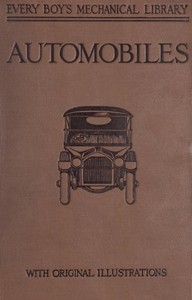
Automobiles — Reading Companion
(0 User reviews)
87
Project Gutenberg
2024
Not confirmed
Automobiles
Readers of public-domain and historical texts
Project Gutenberg digital edition
en
Edition facts
Words
47,439
Reading time
207 min
Text sections
32
The source record for Automobiles — Reading Companion measures this digital text at 47,439 words, 3 hr 27 min estimated reading time, and 32 detected text sections.
The text analysis averages about 19.4 words per sentence, while the detected sections provide another way to judge how the source is divided.
Project Gutenberg metadata also associates the work with “Automobiles,” connecting these edition facts with the source record’s subject description.
Source:
Project Gutenberg record #73790
This 1915 manual from the Every Boy’s Mechanical Library uses original drawings and plain language to explain automobile construction, from frame and motor to electrical systems, with a focus on practical understanding for young mechanics.
Editorial Edition Score
4.9/5
★★★★★
★★★★★
Calculated from edition completeness, EPUB availability, text structure and catalogue metadata. Not a user rating.
How this score is calculated
- Description quality20 pts
- Title & short description10 pts
- Source metadata20 pts
- Text length15 pts
- Chapters / structure15 pts
- EPUB file integrity20 pts
Total of 100 points, scaled to a 2.5-5.0 range. Editions with an empty description or a missing EPUB file are not scored.
Edition quality
Read the Text
APTER I. AUTOMOBILE HISTORY AND DEVELOPMENT 5-12
Development of the Industry. The First Patent. Newton’s car. Watt’s Invention. Traction. Push legs. Power. Springs. Water Tube Boiler. The First Differential. The First Gas Motor Car. Gasoline Car. Flash Boiler System. The Carbureter. Improved Structures. The Order of Development. Speed vs. Power. Lighter Vehicles.
CHAPTER II. THE FRAME AND ITS ACCESSORIES 13-23
The Frame. Channel-bar Frames. How the Frame is suspended. Fore and aft Motion. Lateral Motion. Cantilever Spring. Shock Absorbers. The Axle. Live Axles. Dead Axles. Semi-Floating Axle. Full Floating Axle. Wheels. Flexibility. Large vs. Small Wheels. Minimizing Shocks. Resiliency.
CHAPTER III. TIRES, TUBES AND RIMS 24-36
Tires. Solid Tires. Cushion Tires. Pneumatic Tires. Single Tubes. Double Tubes. The Outer Tube. The Inner Tube. Advantage of Double Tube. Putting on and Taking off Double Tubes. Damage to Tires. Repair to Tires. Vulcanizing. Oil as an enemy of Tires. Non-skidding Tires. Tires for City Use. Side slipping. Faulty Alinement. Broken Fabric. Bruises. Under Inflation. Stretched Tires. Blistered Tires. Rim Cutting. Inflation Pressures. Expansion of Heated Air.
CHAPTER IV. THE STEERING GEAR AND BRAKES 37-45
The Steering Column. Motor Control. Throttle Movement. Steering Wheel Type. Steering Gear. Front Axle. Running Brake. Double-acting Contracting Brake. Contracting Brake. Equalizers. The Emergency Brake. Combined Service and Emergency Brake.
CHAPTER V. THE DIFFERENTIAL 46-54
The Meaning of Differential. Equalizing Bar. Unequal Resistance. Balanced Equalizer Bar. Transmission Wheel. Action of Transmission Gearing.
CHAPTER VI. THE DRIVE 55-61
Power Transmitted to Wheels through Springs. Illustrating power transmission. Torsion Rod. The Torque Tube. Radius Rod. Chain Drive. Jack Shaft. Objections to Chains. Shaft Drive. Train of Shafting.
CHAPTER VII. CLUTCHES 62-68
Clutch Requirements, Frictional Contact. Cone Clutch. Compression Spring in Clutches. The Multiple Disk Clutch. Its Construction. Disadvantages of Multiple-Disk Clutches. Care of Multiple Disk Clutch.
CHAPTER VIII. TRANSMISSION, OR CHANGE SPEED GEARS 69-89
Transmission Leverage. Economy of Transmission Gearing. Types of Transmission. The Progressive. Low Gear. Intermediate Gear. High Gear. Reverse. Selective Type. Low Gear. Intermediate Gear. High Gear. Reverse Gear. Control Lever for Progressive Transmission. Operation of the Selective Gear. Selector Bars. Shifting Lever. Speed Selectors. 3-speed Selectors. 4-Speed Selectors. An approved Type of Selector. Controlling the Selector. Using the Clutch and Selector. Planetary Transmission. Frictional Transmission.
CHAPTER IX. THE MOTOR 90-108
Value of Fuel Utilized. The Waste. Water Absorption. Engine Types. The Four-Cycle Engine. The Two-Cycle. Compression. Economy of Four-Cycle Engine. Valve Movements. The Ignition point in the Cycle. The Fly-wheel. Impulses in Four-Cycle Engine. The Cylinder Case, and Connections. Piston and Crank Construction. Calculating the Efficiency. Pressures in Explosions. Expansion Line. Mean Effective Pressure. The Two-cycle Engine. Foot Pounds. Work or Energy. Cycle of Operation. The Crank Shaft. Special Metal. Engine Troubles. Difficulties pointed out. Starting the Engine. Carbureter. Low Compression. Mixtures. Spark Plugs. The Weather. Drainage.
CHAPTER X. COOLING SYSTEMS 109-117
Air Cooling. Air-Cooling Devices. Water Cooling. Gravity System. Locating the Reservoir. Force System of Cooling. The Radiator Connections. Radiators. Construction of Radiator. Operation of Radiator. The Pump. Pump Construction. Action of Pump.
CHAPTER XI. CARBURETERS 118-132
Carbureted Air. Composition of Gasoline. Gasoline Expansion. Requirements of a Carbureter. Evaporation. Air Saturation. Air Contact with Gasoline. Instantaneous Combustion. Compression. Compression as a Mixing Means. Carbureter Types. The Spraying Carbureter. Dissecting the Carbureter. The Mixing Chamber. The Float Chamber. The Venturi Tube. The Inlet Valve. The Throttle Valve. The Secondary Air Supply. Automatic Admission of Secondary Air. Carbureter Adjustments. Special Points Concerning Carbureters. Thin Mixtures. Speeds and Mixtures. Surface Carbureter. The Float. The Oil Inlet. Securing Surface for air Contact.
CHAPTER XII. IGNITION SYSTEMS 133-158
Seeing the Effect of Electricity. Action of a current. Amperes and Volts. Conductivity. Resistance. Generating Electricity. Magnetic Field. Armature. Batteries. Metallic Couples. What Determines Voltage. Controlling Amperage. Dry Batteries. Cell Construction. Connecting up Cells. The Series Connection. The Parallel Connection. Series-Multiple Connection. Storage Batteries. The Sparking Methods. Air Resistance. Make and Break Spark. The High Tension System. The Spark Plug. How Produced. The Magneto. Difference Between Dynamo and Magneto. Advantages of Magneto. Different Kinds of Magnetos. Primary and Secondary. Igniters. High Tension Coils, Inductance. Constructing a coil. A Simple High Tension Sparking System. Condenser. Interrupter. Arrangement of a high Tension System. The High Tension Connections. The Secondary Coil. Operation of System. The Spark Gap. Function of the Interrupter. Vibratory Coils. Operation of Vibratory Coil. Surging Movement of Current. Timing Device. Contact Makers. The Contact Breaker. Sparking Plugs. Testing Plugs. Short Circuiting Faults. Short Circuiting of Secondary Wires.
CHAPTER XIII. AUTOMOBILE ACCESSORIES 159-168
Self Starting. Simple Type of Starter. The Distributer. Lighting. Car Signals. Speed Signals. Mufflers. Exhaust. Construction of Muffler. Ball and Roller Bearing. Race ways. The Three-point Contact. Wrong Constructions. Roller Bearings. Form of Roller Bearings.
CHAPTER XIV. RUNNING AN AUTOMOBILE 169-179
James Slough Zerbe’s Automobiles (1915) opens with a clear pedagogical aim: to make the boy acquainted with each element of an automobile so that he may understand why it is made in that special way. The book belongs to the Every Boy’s Mechanical Library, a series that treats technical subjects with direct, illustrated instruction. Zerbe, an engineer, writes in a voice that is patient and methodical, often breaking down complex systems into numbered steps or labeled diagrams. The excerpts show a consistent pattern: he first states a principle, then illustrates it with a concrete example, and finally draws a practical conclusion. This structure is especially evident in the electrical sections, where he explains series, parallel, and series-multiple wiring using a six-cell battery as a recurring example.
A Methodical Voice for Young Readers
Zerbe’s prose is deliberately plain, avoiding jargon without explanation. He writes in short, declarative sentences: “Air has resistance, the same as all other substances.” When introducing a new term, he immediately defines it: “Any circuit having a small voltage is termed low tension, to distinguish it from a high tension, or high voltage.” This habit of immediate definition recurs throughout the excerpts. He also uses direct address—“you will see we have 225 watts”—to keep the reader engaged. The tone is that of a patient instructor who expects the reader to follow along with the original drawings mentioned in the preface. The language is free of rhetorical flourishes; every sentence serves the goal of clear explanation.
Repeating Patterns in Electrical Instruction
The electrical chapters reveal Zerbe’s preferred teaching method: he presents a problem, then offers multiple solutions. In the battery section, he shows three ways to connect six cells—series, parallel, and series multiple—each yielding different voltage and amperage while maintaining the same total wattage (225 watts). He uses the same cells (1.5 volts, 25 amperes) throughout, allowing the reader to compare outcomes directly. The pattern is repeated with ignition systems, where he distinguishes low-tension from high-tension circuits and explains air resistance as a non-conductor. This repetition of core examples with slight variations is a deliberate scaffolding technique, reinforcing concepts before moving to more advanced topics like storage batteries and sparking methods.
Pacing and the Shift from Theory to Practice
The book’s pacing alternates between broad principles and specific applications. Early chapters cover history and frame construction in a narrative style, but the electrical sections slow down into step-by-step exposition. For instance, after explaining the three wiring methods, Zerbe adds a practical note: “This, if well understood, will enable the user, for instance, to strengthen a battery, where it is weak, by connecting it up in series multiple, instead of in parallel.” He then advises testing cells regularly and replacing weak ones. This shift from theory to maintenance tips is characteristic of the manual’s overall rhythm: it builds knowledge incrementally and then applies it to real-world troubleshooting. The excerpts suggest that later chapters on electric vehicles and ignition systems follow the same pattern, though the full text is not available here.
Readers should approach Automobiles as a self-contained course in early automotive technology, best studied with the original drawings at hand. Zerbe’s methodical repetition of key examples—especially the six-cell battery—makes the book ideal for readers who learn by comparing cases. The manual does not assume prior knowledge, but it does reward careful attention to its numbered steps and cross-references. For those interested in the history of technical education, this volume offers a clear snapshot of how mechanical knowledge was packaged for a young audience in the 1910s.
Sometimes I page through that old Automobiles — Reading Companion and miss the quiet certainty of its diagrams — every bolt explained, every wire assigned a purpose. There’s a similar comfort, I find, in Stokers and pokers — Story, Setting & Ideas, where even the coal-fired machinery of another era hums with logic. Just a feeling I keep returning to.
There are no reviews for this eBook.
There are no comments for this eBook.
Reader reflection
Record your reading impressions
A brief reflection can help important ideas stay with you longer.
Your progress
0
/
10
2
Did this book hold your interest?
3
Would you recommend this book to another reader?
4
Did the language feel accessible?
5
Did the book offer a fresh perspective?
6
Was the book moving at the right speed?
7
Would this book work well in a reading group?
8
Which aspect of the book did you value most?
9
Which lesson or insight stayed with you?
10