1

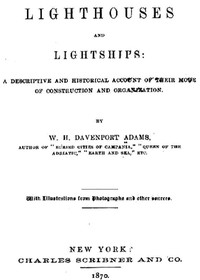
Lighthouses and Lightships A Descriptive and Historical Account of Their Mode of Construction and Organization — Reading Companion
(0 User reviews)
1260
Project Gutenberg
2018
Not confirmed
Lighthouses; Lightships
Readers of public-domain and historical texts
Project Gutenberg digital edition
en
Edition facts
Words
74,295
Reading time
324 min
Text sections
33
This digital edition of Lighthouses and Lightships A Descriptive and Historical Account of Their Mode of Construction and Organization — Reading Companion is described by source-level measurements including 74,295 words, 5 hr 24 min estimated reading time, and 33 detected text sections.
The text analysis averages about 20.2 words per sentence, while the detected sections provide another way to judge how the source is divided.
Project Gutenberg metadata also associates the work with “Lighthouses,” connecting these edition facts with the source record’s subject description.
Source:
Project Gutenberg record #57900
Examines the engineering and administrative evolution of lighthouses and lightships, with detailed accounts of construction feats such as the Eddystone and Bell Rock, and the 1841 relocation of Sunderland's lighthouse.
Editorial Edition Score
4.9/5
★★★★★
★★★★★
Calculated from edition completeness, EPUB availability, text structure and catalogue metadata. Not a user rating.
How this score is calculated
- Description quality20 pts
- Title & short description10 pts
- Source metadata20 pts
- Text length15 pts
- Chapters / structure15 pts
- EPUB file integrity20 pts
Total of 100 points, scaled to a 2.5-5.0 range. Editions with an empty description or a missing EPUB file are not scored.
Edition quality
Read the Text
We are apt to look upon the lighthouse as completely a modern invention, but a little reflection would convince us that the early navigators, in their arduous struggle against the ocean, could not have failed to establish some sure indications by which to guide their adventurous course. Undoubtedly, the first rude signal would be no more than a huge fire blazing on the wave-washed promontory, or on the summit of hoary hill or grassy mound nearest to the more dangerous parts of the shore. But it can easily be conceived that the difficulty of keeping these fires kindled on stormy nights would soon suggest to man’s ingenuity the idea of erecting a suitable structure for their shelter.
The value of this kind of coast defences was so apparent, that the ancients felt unable to ascribe them to simple human invention. And thus the Greeks attributed their origin to the demigod Hercules. But there seems some reason to believe that, long before Greece became a maritime nation, light-towers had been built by the Lybians and the Cuthites along the coast-line of Lower Egypt. These towers, we are told,[1] served as landmarks during the day, as beacons during the night. Their purpose was a holy one, and accordingly they were also used as temples, and each was dedicated to a divinity. The mariner, who naturally held them in great veneration, enriched them with his votive offerings. It has been conjectured by some authorities that their walls at first were painted with charts of the Mediterranean coast and of the navigation of the Nile; these charts being afterwards transferred to papyrus. The priests of these singular but valuable institutions taught the sciences of hydrography and pilotage, and the art of steering a vessel’s course by the aid of the constellations. On the summit of each tower a fire was continually burning; the fire being placed in a machine of iron or bronze, composed of three or four branches, each representing a dolphin or some other marine animal, and all bound together by skilful decorative work. The machine was attached to the extremity of a stout pole, and so placed that its radiance was directed seaward.
[1] Renard, “Les Phares” (Paris, 1867).
According to the Baron de Zach, in his “Correspondance Astronomique,” the Lybian appellation for these towers was _tar_, or _tor_.[2] As _is_ signifies “fire,” we thus obtain the compound _Tor-is_, or “fire-tower;” whence the Greeks derived their τύῤῥις, and the Latins their _turris_. In like manner, the Latin _columna_ comes, it is said, from _Col-On_, the “pillar of the sun.”
[2] _Tor_ is Celtic for a height, as in the _tors_, or granite hills, of Dartmoor.
Some authorities boldly carry this etymological diversion a little further. When the fire-towers were situated upon eminences outside the boundaries of cities, and constructed of a circular form, they were called _Tith_. The mythological Tithonus, so celebrated for his longevity, seems, they assert, to have been one of these edifices dedicated to the sun; and Thetis, the ancient ocean-goddess, simply a fire-tower near the sea, called _Thit-is_. Nor have ingenious theorists been wanting to maintain that the massacre of the Cyclops, who, according to the old legend, were stricken by Apollo’s arrows, was nothing but a poetical version of the manner in which the fires of the Cyclopean towers, planted on the eastern coasts of Sicily, were extinguished by the rays of the rising sun.[3]
[3] As Mr. Stevenson says (in his “Treatise on Lighthouses”), a notion so fanciful as this deserves little consideration.
The impression which the light-tower produced on the popular imagination is, however, more beautifully, as well as more certainly, described by Homer in a well-known passage of the “Iliad” (bk. xix. 375):—
“As to seamen o’er the wave is borne The watch-fire’s light, which, high among the hills, Some shepherd kindles in his lonely fold.”
In our English Bible the word _beacon_ occurs but once—namely in the Prophecies of Isaiah (xxx. 17), who lived about two centuries later than Homer; but in the Septuagint version, the same word is rendered as a “flagstaff” or “perch,” and unquestionably refers to a _land_-signal rather than to a maritime light.
The first pharos which performed its duties in a regular manner seems to have been that which Lesches, the author of the “Little Iliad” (who flourished about the 9th Olympiad), erected on the promontory of Sigeum, at the entrance of the Hellespont. It is figured in the Iliac Table.
Adams opens by asserting that most readers know little beyond the Eddystone and Bell Rock lighthouses, framing his book as an attempt to supply an "admitted deficiency." His preface promises a popular yet authoritative account, grounded in "the best authorities" and revised by competent critics. The work moves from Roman pharoi with flickering wood fires to modern towers with powerful illuminating apparatus, emphasizing both administrative principles and engineering skill.
The excerpts reveal a writer who blends technical description with rhetorical flourish. When describing the North Unst tower, he notes its foundation on an isolated reef 200 feet above the sea, exposed to "the most violent assaults of Ocean." Such phrasing—part engineer's report, part Romantic nature writing—characterizes the book's dual voice.
The Rhetoric of Construction
Adams frequently frames engineering challenges as quasi-heroic struggles. The North Unst lighthouse, he writes, "offered no difficulties comparable to those which tested the skill and perseverance of the builder of the Bell Rock"—yet he still calls it "one of the most important results obtained by our English engineers." This comparative approach elevates each project by linking it to a famous predecessor. The language of conquest appears again when he quotes a poet on the sea's power: "Great I must call them, for they conquered me!"
His descriptions of the Sunderland relocation are notably precise: the tower weighed 757,000 lbs., stood 64 feet high, and had to be turned on its axis while traversing a broken line of 28 feet north-south and 447 feet west-east. Yet he also indulges in broader cultural commentary, noting that in Europe "the removal of great masses of masonry ... always excites a very general curiosity," while in the United States such enterprises are more frequent. This juxtaposition of technical detail with national character sketches is a recurring structural device.
Diction and the Sublime
Adams's word choices oscillate between the technical and the elevated. He describes the Eddystone's construction with terms like "foundation," "illuminating apparatus," and "administrative principles," but also reaches for the sublime: the sea's "equinoctial wrath," the tower "rooted on an isolated reef." This dual register suggests an intended audience of both engineers and general readers—the "popular and intelligible form" he promises in the preface.
His treatment of the Sunderland lighthouse is particularly instructive. The phrase "one of the strangest operations recorded in the history of lighthouses" signals wonder, but he immediately follows with a dry enumeration of wheels, beams, and grooves. The illustration he references is described as affording "an idea of the manner in which this difficult engineering problem was solved." The tension between awe and analysis is a defining feature of the prose.
Structure: From Ancient to Modern
The book's organization follows a clear chronological and geographical arc. The preface establishes a trajectory from "the rude Roman pharos or old sea-tower" to "the modern pharos, shapely and yet substantial." Within chapters, Adams often begins with a general statement about a lighthouse's significance, then narrows to specific dimensions, materials, and logistical challenges. The North Unst chapter, for example, opens with a comparative remark about difficulty, then describes the reef's elevation, the tower's height (50 feet), and its internal rooms: a light-room, sleeping chamber, kitchen, and store-room.
He also integrates administrative details—the four keepers housed four miles away on Unst—alongside engineering data. This layered structure allows him to address both the physical construction and the human systems that maintain it. The Sunderland account similarly moves from the problem (a useless pier) to the solution (Murray's proposal) to the mechanical process, ending with a note on the tower's weight and the new pier's height difference.
Recurring Details and Implied Limits
Several details recur across the excerpts: the emphasis on weight and dimensions, the mention of "the best authorities" and "competent critics," and the invocation of national character. Adams repeatedly contrasts British engineering with American boldness, as when he calls the United States "that 'go-ahead' land of bold projects and daring inventions." Such asides reveal a Victorian sensibility that sees engineering as a measure of national progress.
However, the excerpts are incomplete. The book's full scope—including lightships, which appear in the title but not in the provided text—remains unclear. Adams's claim that the volume is "based on the best authorities" and revised by critics suggests a scholarly apparatus, but the excerpts do not show footnotes or bibliography. Readers should expect a synthesis of existing knowledge rather than original research, and the author's voice—part enthusiast, part compiler—shapes every page.
Adams writes as a popularizer who respects his subject's complexity. His prose rewards readers who enjoy technical detail wrapped in Victorian rhetorical flourishes. The book's value lies less in novelty than in its synthesis of engineering feats and administrative history, all delivered with a palpable sense of wonder at human ingenuity confronting the sea. Approach it as a period piece that illuminates both lighthouses and the mindset of their chronicler.
That lighthouse book stayed with me the way certain quiet labors do—the slow patience behind each stone laid at Eddystone, the weird tenderness of crews relocating Sunderland's beacon. It made me think of another kind of focused persistence, someone polishing glass until stars became reachable. On the Construction of a Silvered Glass Telescope Fifteen and a half inches in aperture, and its use in celestial photography — Reading Notes feels like that same unhurried devotion, pointing outward instead of toward shore.
There are no reviews for this eBook.
There are no comments for this eBook.
Reader reflection
How did this book work for you?
Your answers remain private and are stored only in this browser.
Your progress
0
/
10
2
Was reading this book enjoyable?
3
How likely are you to recommend this book?
4
What was the reading difficulty like?
5
Did anything about the book feel genuinely new?
6
Would you like to discuss this book with someone?
7
How would you describe its reading pace?
8
Was the book what you thought it would be?
9
What did this book teach you most?
10