1

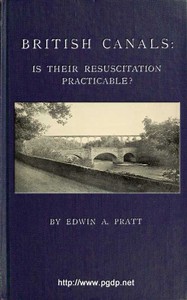
British Canals: Is their resuscitation practicable? — Story, Setting & Ideas
(0 User reviews)
2192
Project Gutenberg
2014
Not confirmed
Canals -- Great Britain; Inland navigation -- Great Britain
Readers of public-domain and historical texts
Project Gutenberg digital edition
en
Edition facts
Words
47,423
Reading time
207 min
Text sections
13
This digital edition of British Canals: Is their resuscitation practicable? — Story, Setting & Ideas is described by source-level measurements including 47,423 words, 3 hr 27 min estimated reading time, and 13 detected text sections.
The text analysis averages about 32.3 words per sentence, while the detected sections provide another way to judge how the source is divided.
Project Gutenberg metadata also associates the work with “Canals -- Great Britain,” connecting these edition facts with the source record’s subject description.
Source:
Project Gutenberg record #47435
Edwin A. Pratt's 1906 examination of British canal viability, challenging claims that railways deliberately strangled waterways, using evidence from coal trade logistics, continental comparisons, and the Birmingham Canal's operations.
Editorial Edition Score
4.8/5
★★★★★
★★★★★
Calculated from edition completeness, EPUB availability, text structure and catalogue metadata. Not a user rating.
How this score is calculated
- Description quality20 pts
- Title & short description10 pts
- Source metadata20 pts
- Text length15 pts
- Chapters / structure15 pts
- EPUB file integrity20 pts
Total of 100 points, scaled to a 2.5-5.0 range. Editions with an empty description or a missing EPUB file are not scored.
Edition quality
Read the Text
opoly of the transport business--except as regards road traffic--and in various instances they helped their proprietors to make huge profits. But great changes were impending, and these were brought about, at last, with the advent of the locomotive.
The general situation at this period is well shown by the following extracts from an article on "Canals and Rail-roads," published in the _Quarterly Review_ of March 1825:--
"It is true that we, who, in this age, are accustomed to roll along our hard and even roads at the rate of 8 or 9 miles an hour, can hardly imagine the inconveniences which beset our great-grandfathers when they had to undertake a journey--forcing their way through deep miry lanes; fording swollen rivers; obliged to halt for days together when 'the waters were out'; and then crawling along at a pace of 2 or 3 miles an hour, in constant fear of being set down fast in some deep quagmire, of being overturned, breaking down, or swept away by a sudden inundation.
"Such was the travelling condition of our ancestors, until the several turnpike Acts effected a gradual and most favourable change, not only in the state of the roads, but the whole appearance of the country; by increasing the facility of communication, and the transport of many weighty and bulky articles which, before that period, no effort could move from one part of the country to another. The pack-horse was now yoked to the waggon, and stage coaches and post-chaises usurped the place of saddle-horses. Imperfectly as most of these turnpike roads were constructed, and greatly as their repairs were neglected, they were still a prodigious improvement; yet, for the conveyance of heavy merchandise the progress of waggons was slow and their capacity limited. This defect was at length remedied by the opening of canals, an improvement which became, with regard to turnpike roads and waggons, what these had been to deep lanes and pack-horses.[1] But we may apply to projectors the observation of Sheridan, 'Give these fellows a good thing and they never know when to have done with it,' for so vehement became the rage for canal-making that, in a few years, the whole surface of the country was intersected by these inland navigations, and frequently in parts of the island where there was little or no traffic to be conveyed. The consequence was, that a large proportion of them scarcely paid an interest of one per cent., and many nothing at all; while others, judiciously conducted over populous, commercial, and manufacturing districts, have not only amply remunerated the parties concerned, but have contributed in no small degree to the wealth and prosperity of the nation.
"Yet these expensive establishments for facilitating the conveyance of the commercial, manufacturing and agricultural products of the country to their several destinations, excellent and useful as all must acknowledge them to be, are now likely, in their turn, to give way to the old invention of Rail-roads. Nothing now is heard of but rail-roads; the daily papers teem with notices of new lines of them in every direction, and pamphlets and paragraphs are thrown before the public eye, recommending nothing short of making them general throughout the kingdom. Yet, till within these few months past, this old invention, in use a full century before canals, has been suffered, with few exceptions, to act the part only of an auxiliary to canals, in the conveyance of goods to and from the wharfs, and of iron, coals, limestone, and other products of the mines to the nearest place of shipment....
"The powers of the steam-engine, and a growing conviction that our present modes of conveyance, excellent as they are, both require and admit of great improvements, are, no doubt, among the chief reasons that have set the current of speculation in this particular direction."
Dealing with the question of "vested rights," the article warns "the projectors of the intended railroads ... of the necessity of being prepared to meet the most strenuous opposition from the canal proprietors," and proceeds:--
Edwin A. Pratt opens his 1906 study with a pointed question: is the resuscitation of British canals practicable? Written in the wake of a Royal Commission on Canals and Waterways, the book sets out to test the popular theory that railways had 'captured' and 'strangled' the canal network. Pratt, author of earlier works on railway rates and agricultural organization, declares his intention to supply facts rather than advocacy, drawing on domestic and international examples. The excerpts reveal a writer deeply engaged with the practicalities of transport—coal loading, shipping logistics, and the physical constraints of canal infrastructure.
The Coal Trade as a Test Case
Pratt devotes considerable attention to coal transport, using it to measure canal viability against railway efficiency. He cites Lord Stalbridge's 1903 figures showing that over 80% of coal on the London and North-Western Railway moved in consignments under 20 tons, with an average of just 17½ tons. This fragmentation, Pratt argues, suits rail's flexibility far better than canal barges, which require larger, more uniform loads. He then examines export coal at Newport, where 50 miles of sidings hold up to 50,000 tons awaiting shipment. Canal boats, he contends, could not match this storage capacity, nor avoid the breakage and depreciation caused by double-handling from colliery screens to barge to ship. The Aire and Calder Navigation is acknowledged as a successful exception, but Pratt stresses its unusually level terrain—a condition not generalizable across Britain.
Railway Control: Fact or Fiction?
The preface directly confronts the 'strangled by railways' narrative, which Pratt compares to belief in the multiplication table—widely held but unexamined. He promises to investigate whether canal decline stems from railway ownership or from deeper structural changes in trade. The chapter list includes a dedicated section on 'Railway-Controlled Canals' and a case study of the Birmingham Canal, suggesting a forensic approach. Pratt's tone is skeptical of easy explanations; he positions himself as a corrective to 'considerable misapprehension' among the public. The excerpts do not reveal his final verdict, but his method—weighing theoretical appeal against practical obstacles—is evident throughout.
International Comparisons as Evidence
Pratt extends his inquiry beyond Britain, with chapters on continental conditions and United States waterways. The appendix further examines declining freight traffic on the Mississippi, indicating a comparative framework. This international lens allows him to test whether British canals are uniquely disadvantaged or face universal challenges. The excerpts do not detail his findings abroad, but the structure suggests he uses foreign examples to isolate factors like geography, investment, and industrial organization. By situating the British canal problem within a broader context, Pratt aims to separate local grievances from systemic issues in inland water transport.
Readers approaching British Canals should attend to Pratt's use of quantitative evidence—tonnages, costs, and distances—and his habit of juxtaposing theoretical arguments with operational realities. The book is as much a critique of public perception as of canal policy. Those interested in transport history, economic regulation, or the Edwardian infrastructure debate will find a meticulous, if partisan, contribution to a controversy that remains relevant in discussions of modal shift and infrastructure investment.
Pratt’s calm tally of canal tonnage reminded me of afternoons spent watching barges glide past my grandfather’s garden, their wakes barely disturbing the reeds. He once lent me The Curtiss Aviation Book — Story, Setting & Ideas, and I felt the same patient wonder—machines moving with quiet purpose, not conquering water or sky, but simply finding their way along it.
There are no reviews for this eBook.
There are no comments for this eBook.
Reader reflection
Record your reading impressions
A brief reflection can help important ideas stay with you longer.
Your progress
0
/
10
2
How much did you enjoy the reading experience?
3
How likely are you to recommend this book?
4
Did the language feel accessible?
5
How useful did the reading feel?
6
What did you think about the pace?
7
Was the book what you thought it would be?
8
Did you relate to its people, ideas, or situations?
9
What is the main idea you are taking away?
10