1

Implement sheds — Reading Companion
(0 User reviews)
1921
Project Gutenberg
2016
Not confirmed
Farm buildings; Barns
Readers of public-domain and historical texts
Project Gutenberg digital edition
en
Edition facts
Words
7,859
Reading time
35 min
Text sections
2
Before opening Implement sheds — Reading Companion, the edition data offers a quick orientation: 7,859 words, 35 min estimated reading time, and 2 detected text sections.
The text analysis averages about 21.5 words per sentence, while the detected sections provide another way to judge how the source is divided.
Project Gutenberg metadata also associates the work with “Farm buildings,” connecting these edition facts with the source record’s subject description.
Source:
Project Gutenberg record #51639
This editorial note examines how K.J.T. Ekblaw's 1916 pamphlet uses census data, cost-benefit reasoning, and detailed construction plans to persuade farmers to build implement sheds, focusing on how the opening, middle, and later excerpts guide a first reading.
Editorial Edition Score
4.5/5
★★★★★
★★★★★
Calculated from edition completeness, EPUB availability, text structure and catalogue metadata. Not a user rating.
How this score is calculated
- Description quality20 pts
- Title & short description10 pts
- Source metadata20 pts
- Text length15 pts
- Chapters / structure15 pts
- EPUB file integrity20 pts
Total of 100 points, scaled to a 2.5-5.0 range. Editions with an empty description or a missing EPUB file are not scored.
Edition quality
Read the Text
Text printed underlined, in italics or in bold face type in the original work have been transcribed between ~tildes~, _underscores_ and =equal signs= respectively.
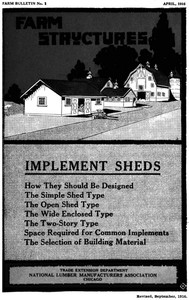
=~IMPLEMENT SHEDS~= How They Should Be Designed The Simple Shed Type The Open Shed Type The Wide Enclosed Type The Two-Story Type Space Required for Common Implements The Selection of Building Material
Revised, September, 1916.
Over fifty million dollars is lost every year on American farms because implements and machinery are not properly housed. Is part of this wasted on YOUR farm?
Protection of farm machinery in well built implement sheds means dollars earned through dollars saved. On the average farm an implement shed saves annually as much as the income from $1,800 at interest.
Implement Sheds _by_ _K. J. T. Ekblaw_
Published by the TRADE EXTENSION DEPARTMENT National Lumber Manufacturers Association
General Series No. 10
Fourth Edition, February, 1917.
A very fair indication of the thrift and general prosperity of a farmer is the method he employs in caring for his tools. Shiftlessness, waste, lack of energy, constant buying and heavy burdens of debt will accompany poor care. Good care is an indication of shrewdness, business ability, long-lived machinery, comfortable bank balances and the assurance of a peaceful, prosperous future.
To the progressive man, figures speak more forcibly than does the most persuasive lecturer on economic topics. The report of the United States Census for 1910 contains some figures that bear a distinct message to the farmers of the country. In 1900 the value of all farm property in the shape of farm implements and machinery was $749,775,970; in 1910 this same value had increased to $1,265,149,783, representing an increase of 68.7 per cent. This increase can be ascribed mainly to increased quantity rather than to higher prices, for the increase in price of farm machinery has been comparatively slight. It means that the farmers are realizing the benefits to be derived from the use of labor-saving machinery. In 1900 the acreage of improved land in farms was 414,498,487; in 1910 this became 478,451,750, an increase of only 15.4 per cent. These figures may be a little more significant if expressed in the following way: In 1900 there was $1.80 worth of machinery for each acre of improved farm land; in 1910 this had increased to $2.65, or an increase of over 47 per cent.
These figures will immediately indicate an opportunity for the furtherance of economic agriculture. With so much capital invested in equipment, the American farmer would certainly be a very bad business man indeed if he did not take some means of protecting this equipment to reduce depreciation and to increase its length of life. The question has sometimes been asked, does it pay to house farm machinery? Is it not a better practice not to give any special care to the machinery but use it as long as it will run without care then buy newer and more up-to-date equipment?
The situation bears some consideration. According to Census figures, the average investment per farm in farm machinery is almost exactly $200. This, however, is the case when every sort of farm is included, and since the Census Bureau’s definition of a farm is extremely liberal it would not be practical for our purposes. A fair estimate of the average value of farm machinery on a farm is $1,000. No reliable figures are available to indicate the rate of depreciation of farm machinery; one farmer will take excellent care of his binder and it may do service for twenty or twenty-five years, while another farmer will leave his binder in the middle of the field where the last stalk of grain was cut, and it would be surprising if his machine could operate satisfactorily for more than five seasons. To take ten years as the average life of farm machinery is certainly to be considered conservative.
Most farm machines are well and substantially constructed and will render satisfactory and efficient service with slight repairs for a much longer term of years than the average which has just been given. It is entirely safe to assume that the average length of efficient service can be increased to fifteen years providing proper care is given. It is almost equally safe to assume that the average life of uncared-for machinery will not be much more than five years.
Ekblaw opens with a blunt financial claim: over fifty million dollars lost annually on American farms because implements are not properly housed. The first pages immediately frame the implement shed as a matter of thrift and business acumen, not mere convenience. By citing 1910 Census figures—$1.80 worth of machinery per improved acre in 1900 rising to $2.65 in 1910—he establishes an economic argument that a shed saves as much annually as the income from $1,800 at interest. This cost-benefit appeal, paired with a rhetorical question about whether to house machinery or simply buy new, sets up the pamphlet’s persuasive core.
Census Figures as Persuasive Leverage
Ekblaw does not assume the reader is already convinced. He devotes the opening paragraphs to a statistical case drawn from the 1910 United States Census. The value of farm implements and machinery increased 68.7 percent from 1900 to 1910, while improved acreage grew only 15.4 percent. By expressing these figures as dollars per acre—$1.80 to $2.65—he makes the investment tangible. The implication is clear: with more capital tied up in equipment, neglecting shelter is financially reckless. This use of national data to personalize a local decision is a deliberate rhetorical strategy, not a neutral presentation of facts.
From General Principle to Specific Dimensions
After establishing the economic motive, Ekblaw shifts to practical specifications. The middle excerpts include detailed framing instructions for a two-story implement shed: 6x6 posts, 4x6 girts spaced at vertical intervals not exceeding five feet, and diagonal bracing as a decided advantage. He specifies building widths of 18 or 26 feet and a maximum length of 40 feet. The foundation must extend below the frost line and be nearly as strong as that used for barns. These precise measurements transform the pamphlet from a general argument into a working blueprint, guiding a reader who may be planning construction.
Table I: A Catalog of Implements and Their Space Needs
One of the most striking features is Table I, which lists floor space and height requirements for common farm implements. Walking plows require 8x3 feet and 3 feet of height; grain binders need 8x14 feet and 7 feet; a 32-inch grain separator demands 26x8 feet and 8.5 feet. The table includes tongue-off dimensions and notes for adding tongue length. This systematic inventory serves a dual purpose: it helps the farmer calculate total shed size and reinforces the argument that each machine has a specific spatial footprint. The table’s thoroughness—covering everything from fanning mills to gasoline tractors—demonstrates Ekblaw’s practical familiarity with farm equipment.
Vertical Storage and the Two-Story Solution
Ekblaw devotes considerable attention to the two-story implement shed, which doubles floor space under the same roof. The second floor stores lighter machines—small plows, harrows, drills—while the first floor holds heavier items like binders and wagons. He discusses two methods for moving machines upstairs: a block and tackle through a gable door or a hole in the floor, or a steep runway at a 30-degree angle. The runway, built from 4x6 joists and rough 2-inch flooring, is presented as superior when the shed sits on a hillside. This section reveals Ekblaw’s awareness that farm layouts vary, and he offers adaptable solutions rather than a single prescription.
Readers approaching this pamphlet for the first time should note its dual nature: it is both a persuasive essay and a technical manual. The opening economic argument gives way to increasingly granular construction details, culminating in a table that could serve as a checklist. Ekblaw assumes a farmer who is literate in both numbers and carpentry. The pamphlet rewards a reading that moves from the broad financial claim to the specific framing dimensions, treating each section as a step toward a single practical conclusion: build a shed, and build it to last.
I’ve often thought Ekblaw’s little pamphlet on implement sheds holds a strange, quiet kinship with The Curtiss Aviation Book — Story, Setting & Ideas—both are manuals of possibility, one grounding farmers in sturdy timber, the other lifting them toward sky. Each treats its machine as a trusted companion, deserving of careful attention and patient hands. Reading them side by side, I feel the same unhurried reverence for craft, for the tools that carry our hopes quietly aloft.
There are no reviews for this eBook.
There are no comments for this eBook.
Reader reflection
How will you remember this book?
Save your reaction, strongest insight, and memorable passage.
Your progress
0
/
10
2
How much did you enjoy the reading experience?
3
Would you pass this book on to a friend?
4
How demanding did the text feel?
5
How did the reading compare with what you expected?
6
Would a second reading be valuable?
7
How personally connected did you feel to the book?
8
Did the story or argument move comfortably?
9
What is the main idea you are taking away?
10