1

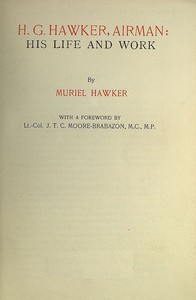
H. G. Hawker, airman: his life and work — Edition Insights
(0 User reviews)
1799
Project Gutenberg
2021
Not confirmed
Hawker, H. G. (Harry George), 1889-1921; Aeronautics -- Great Britain
Readers of public-domain and historical texts
Project Gutenberg digital edition
en
Edition facts
Words
93,148
Reading time
405 min
Text sections
38
H. G. Hawker, airman: his life and work — Edition Insights can be approached with a clearer sense of reading commitment from its source measurements: 93,148 words, 6 hr 45 min estimated reading time, and 38 detected text sections.
The text analysis averages about 22.1 words per sentence, while the detected sections provide another way to judge how the source is divided.
Project Gutenberg metadata also associates the work with “Hawker, H. G. (Harry George), 1889-1921,” connecting these edition facts with the source record’s subject description.
Source:
Project Gutenberg record #64793
Muriel Hawker's biography of her husband Harry George Hawker, a pioneering aviator, details his early flights, record-breaking altitude achievements, and test pilot work for Sopwith, based on personal letters and technical notes.
Editorial Edition Score
4.9/5
★★★★★
★★★★★
Calculated from edition completeness, EPUB availability, text structure and catalogue metadata. Not a user rating.
How this score is calculated
- Description quality20 pts
- Title & short description10 pts
- Source metadata20 pts
- Text length15 pts
- Chapters / structure15 pts
- EPUB file integrity20 pts
Total of 100 points, scaled to a 2.5-5.0 range. Editions with an empty description or a missing EPUB file are not scored.
Edition quality
Read the Text
optimist, and the way he came out of his many troubles warranted his optimism. It was so natural if he had a smash to know he was not hurt, or if he had any trouble it would be righted very quickly. This feeling is so real that, even now, apart from all religion, I know he has come up smiling somewhere and all is well with him.
The production of this book has necessitated the collecting and sifting of a considerable amount of detail, particularly as regards the earlier chapters and those dealing with the Atlantic flight. In this and in the general plan of the book I have received considerable assistance from Mr. W. R. Douglas Shaw, F.R.S.A., who has rendered invaluable help in many ways through his wide knowledge of aeronautical matters.
This introduction would not be complete without my also acknowledging the help received from Lt.-Commander Mackenzie-Grieve, R.N., who has kindly read through the chapters dealing with the Atlantic flight; from Mr. Alan R. Fenn, formerly of the Sopwith Aviation Company, for details of Harry’s experiences at Villacoublay; from the authorities at Australia House in allowing me to consult their records, and from many others who have contributed in various ways to this work.
My acknowledgments are also due to the Press, on whose reports I have relied in many cases, and I would mention _The Times_, _Morning Post_, _The Daily Mail_, Temple Press, Iliffe & Sons, _Flight_, _The Aeroplane_, and particularly the kindness of the proprietors of the _Melbourne Argus_ and _Sydney Bulletin_ in giving me free access to their files of 1913-14.
Harry’s Parents—His Sisters and Brothers—Schooldays—Four Schools in Six Years—The Attraction of a Cadet Corps—Motor Work at Twelve Years of Age—The Expert of Fifteen—Managing a Fleet of Cars—First Desire to Fly—The Kindness of Mr. and Mrs. McPhee—Harry Meets Busteed—And Comes to England with Him—Kauper—Seeing London—Quest for Employment—A Job at Sevenpence per Hour—Another at Ninepence-Halfpenny—Thoughts of Returning to Australia—Forty Pounds in the Bank—Kauper Strikes Oil—And Helps Harry—Sigrist—How Harry was Happy on Two Pounds per Week—His First Flight—Reminiscences of Brooklands Days 25
THE BRITISH DURATION RECORD
Harry’s Aversion to Publicity—Circumstances of His First Brooklands Associations—The Sopwith-Burgess-Wright Biplane—Harry’s Effort in a Quick-Starting Competition—Beating His Employer—Early Attempts for Michelin Laurels—A Real Success—Tuning-up for the Duration Record—Raynham Makes a Race—And Secures an Advantage—Raynham Lands after 7 hours 31½ minutes—And Holds the Record for an Hour or Two—Opportunity Knocks at Harry’s Door—And is Well Received—Harry Lands after 8 hours 23 minutes—To Him the Spoils—His Own Account of the Experience—A Reminiscence of Cody—The Significance of Harry’s Achievement—Other Flights at Brooklands—The Growth of a Pioneer Firm 35
ABOUT ALTITUDE AND OTHER RECORDS
A Colleague’s Impression of Harry in 1913—Harry in the Passenger’s Seat—“Aerial Leap-Frog”—Competition Flights at Brooklands—Testing the First “Bat Boat”—End of the First “Bat Boat”—Harry as a Salesman-Demonstrator—Testing the Second “Bat Boat”—70 Miles per Hour in 1913—Asçent to 7,450 feet in 15 minutes—A Prize Flight—How Harry Deserted from a Race which He Won—How a Biplane Beat a Monoplane—More Seaplane Testing—The British Altitude Record—11,450 Feet—“Bravo, Hawker!”—A Journalist’s Tribute—Flying in a High Wind—To the Isle of Wight and Back 53
AMPHIBIANS—AND MORE HEIGHT RECORDS
An Amphibian of 1913—Harry Gets Up to 13,000 feet with a Passenger—Several Other Height Records—Three Climbs in One Day—The Progress of the Sopwith Enterprise—Several Types of Aeroplanes—And Seaplanes—Harry Wins the Mortimer Singer Prize—And Has Time to Spare—A Friendly Race with Hamel—A World’s Height Record—A Cross-Country Race—Preliminaries of the Round-Britain Seaplane Flight—Conditions Governing the _Daily Mail_ £5,000 Prize 63
FIRST ATTEMPT TO FLY ROUND BRITAIN
The Task of the Flight Round Britain—And the Machine for the Job—Public Interest in the Pilot—“Good Luck!”—The Night Before the Start—A Mayor’s Early Call—And the Sequel—The Scene at the Start—To Ramsgate at Sixty Miles per Hour—An Aerial Escort—The Ramsgate Cup—Fog in the Thames Mouth—To Yarmouth in Next to No Time—Harry Collapses—Pickles Relieves Him—And Meets with Misfortune—Starting All Over Again 77
SECOND ATTEMPT TO FLY ROUND BRITAIN
Muriel Hawker’s biography of her husband, Harry George Hawker, opens with a foreword by Lt.-Col. J. T. C. Moore-Brabazon, who frames Hawker as a figure emblematic of a shift from animal to mechanical sport. The narrative, drawn from Hawker’s own words and letters, presents a detailed account of his aviation career rather than a personal memoir. The catalog subjects—Civil Engineering, Aeronautics—suggest a technical focus, but the excerpts reveal a work equally concerned with the social and commercial aspects of early flight, such as looping-the-loop displays for bonuses and the public’s fascination with aerial stunts.
Technical Modifications and Public Spectacle
The excerpts show Hawker’s hands-on involvement in aircraft modification, such as applying a lateral dihedral angle to lower planes and uncovering the rear fuselage of the Tabloid to improve its looping capability. These changes were not purely experimental; they were driven by public demand. Between July 13 and 31, 1914, Hawker earned £30 in bonuses for looping displays at Brooklands. The text notes that public interest in looping-the-loop was at its zenith, and Hawker was kept busy satisfying the craze until war was declared. This intertwining of technical tinkering and commercial spectacle is a recurring theme.
Record Flights and Wartime Testing
On June 6, 1915, Hawker broke the British Altitude Record for pilot alone, reaching 18,393 feet—nearly 4,000 feet higher than the previous record. The excerpts also describe his wartime test flights, including an Admiralty one-hour test of a new machine at Hendon, where onlookers speculated he had lost his way or had engine trouble. Hawker’s role as a test pilot for Sopwith is evident in his flights on various machines, such as the Beatty-Wright biplane, which he noted for its ease of handling and resemblance to the old Sopwith-Burgess-Wright. The narrative balances technical detail with anecdotal observation.
The Author’s Perspective and Editorial Choices
Muriel Hawker states in the preface that she undertook the writing at her husband’s suggestion, to occupy her mind after his death. The book is thus a widow’s tribute, but the excerpts show a restrained, factual tone, relying on letters and technical notes. The foreword by Moore-Brabazon emphasizes Hawker’s modesty and hard work, yet the catalog classification under Civil Engineering may mislead readers expecting a purely technical treatise. The text includes details of athletic sports meetings at the Sopwith works and Royal visits, indicating a broader social history of aviation’s early community.
Readers should approach this work as a hybrid: part technical record of early aeronautical engineering, part personal chronicle of a pilot’s career. The catalog subjects understate the human and commercial dimensions visible in the excerpts. Pay attention to the interplay between Hawker’s modifications and the public’s appetite for spectacle, as well as the author’s deliberate choice to foreground professional achievements over private grief.
Reading Muriel Hawker’s gentle account of Harry’s quiet patience aloft, his careful notes on wind and wing, I found myself thinking of another sort of mastery over the deep. There is a similar reverence in the way old manuals chart a hull’s lines—both are prayers for steadiness. Modern ships of war — Key Ideas to Explore holds that same hushed arithmetic of courage.
There are no reviews for this eBook.
There are no comments for this eBook.
Reader reflection
Before you leave, reflect on the book
Use these questions to collect your thoughts before moving on.
Your progress
0
/
10
2
Was reading this book enjoyable?
3
Would you recommend this book to another reader?
4
How demanding did the text feel?
5
Which element worked best for you?
6
Did the book meet your expectations?
7
Did it raise ideas you would like to talk about?
8
Do you expect to return to this book?
9
What is the main idea you are taking away?
10