1

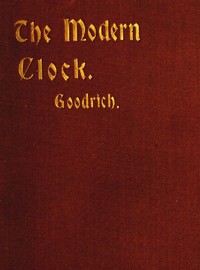
The Modern Clock A Study of Time Keeping Mechanism; Its Construction, Regulation and Repair — A Reader’s Guide
(0 User reviews)
42
Project Gutenberg
2020
Not confirmed
Clocks and watches; Clocks and watches -- Repairing
Readers of public-domain and historical texts
Project Gutenberg digital edition
en
Edition facts
Words
143,945
Reading time
626 min
Text sections
35
Before opening The Modern Clock A Study of Time Keeping Mechanism; Its Construction, Regulation and Repair — A Reader’s Guide, the edition data offers a quick orientation: 143,945 words, 10 hr 26 min estimated reading time, and 35 detected text sections.
The text analysis averages about 27.0 words per sentence, while the detected sections provide another way to judge how the source is divided.
Project Gutenberg metadata also associates the work with “Clocks and watches,” connecting these edition facts with the source record’s subject description.
Source:
Project Gutenberg record #61494
Ward L. Goodrich's 1905 manual on clock construction, regulation, and repair, emphasizing precise mechanical calculations and practical workshop techniques for pendulum and escapement systems.
Editorial Edition Score
4.9/5
★★★★★
★★★★★
Calculated from edition completeness, EPUB availability, text structure and catalogue metadata. Not a user rating.
How this score is calculated
- Description quality20 pts
- Title & short description10 pts
- Source metadata20 pts
- Text length15 pts
- Chapters / structure15 pts
- EPUB file integrity20 pts
Total of 100 points, scaled to a 2.5-5.0 range. Editions with an empty description or a missing EPUB file are not scored.
Edition quality
Read the Text
THE NECESSITY FOR BETTER SKILL AMONG CLOCKMAKERS.
The need for information of an exact and reliable character in regard to the hard worked and much abused clock has, we presume, been felt by every one who entered the trade. This information exists, of course, but it is scattered through such a wide range of publications and is found in them in such a fragmentary form that by the time a workman is sufficiently acquainted with the literature of the trade to know where to look for such information he no longer feels the necessity of acquiring it.
The continuous decrease in the prices of watches and the consequent rapid increase in their use has caused the neglect of the pendulum timekeepers to such an extent that good clock men are very scarce, while botches are universal. When we reflect that the average ‘life’ of a worker at the bench is rarely more than twenty years, we can readily see that information by verbal instruction is rapidly being lost, as each apprentice rushes through clock work as hastily as possible in order to do watch work and consequently each “watchmaker” knows less of clocks than his predecessor and is therefore less fitted to instruct apprentices in his turn.
The striking clock will always continue to be the timekeeper of the household and we are still dependent upon the compensating pendulum, in conjunction with the fixed stars, for the basis of our timekeeping system, upon which our commercial and legal calendars and the movements of our ships and railroad trains depend, so that an accurate knowledge of its construction and behavior forms the essential basis of the largest part of our business and social systems, while the watches for which it is slighted are themselves regulated and adjusted at the factories by the compensated pendulum.
The rapid increase in the dissemination of “standard time” and the compulsory use of watches having a maximum variation of five seconds a week by railway employees has so increased the standard of accuracy demanded by the general public that it is no longer possible to make careless work “go” with them, and, if they accept it at all, they are apt to make serious deductions from their estimate of the watchmaker’s skill and immediately transfer their custom to some one who is more thorough.
The apprentice, when he first gets an opportunity to examine a clock movement, usually considers it a very mysterious machine. Later on, if he handles many clocks of the simple order, he becomes tolerably familiar with the time train; but he seldom becomes confident of his ability regarding the striking part, the alarm and the escapement, chiefly because the employer and the older workmen get tired of telling him the same things repeatedly, or because they were similarly treated in their youth, and consider clocks a nuisance, any how, never having learned clock work thoroughly, and therefore being unable to appreciate it. In consequence of such treatment the boy makes a few spasmodic efforts to learn the portions of the business that puzzle him, and then gives it up, and thereafter does as little as possible to clocks, but begs continually to be put on watch work.
We know of a shop where two and sometimes three workmen (the best in the shop, too) are constantly employed upon clocks which country jewelers have failed to repair. If clock work is dull they will go upon watch work (and they do good work, too), but they enjoy the clocks and will do them in preference to watches, claiming that there is greater variety and more interest in the work than can be found in fitting factory made material into watches, which consist of a time train only. Two of these men have become famous, and are frequently sent for to take care of complicated clocks, with musical and mechanical figure attachments, tower, chimes, etc. The third is much younger, but is rapidly perfecting himself, and is already competent to rebuild minute repeaters and other sorts of the finer kinds of French clocks. He now totally neglects watch work, saying that the clocks give him more money and more fun.
Ward L. Goodrich opens The Modern Clock with a direct complaint: good clock men are scarce, while “botches are universal.” The book is a response to that scarcity, written for the working repairman who already knows his way around a lathe but needs exact, reliable information on pendulum physics, train calculations, and escapement geometry. Goodrich does not waste words on general history or philosophy; he moves quickly into formulas, tables of wheel teeth, and instructions for cutting pinions. The tone is that of a master explaining to an apprentice who is expected to follow every step.
A Voice of Practical Frustration
Goodrich’s preface and first chapter establish a distinctive narrative voice: impatient, exacting, and slightly aggrieved. He notes that the necessary information “exists, of course, but it is scattered through such a wide range of publications” that by the time a workman knows where to look, he no longer needs it. This is not a detached textbook; it is a craftsman’s manifesto. The author repeatedly contrasts the “average” clockmaker’s sloppy habits with the precision he demands. When he presents a table of turret clock trains, he annotates it with curt judgments—“These are good examples”—as if daring the reader to disagree. The voice gives the technical material a persuasive urgency: follow these methods or remain a botch.
Calculations as the Core of the Text
The book’s structure is driven by arithmetic. Goodrich devotes long passages to train calculations, showing how to derive pendulum vibrations per hour from wheel and pinion counts. A typical sequence: “Take a pendulum vibrating 5,400 times an hour, escape wheel of 30, pinions of 8, and third wheel of 72. Then 5,400 ÷ 60 = 90. And 90 × 8 ÷ 72 = 10.” The prose itself becomes a kind of algorithm, with each step chained to the next. Tables of gear ratios and barrel circumferences occupy whole pages, and the reader is expected to work through them with pencil in hand. This quantitative density sets The Modern Clock apart from more descriptive horological works; it is a book to be used at the bench, not read in an armchair.
Shifts in Pace: From Theory to Workshop
Goodrich varies his pace markedly between chapters. Early chapters on pendulum laws and compensation are slow, explanatory, and laced with physical reasoning. Later chapters on cleaning cuckoo clocks or repairing dials are brisk and procedural, almost like checklists. The chapter on “Cleaning and Repairing Cuckoo Clocks,” for instance, jumps straight into disassembly steps without preamble. This shift reflects the book’s dual audience: the student who needs to understand why a mercurial pendulum works, and the repairman who just wants to get a customer’s clock running again. The change in tempo is not accidental; it mirrors the movement from theory to practice that Goodrich insists is necessary for real skill.
Because The Modern Clock is organized as a reference, readers may start with the chapter that matches their immediate problem—escapements, striking trains, or electric clocks—and work outward. Goodrich’s cross-references are sparse, so the index and table of contents are essential tools. The book rewards a patient, iterative reading: a formula that seems opaque on first encounter often becomes clear after studying the worked examples. Keep a notebook and a calculator handy; the text expects you to do the math.
There’s something humbling about manuals that assume your patience, like The Modern Clock did for me—every gear a small promise. It made me think of that other quiet craft, the slow shaping of hulls in Shipbuilding from its beginnings. Vol. 1 (of 3) — Reading Companion. Both feel like listening to old friends who knew exactly when to pause.
There are no reviews for this eBook.
There are no comments for this eBook.
Reader reflection
Your personal reading reflection
Build a private reading journal entry for this title.
Your progress
0
/
10
2
Did this book hold your interest?
3
Would you pass this book on to a friend?
4
How easy was the book to follow?
5
Was the book easy to understand?
6
Would you like to discuss this book with someone?
7
How did the reading compare with what you expected?
8
Did the book offer a fresh perspective?
9
What did this book teach you most?
10