1

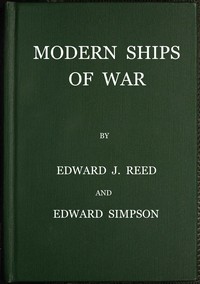
Modern ships of war — Key Ideas to Explore
(0 User reviews)
184
Project Gutenberg
2024
Not confirmed
Navies; Warships
Readers of public-domain and historical texts
Project Gutenberg digital edition
en
Edition facts
Words
106,923
Reading time
465 min
Text sections
27
The source record for Modern ships of war — Key Ideas to Explore measures this digital text at 106,923 words, 7 hr 45 min estimated reading time, and 27 detected text sections.
The text analysis averages about 27.1 words per sentence, while the detected sections provide another way to judge how the source is divided.
Project Gutenberg metadata also associates the work with “Navies,” connecting these edition facts with the source record’s subject description.
Source:
Project Gutenberg record #73887
An 1888 technical and political analysis of late-19th-century naval construction, co-authored by a British chief constructor and a U.S. rear-admiral, arguing for American naval modernization through detailed comparisons of warship design, armament, and national policy.
Editorial Edition Score
4.9/5
★★★★★
★★★★★
Calculated from edition completeness, EPUB availability, text structure and catalogue metadata. Not a user rating.
How this score is calculated
- Description quality20 pts
- Title & short description10 pts
- Source metadata20 pts
- Text length15 pts
- Chapters / structure15 pts
- EPUB file integrity20 pts
Total of 100 points, scaled to a 2.5-5.0 range. Editions with an empty description or a missing EPUB file are not scored.
Edition quality
Read the Text
ships there has been brought about—voluntarily, and not as a consequence of reduced size, for it was first applied in the largest of all British men-of-war, the _Inflexible_—a system of stripping the so-called armored ships of the English navy of a large part of their armor, and reducing its extent to so deplorable a degree that, as has already been said, they are quite unfit to take part, with any reasonable hope of success, in any general engagement. Here, again, there might have been something to say for a large reduction in the armored surface of ships if it had been attended by some great compensation, such as that which an immense increase in the thickness of the armor applied might have provided, although no such increase could ever have compensated for such a reduction of the armored part of the ship as would have exposed the whole ship to destruction by the mere bursting in of the unarmored ends, which is what has been done. But although in the case of the large _Inflexible_ the citadel armor was of excessive thickness, that is not true of the more recent ships of England, the armor of which sometimes falls short of that of the French ships, in two or three instances by as much as four inches, the French ships having 22-inch armor, and the English 18-inch. But by the combined effect of injudicious economy and of erroneous design, therefore—both furthered by a sort of frenzied desire on the part of the British Admiralty to strip the ships of armor, keep down their speed, delay their completion, and otherwise paralyze the naval service, apparently without understanding what they were about—the British navy has been brought into a condition which none but the possible enemies of the country can regard without more or less dismay.
In order to illustrate the extent to which side armor has been denied to the British ships, as compared with the French, we refer the reader to these diagrams of the _Amiral Duperré_ (French) and of the _Inflexible_ and _Collingwood_ (both English). The black portions represent the side armor in each case. It is scarcely possible for any one friendly to Great Britain to look at these diagrams, and realize what they signify, without profoundly regretting that a sufficient force of public opinion has not yet been exerted to compel the Admiralty to a much more liberal use of armor in the new first-class ships, the intended construction of which was announced to Parliament in December, 1885. In these new ships, while the length of the partial belt has been slightly increased, no addition to its height above water has been made (as compared with the _Collingwood_ or “Admiral” class), so that the slightest “list” towards either side puts all the armor below water. To describe such ships as “armored ships” is to convey a totally false impression of their true character. A side view of one of these new ships shows that the two principal guns are carried high up forward in an armored turret, which sweeps from right ahead, round the bow on each side, and well towards the stern, while several smaller guns are carried abaft with very thin armor protection to complete the offensive powers of the ship. The arrangement of the two principal guns in a turret forward resembles that of the _Conqueror_, but in her the armor rises high above the water, and a belt extends to the bow and nearly to the stern. It is a matter of inexpressible regret that the armored surface of these new ships is so excessively contracted as to be wholly insufficient to preserve the ship from that terrible danger to which so many of their predecessors have been exposed, _viz._, that of capsizing from loss of stability when the unarmored parts alone have been injured.
The preface opens with a blunt indictment of American naval neglect: “After many years of neglect, the people of this country have awakened to the necessity of creating a modern fleet.” The authors—Sir Edward J. Reed, former Chief Constructor of the British Navy, and Rear-Admiral Edward Simpson, former President of the U.S. Naval Advisory Board—frame the work as both a technical treatise and a political argument. They describe a “lazy optimism of indifference” that allowed the U.S. Navy to decay, relying on what they call “the creative possibilities of American genius” as a substitute for sustained investment. The tone is urgent, even caustic, as they recount how Congress prescribed “three unarmored cruisers and a despatch-boat” as a remedy for deep systemic decline.
A Rhetoric of Indictment
The authors adopt a prosecutorial voice, using phrases such as “a fatuous hope” and “a neatly balanced policy of pride and folly” to describe congressional inaction. They contrast the “heroic treatment” needed with the “homœopathy” actually delivered. This rhetorical strategy is not merely decorative; it establishes the book as a polemic disguised as a technical manual. The preface’s language—“apathy inexplicable,” “degeneracy,” “humiliation and mortification”—reveals a deep frustration with political inertia. The authors do not simply list deficiencies; they assign blame, targeting both lawmakers and a public that “met all claims for its re-establishment by a denial of its usefulness.”
Technical Specificity as Evidence
The excerpts shift from broad critique to precise technical data. For example, one vessel is described as having “a displacement of 3900 tons,” attaining “a speed of 12.8 knots per hour with an indicated horse-power of 2813,” and carrying “350 tons” of coal. The battery consists of “ten 8-inch muzzle-loading rifles (converted).” This granular detail serves a dual purpose: it demonstrates the authors’ expertise and provides concrete evidence for their argument that the U.S. fleet was obsolete. They note that existing cruisers are “built of wood, have low speed, and are armed with smooth-bore guns, with a sprinkling of rifled cannon.” The contrast between these figures and the implied capabilities of foreign warships is left implicit but unmistakable.
The Pace of Naval Obsolescence
The authors repeatedly emphasize the speed of technological change. They observe that “the rapidity of naval development has not been properly appreciated” and that after “a long interval of indifference,” the U.S. found itself “utterly distanced in the race.” This theme of accelerating progress—and the danger of falling behind—structures the narrative. They describe a “most violent transition” from sailing ships with auxiliary steam to full-powered steamers, noting that for over thirty years “we saw no new type of cruiser.” The shift from “the sailing-ship with auxiliary steam-power” to “the steamer with auxiliary sail-power” is presented as a halting, inadequate evolution. The authors argue that only by reducing sail-power to a minimum could a true “full-powered steamer” emerge.
Readers should approach Modern Ships of War as a hybrid document: part technical catalog, part national security brief. The authors’ dual expertise—British and American—gives the work a comparative dimension that is rare in single-nation studies. Pay attention to how they weave quantitative data (tonnage, speed, armament) into a broader argument about policy failure. The book’s structure, moving from indictment to evidence to prescription, rewards careful attention to its rhetorical shifts as much as its technical content.
There’s something touching about how these old manuals and naval treatises assume a world where mastery was achievable—steel, steam, and firemen’s exams all demanding the same quiet diligence. I keep my 1888 copy near the The Traveling Engineers' Association to Improve the Locomotive Engine Service of American Railroads Examination Questions and Answers for Firemen for Promotion and — Background and Themes, two eras agreeing that progress was simply careful work. Strange, how nostalgic certainty feels now.
There are no reviews for this eBook.
There are no comments for this eBook.
Reader reflection
Record your reading impressions
A brief reflection can help important ideas stay with you longer.
Your progress
0
/
10
2
How much did you enjoy the reading experience?
3
Would you pass this book on to a friend?
4
How easy was the book to follow?
5
How distinctive were its ideas or approach?
6
What was the strongest part of the book?
7
Did you relate to its people, ideas, or situations?
8
Do you expect to return to this book?
9
What changed or sharpened your thinking?
10