1

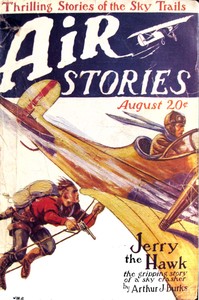
How to get an air job — Reading Notes
(0 User reviews)
47
Project Gutenberg
2023
Not confirmed
Aeronautics
Readers of public-domain and historical texts
Project Gutenberg digital edition
en
Edition facts
Words
4,755
Reading time
21 min
Text sections
1
The catalog record for How to get an air job — Reading Notes provides practical reading context through 4,755 words, 21 min estimated reading time, and 1 detected text section.
The text analysis averages about 23.5 words per sentence, while the detected sections provide another way to judge how the source is divided.
Project Gutenberg metadata also associates the work with “Aeronautics,” connecting these edition facts with the source record’s subject description.
Source:
Project Gutenberg record #71315
Jack Byrne's 1927 career guide frames aviation as a new frontier, blending pioneer rhetoric with practical advice for ground and air jobs. The catalog subject 'Aeronautics' fits, but the text focuses more on selling the industry than technical instruction.
Editorial Edition Score
4.4/5
★★★★★
★★★★★
Calculated from edition completeness, EPUB availability, text structure and catalogue metadata. Not a user rating.
How this score is calculated
- Description quality20 pts
- Title & short description10 pts
- Source metadata20 pts
- Text length15 pts
- Chapters / structure15 pts
- EPUB file integrity20 pts
Total of 100 points, scaled to a 2.5-5.0 range. Editions with an empty description or a missing EPUB file are not scored.
Edition quality
Read the Text
HOW TO GET AN AIR JOB
If you have the nerve and ambition to become a cloudman, this will tell you where to go to bat--and how.
Back in the days when the clipper ships spread their great, white sails from Hudson’s Bay clear down around the Horn, the youth of America heard the call of the sea--the whistle of a hurricane through the shrouds, the _boom, boom, boom_ of the surf pounding a coral shore. They heard the call and they answered it; and with their youth and their strength and their undying courage they toiled till their new flag ruled the seas.
Then came the call of the West. The pioneer spirit that was Kit Carson’s, that was Boone’s, reached out through the land. Clerks put down their pens and joined the wagon trains; farmers gave up the plows to strap on their muskets. From every walk in life they came to battle with their wilderness. And they stretched their homes from coast to coast to rule the land.
The sea, first; then the land. And now they have come to that last great frontier--the air!
The advance man has made toward his conquest of the air is common knowledge. The development of heavier-than-air craft from a purely experimental stage to its present place in the commercial world has been a part of our lives; in a sense, we have all grown up with it. We have come naturally to recognize aviation as one of the prime factors of the future--and the same pioneer spirit that conquered the land and the sea is impelling our young men to ask questions about it.
“Does aviation offer _me_ an opportunity?” they want to know. And then they ask, “How can I take advantage of this opportunity? How can I learn aviation and get a job in the air?”
The answer to the first question is emphatically, YES! American aviation today has reached a good sound beginning. The countries of Europe may boast more widespread routes, may point to their greater number of planes and a greater volume of business, but experts now declare unanimously that this condition is only temporary. The United States has solved its air problem in typical Yankee style--and our unsubsidized, privately-owned companies form a solid basis upon which to build.
_You_, if you have certain definite qualifications, can help in the building.
The qualifications are simple and concise. They are:
(1) Good health and a strong body. (2) A common-school education, or better. (3) An interest in mechanics and a flair for adventure.
If you have these things, and with them an impelling desire to pioneer in a virgin field, aviation offers you an opportunity to get in on the ground floor. Of course, everyone cannot be a pilot or a flyer any more than every man on the baseball team can be the pitcher. For every person in the air there must be at least ten men doing work on the ground, and many of you will find your opportunity there.
Aircraft companies will need Aeronautical Engineers, Mechanics, Motor Experts, Airplane Builders and Designers, Assemblers, Salesmen--and as the industry develops the need for men trained in this field will increase, just as it did in the automotive industry. And aviation is growing by leaps and bounds.
The second question--how to learn aviation and get a job in the flying game--is more complex and more difficult to answer. It would be best to divide the answer in two parts; (1) for the fellow who can afford to take a course in aviation instruction; and (2) for the fellow who has to make his way while he learns.
If you have between $500.00 and $1,000.00 dollars to spend, you can take a complete training in the theory and practice of aviation; and with this training you should be able to get a job that will repay your investment--and with interest. There are hundreds of schools and private operators who can teach you the business of flying. Several of our leading colleges offer technical courses for more advanced students. There are even organizations that offer courses in aeronautics by correspondence. The prospective student has a wide choice.
_Air Stories_ will be glad to help you in the selection of a school to meet your own requirements if you say the word.
If you have to make your way while you learn, you might well consider the chance that is offered young men interested in aviation by the United States Army Air Corps.
Jack Byrne opens How to Get an Air Job with a sweeping historical parallel: the clipper ships and the westward expansion are invoked to cast aviation as the 'last great frontier.' This rhetorical move, rather than technical detail, dominates the early pages. The catalog subject 'Aeronautics' suggests a manual on flight mechanics, but the excerpt reveals a career-counseling pamphlet aimed at young men with 'nerve and ambition.' Byrne lists three qualifications—health, common-school education, and 'a flair for adventure'—and emphasizes that most aviation jobs are on the ground. The text is a product of its time, 1927, when commercial aviation was nascent and the author sells opportunity more than skills.
Pioneer Rhetoric as Career Pitch
Byrne’s opening paragraphs do not describe aircraft or flight principles. Instead, he aligns aviation with the sea and land conquests, using phrases like 'the call of the sea' and 'the pioneer spirit that was Kit Carson’s.' This framing suggests the intended reader is not an engineer but a young man seeking adventure. The catalog subject 'Aeronautics' might lead one to expect diagrams or technical terms, but the excerpt contains none. The text’s persuasive tone—'You, if you have certain definite qualifications, can help in the building'—is closer to recruitment than instruction. The historical analogy serves to legitimize aviation as a worthy pursuit, but it also reveals the author’s assumption that his audience needs motivation, not just information.
Ground Jobs Over Pilot Glamour
Byrne explicitly counters the popular focus on pilots: 'everyone cannot be a pilot or a flyer any more than every man on the baseball team can be the pitcher.' He states that for every person in the air, ten work on the ground. The list of ground roles—Aeronautical Engineers, Mechanics, Motor Experts, Airplane Builders, Salesmen—is the most concrete career information in the excerpt. Yet the catalog subject 'Aeronautics' is broad; the text’s actual emphasis on non-flying jobs is a notable nuance. Byrne compares aviation’s growth to the automotive industry, suggesting a trajectory of increasing demand for trained workers. This pragmatic section contrasts sharply with the romanticized opening, indicating a dual purpose: inspire and then ground expectations.
The Unseen Structure: What the Excerpt Omits
The provided excerpt breaks off before Byrne can detail how to actually get a job. The text’s title promises a 'how-to,' but the surviving portion is largely motivational. The catalog subject 'Aeronautics' implies technical content, yet the excerpt contains no discussion of aircraft types, flight theory, or application procedures. This gap between subject and substance is significant: the book may have included practical chapters later, but the opening sells the dream first. Readers expecting a manual will find a pitch. The text’s brevity—4,755 words—suggests it is a concise guide, but the excerpt’s focus on attitude over action means the 'how' remains largely implied. The work is best understood as a period piece of career advice, not a technical primer.
How to Get an Air Job is best approached as a historical document of vocational persuasion. Its catalog subject 'Aeronautics' is accurate only in the broadest sense; the text’s core is a call to join an industry, not a study of its science. Readers interested in 1920s aviation culture or early career-guidance literature will find value in Byrne’s blend of frontier myth and practical realism. Those seeking technical instruction should look elsewhere.
I found myself thinking about Jack Byrne’s old How to Get an Air Job the other day—how he made aviators sound like frontier folk, all promise and grit. That same sense of starting something huge settled over me with Shipbuilding from its beginnings. Vol. 1 (of 3) — Reading Companion. Different craft, same quiet hum of beginning.
There are no reviews for this eBook.
There are no comments for this eBook.
Reader reflection
Record your reading impressions
A brief reflection can help important ideas stay with you longer.
Your progress
0
/
10
2
Was reading this book enjoyable?
3
Would you pass this book on to a friend?
4
How easy was the book to follow?
5
Which part made the strongest impression?
6
Could you follow the author’s main argument?
7
How did the reading compare with what you expected?
8
How strong was your personal connection to the text?
9
In one sentence, what did you learn?
10