1

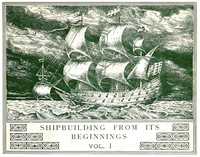
Shipbuilding from its beginnings. Vol. 1 (of 3) — Reading Companion
(0 User reviews)
1953
Project Gutenberg
2024
Not confirmed
Shipbuilding -- History; Ships -- History
Readers of public-domain and historical texts
Project Gutenberg digital edition
en
Edition facts
Words
70,637
Reading time
308 min
Text sections
19
Shipbuilding from its beginnings. Vol. 1 (of 3) — Reading Companion can be approached with a clearer sense of reading commitment from its source measurements: 70,637 words, 5 hr 8 min estimated reading time, and 19 detected text sections.
The text analysis averages about 19.6 words per sentence, while the detected sections provide another way to judge how the source is divided.
Project Gutenberg metadata also associates the work with “Shipbuilding -- History,” connecting these edition facts with the source record’s subject description.
Source:
Project Gutenberg record #74360
This first volume of a three-part study traces shipbuilding from ancient Egypt through the 19th century, focusing on the Northern and Southern European centers. Using technical descriptions and historical records, it examines vessel types, construction methods, and the impact of materials like iron and steel.
Editorial Edition Score
4.8/5
★★★★★
★★★★★
Calculated from edition completeness, EPUB availability, text structure and catalogue metadata. Not a user rating.
How this score is calculated
- Description quality20 pts
- Title & short description10 pts
- Source metadata20 pts
- Text length15 pts
- Chapters / structure15 pts
- EPUB file integrity20 pts
Total of 100 points, scaled to a 2.5-5.0 range. Editions with an empty description or a missing EPUB file are not scored.
Edition quality
Read the Text
etched above and across the ship, one side being raised so as to let the air enter.
Their slender build did not give the galleys sufficient stability at sea, consequently the rowers were often very much tried by the waves.
The armament was simple: three guns were placed at the bow, the principal one of which was in the middle (set in the longitudinal axis of the ship); on the large galleys, there were found, as a rule 18, 48 and 12 pounders and, on the small ships, there were one 12-, one 24-and one 8-pdr.
The fighting value was measured by the amount of iron which could be thrown at once and per man. Take, for example, a galley throwing 44 kilogrammes of iron at once and carrying a crew of about 400 men. There would be hurled, then, 0.110 m. per man. A galley cost 400,000 francs, or 9090 francs per kilogramme of iron.
Compare this galley with an ordinary war ship, carrying 55 pieces of artillery with a crew of 1100 men and able to throw 1000 kilogrammes at once (or 0.910 m. per man), and assume its cost to be 3000 francs per kg. The lower fighting efficiency, of the galleys and their much greater relative cost can be clearly seen. This ordinary war ship throws at once nine times more iron per man while its cost is less than that of the galley considered.
In conclusion, it will be stated that the speed of the galleys was 2.50 m. per second or 5.6 miles per hour, and that sails were available in addition to the oars. They carried two masts, one at the bow and the other about midship, both provided with lateen sails (~Jal~, _Clos. nautique_, p. 749), which were furled while the vessel was in action.
No further demonstration is necessary to show that the galley was not suited to take the Ocean, which was more and more frequented. The invention of gunpowder soon brought out this vessel’s inferiority for fighting. Hence endeavors were made to improve it.
Thus there is seen to arise in the XVIth century a ship, the “galliass”, of which the bow and stern recall the boats of broad beam, and of which the intermediate part brings the galleys to mind. This ship had more beam than the galleys; its breadth being to its length as 1 to 5½.
With a length of 50.01 m., the galliass had a beam of 9.01 m. and drew 3.35 m.; its greatest depth was 6.52 m. There were 25 oars on each side and the benches of the rowers were 1.30 m. apart. The oars were handled at times by 7 or 8 men and as the sides were higher above the water than those of the galleys, the rowers were better protected against waves.
The galliass carried generally from 700 to 1000 men. Fifty guns were mounted in the towers and between the benches of the rowers.
The galliass was more stable on the water than the galley, protected the rowers better and carried more guns; but, just on account of these advantages, it was less agile as its propelling force was limited by the restricted number of rowers.
The galliass, like the galleys carried three masts furnished with lateen sails. These were very hard to work, so that in violent winds the large sails were replaced by others of smaller size.
It is not astonishing that even the galliass should have been inferior to the broad-beamed ships. Furthermore, they were never numerous; at the end of the XVIth century, in the naval battle of the allied powers against the Turks at Lepanto, only six of them could be assembled. (~Jal~, _Archéologie Navale_, p. 394.) It is therefore very doubtful whether the invincible “Armada”, the famous fleet of 1588, included a division of twenty-two galliass; the greater part of these vessels were undoubtedly galleys.
In the same way, there existed among the Ancients, beside the _naves longæ_, broad beamed ships which were used in the beginning solely for commerce and transportation.
The invention of gunpowder, and still more the closing by the Turks of the old route to the Indies, at the end of the XVth century, made a change in this situation. From this time, trade moves toward the ocean; a new route to the Indies is sought and the New World is discovered.
Then too, the nations of the North greedy for riches and no longer content with the Baltic Sea, take their chances toward the South.
The volume opens by dividing Europe into two shipbuilding centres: the Northern, centred on the Baltic, and the Southern, centred on the Mediterranean. This geographical framework structures the entire work, allowing the author to trace parallel developments—from Egyptian papyrus boats to Viking longships, from medieval galleys to the iron-hulled steamships of the 19th century. The text moves methodically through time, but its real interest lies in the recurring attention to specific structural features: the shape of the stern, the use of carvel planking, the introduction of the rudder. These details are not merely catalogued; they are used to explain how one type of vessel gradually transformed into another.
A Geography of Hull Forms
The author’s decision to organise the material by region rather than by chronology alone gives the work a distinctive shape. The Southern centre (Egypt, Phoenicia, Greece, Rome, the Mediterranean Middle Ages) is treated first, then the Northern centre (Vikings, the Cog, the Netherlands, England, France). Within each region, the narrative follows a roughly chronological line, but the emphasis falls on the persistence and variation of certain hull forms. For instance, the galley appears in both centres, but its Northern variant—the galley in the Netherlands—is discussed as a distinct adaptation, influenced by local conditions and the need for coastal navigation. The text repeatedly returns to the idea that a vessel’s shape is a response to its environment: the shallow-draft tjalk for inland waters, the sturdy koff for the open sea. This geographical lens makes the book more than a simple timeline; it becomes a comparative study of how different maritime cultures solved similar problems.
The Fireship as a Case Study in Design
One of the most striking passages in the excerpts describes the construction and use of fireships. These were deliberately expendable vessels, often old ships repurposed for a single mission: to be set alight and steered into an enemy. The author notes that “a very ordinary, very light and very inflammable wood was used” for new fireships, and that externally they did not differ from ordinary vessels—a tactical necessity, since the enemy would otherwise recognise them. The crew was kept as small as possible, and every precaution was taken to allow them to escape once the ship was well on fire. This example illustrates a recurring theme: the way functional requirements—here, the need for deception and controlled destruction—shaped every aspect of a vessel’s design, from materials to crew size. The fireship is an extreme case, but it shows how the author uses specific, documented examples to illuminate broader principles of naval architecture.
The Transition from Wood to Iron
The closing pages of the volume deal with the revolutionary shift from wood to iron and steel. The author traces this change through the Netherlands, noting that the first iron ship was built by Fop Smit, who also invented iron masts. The adoption of iron was not uniform: many shipyards that continued to build in wood declined, while those that embraced the new material prospered. The text also records the first Dutch steamboats, built at Feyenoord in 1834-1835. But the author’s tone becomes notably sombre when discussing the impact on warships: “these vessels have lost all character of their own and they can no longer be recognised except by the flag which they fly.” This lament for the loss of distinctive national styles is a rare moment of personal reflection in an otherwise factual account. It suggests that for the author, the history of shipbuilding is not just a technical progression but a story of cultural identity expressed through hull forms.
The Role of the Illustrator and the Missing Numbers
The text is accompanied by references to illustrations in volumes II and III, and the side notes provide links to these images. However, the transcriber’s notes warn that such links “might not be operational in the e-book versions.” This creates an interesting gap: the reader is told that certain details are best understood visually, but the images are not present in this volume. Additionally, two numerical values are missing from the text, highlighted by triple underscores (___). The transcriber notes that these “could not be retrieved from other sources.” These lacunae are a reminder that the digital edition is a reconstruction, not a perfect facsimile. They also underscore the book’s reliance on precise data—tonnages, dates, dimensions—that the author considered essential to his argument. The missing numbers are a small but telling example of how the work’s evidentiary foundation is both its strength and its vulnerability.
Readers should approach this volume as a technical history that rewards close attention to its structural details. The author’s method is cumulative: each new vessel type is introduced with reference to what came before, and the geographical framework ensures that no development is treated in isolation. The missing illustrations and numerical gaps are minor frustrations, but they do not detract from the work’s core value as a systematic account of how ships were built, why they took the shapes they did, and how those shapes changed over time.
My grandfather once spoke of driving iron rivets into hulls, a rhythm he missed for years. This book’s patient diagrams brought that cadence back, yet I also recalled the steely silence of Modern ships of war — Key Ideas to Explore, where the old wood and hands gave way to measured plate armor, a different kind of quiet.
There are no reviews for this eBook.
There are no comments for this eBook.
Reader reflection
What was your reading experience?
Capture what you thought, learned, and would like to remember.
Your progress
0
/
10
2
What was your overall reaction to the book?
3
How likely are you to recommend this book?
4
How demanding did the text feel?
5
How would you rate its originality?
6
Was the book what you thought it would be?
7
Which aspect of the book did you value most?
8
Would you like to discuss this book with someone?
9
In one sentence, what did you learn?
10