1

Pegasus — Edition Insights
(0 User reviews)
1211
Project Gutenberg
2025
Not confirmed
Transportation; Railroads -- History; Trucks
Readers of public-domain and historical texts
Project Gutenberg digital edition
en
Edition facts
Words
19,561
Reading time
86 min
Text sections
12
Before opening Pegasus — Edition Insights, the edition data offers a quick orientation: 19,561 words, 1 hr 26 min estimated reading time, and 12 detected text sections.
The text analysis averages about 21.2 words per sentence, while the detected sections provide another way to judge how the source is divided.
Project Gutenberg metadata also associates the work with “Transportation,” connecting these edition facts with the source record’s subject description.
Source:
Project Gutenberg record #75248
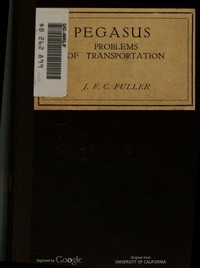
Colonel J.F.C. Fuller's 1925 study argues that transportation is the key to civilization, contrasting one-dimensional rail with the potential of cross-country vehicles. The book blends military insight, historical analysis, and technical speculation, using the metaphor of Pegasus to envision a future of two-dimensional movement.
Editorial Edition Score
4.7/5
★★★★★
★★★★★
Calculated from edition completeness, EPUB availability, text structure and catalogue metadata. Not a user rating.
How this score is calculated
- Description quality20 pts
- Title & short description10 pts
- Source metadata20 pts
- Text length15 pts
- Chapters / structure15 pts
- EPUB file integrity20 pts
Total of 100 points, scaled to a 2.5-5.0 range. Editions with an empty description or a missing EPUB file are not scored.
Edition quality
Read the Text
and doublets, or whatever was the tuxedo of their day. “Carriages driven by steam ... lock him up!” So he was locked up. But the idea lived on, and it grew. There was Giovanni Branca, Edward Somerset, Marquis of Worcester, then Thomas Savery, who, in 1698, obtained a patent for a water raising engine. There were others, Jean de Hautefeuille, who, in 1678, suggested the piston; Denis Papin, 1690, of cylinder and piston fame. At length Thomas Newcomen, 1705, something near success; others still, Humphrey Potter, Henry Beighton, but all waiting for _the_ man. Then _the_ man came in the form of a poor instrument maker, and the new Jerusalem of the steam age was Glasgow, for there did he work. This man was James Watt, who, having realized that the cylinder of an engine should always be as hot as the steam which entered it, in 1769 threw open the doors of the most stupendous epoch in economic history. The transmutation of heat into mechanical work had been discovered, it was the true stone of the philosophers, the “Open Sesame” to another age.
GEORGE STEPHENSON, ENGINE-WRIGHT
In the very year James Watt built the first practical steam engine, namely, the year 1769—the year Napoleon was born—fearful riots were taking place in Russia, because some enlightened person had introduced the potato, a useful vegetable as we all know, yet at this time one in which the Russian peasant saw the Satanic thumb, for he was certain that this humble vegetable was the “devil’s apple.” Though why this should have detracted from its nutritive qualities I cannot say.
Looking back now, and we are nearing Brusselton, it seems to me that there is no difference between the spirit of these deluded peasants and those who, with shoe lasts, beat vigorously on the door of Erichthonius’s house. They are one and all Sir Henry Herberts, though the particular cut of their clothes may differ. George Stephenson, having studied steam engines in general and Mr. Trevithick’s crude and inefficient locomotive in particular, determined to build one of his own, and, with the support of Lord Ravensworth, he accomplished this feat at Killingworth in 1814. There the first efficient locomotive was made. Had Lord Eldon been a Russian, he would probably have objected to potatoes, but being an Englishman he preferred bigger game. “I am sorry,” he said, “to find the intelligent people of the North-country gone mad on the subject of railways.” A few miles had only been opened, but this was quite sufficient to establish madness, and by some other of his ilk, the adage, “A fool and his money are soon parted,” was applied to Lord Ravensworth.
The Killingworth railway was followed by the Stockton and Darlington line. Mr. Edward Pease, the Quaker supporter of Stephenson, had said: “Let the country but make the railroads, and the railroads will make the country.” Be it remembered that locomotives had been working at Killingworth, and very efficiently, for ten years; but there were others who, unlike Mr. Pease, were full of the spirit of old Herbert. The Duke of Cleveland opposed the measure in Parliament, as the line would pass through his fox covers, and, due to his influence it was thrown out. A new survey was made, avoiding these precious earths, and the railway was built.
The next line was that between Manchester and Liverpool. Lord Derby turned out his farm hands to chase Stephenson’s surveyors off his estates. Lord Sefton did likewise, and the Duke of Bridgewater threatened to shoot them at sight. Stephenson had his theodolite so often smashed that he deemed it wise to hire a prize fighter to carry it. The “Quarterly Review” supported the project, and it is curious to read what it said, for it will give the reader some idea of the virulence of the opposition. It says:
“What can be more palpably absurd and ridiculous than the prospect held out of locomotives travelling _twice as fast_ as stage coaches! We should as soon expect the people of Woolwich to suffer themselves to be fired off upon one of Congreve’s ricochet rockets, as trust themselves to the mercy of such a machine going at such a rate.... We trust that Parliament will, in all railways it may sanction, limit the speed to _eight or nine miles an hour_, which we entirely agree with Mr. Sylvester is as great as can be ventured on with safety.”
Colonel J.F.C. Fuller opens Pegasus with a bold claim: "Whatever man does entails movement, mental or bodily." This sets the stage for a work that treats transportation not as a narrow engineering topic but as the mainspring of human evolution. The book's subtitle, "Problems of Transportation," undersells its scope; Fuller ranges from Roman chariot gauges to the future of cross-country machines, blending military experience with historical reflection. The preface reveals that the first part appeared in The National Review in 1925, and the second draws on lectures by military engineers. Fuller, a tank warfare pioneer, sees the tank's wartime potential as a template for peacetime transport revolution.
The Battle of the Iron Horse
Fuller frames the railway centenary as a "Battle of the Iron Horse," arguing that railways, like Roman roads, are fundamentally one-dimensional. He writes that Stephenson "conquered Time rather than Space," reducing the London-to-Edinburgh journey from three weeks to eight hours. Yet this linear thinking, he contends, limits movement to fixed routes. The author draws a direct line from Roman chariot gauges to modern railway track widths, suggesting that technological inertia has constrained transport for millennia. The solution, he hints, lies in breaking free from this one-dimensional mindset.
The Will to Move
In a chapter titled "The Problem of Power," Fuller argues that movement requires not just machinery but will. He provocatively states that "the will to move is stimulated by material gain" and links commerce and robbery as twin forces driven by "Fear and Greed." Historical examples—nomadic hordes, European colonization, American expansion—illustrate how the desire for food, security, or wealth has propelled human migration. Fuller's tone is blunt: "Security, what is this? The shield of Prosperity and Liberty—a desert, a river, a range of mountains, or a feeble neighbour." This section reveals his belief that economic and military motives are inseparable from transport innovation.
Two-Dimensional Movement
Fuller envisions a future where roads and railways "expand laterally" from a few feet to hundreds of miles, enabling movement "as easy... as over the surface of the sea." He calls this "two-dimensional movement" and identifies the cross-country machine as the key. Drawing on his tank experience, he sees vehicles that can traverse any terrain as the solution to what he terms "the storming of the Bastions of Space." The book categorizes movement into five types—air, water, rail, road, and pack—each with subcategories, but the emphasis is on breaking free from fixed paths. Fuller's vision is both technical and philosophical: a new world of untapped power awaits if humanity can detonate the "stupendous sleeping power" of the Empire's resources.
Pegasus is not a conventional history of railroads or trucks, despite its catalog subjects. Fuller uses transportation as a lens to examine civilization, power, and human will. Readers should expect a polemical essay that jumps from ancient chariots to postwar tanks, often prioritizing provocative argument over technical detail. The excerpts show a writer more interested in the philosophy of movement than in engineering specifications. This book rewards those who enjoy bold, speculative thinking about technology's role in shaping society.
Fuller’s Pegasus stayed with me not for its tanks, but for its quiet faith in movement as freedom—one dimension at a time. It reminded me of that older, stranger optimism in The Curtiss Aviation Book — Story, Setting & Ideas, where the sky itself felt like a road nobody had yet paved. Both linger like a map half-unfolded.
There are no reviews for this eBook.
There are no comments for this eBook.
Reader reflection
Record your reading impressions
A brief reflection can help important ideas stay with you longer.
Your progress
0
/
10
2
Did this book hold your interest?
3
Would you pass this book on to a friend?
4
How demanding did the text feel?
5
Could you apply anything you learned?
6
How closely did the book connect with your experience?
7
Would you read this book again?
8
How distinctive were its ideas or approach?
9
Which lesson or insight stayed with you?
10